
fl. early 7th century·Feast November 2
St. Aelhaiarn
Welsh Confessor ('Iron Brow')
Overview
Aelhaiarn — the Welsh means 'Iron Brow' — was a confessor and saint of Wales in the age of the British Church, active in the early seventh century. Listed in the Bonedd y Seint, the Genealogies of the Saints, he was a son of Hygarfael (or Cerfael), son of Cyndrwyn, a prince of Pengwern whose lands centered on the Severn valley around Shrewsbury, and brother of the saints Llwchaiarn and Cynhaiarn. A disciple and kinsman of Saint Beuno, he is thought to have gone with that elder saint from Powys into Edeirnion and onward to northeastern Llŷn, where the church of Llanaelhaearn keeps his name. The principal miracle associated with him is his own resurrection by Beuno, one of six the master was said to have raised; the folk tale that explains his name gives him an iron brow. His feast was usually 2 November, though sometimes recorded as 1 November, and is no longer observed in Wales.
The Complete Life
Early Life
Aelhaiarn is listed among the Bonedd y Seint, the genealogies of the Welsh saints that preserve the kinship networks of the early British Church. He was the brother of the saints Llwchaiarn and Cynhaiarn and the son of Hygarfael, also given as Cerfael, himself son of Cyndrwyn, a prince of Pengwern, the Brittonic kingdom whose control centered on the Severn valley around Shrewsbury in modern Shropshire. Saint Beuno also belonged to the dynasty, so that master and disciple were cousins. Cadfan and other members of the Cuneddan dynasty of Gwynedd sponsored Beuno's activity, and Aelhaiarn appears to have gone with him from Powys into Edeirnion, then onward to northeastern Llŷn — the peninsula where his name survives. The genealogies matter because they are the nearest thing to documents the Welsh saints possess: without charters or chronicles, the Bonedd y Seint preserves the network of kin and discipleship by which Christianity in Wales was actually organized.
§ Life
Vocation
Aelhaiarn's vocation was the classic one of the Welsh saint: discipleship to a great master followed by the care of a church. Following Beuno north, he settled in Llŷn, where Llanaelhaearn — 'the church of Aelhaiarn' — was established on the site the legends associate with his resurrection, and Beuno charged him to oversee the new foundation. He was separately venerated at Guilsfield in his native east, so that his cult stretched across both halves of his life, from Pengwern to the western sea. This pattern — one saint's dynasty seeding churches along the line of a master's travels — is the organizational reality behind the dense map of the Welsh holy places. The charge to oversee a foundation raised on the site of his own rescue gave Llanaelhaearn its particular character, a church built where a man had been given back his life. Pilgrims and readers still invoke his prayers today.
§ Introduction
The Legend of the Iron Brow
The principal miracle associated with Aelhaiarn was performed on him rather than by him: Beuno, so it was said, brought him back from the dead — one of six such raisings. The eighteenth-century version of the story told at Llanaelhaearn gives a folk etymology for his strange name. Each night, so the story ran, Beuno left his cell by Clynnog to pray upon a flat stone set in the Afon Erch's middle; once he discovered a man lurking in the dark, and prayed that if the stranger's errand were good it should succeed, but if ill, that an example be made of him. Wild animals immediately rent the man limb from limb. Beuno, discovering it was his own servant spying, set the bones together again — but the bone beneath the brow was lost, and he replaced it with an iron bit from his pike. Sabine Baring-Gould compared the tale to Thor's restoration of his goats in the Prose Edda; Thomas Pennant found it too absurd to relate, and did not.
§ Miracles
Veneration
Aelhaiarn belongs to the pre-congregation saints of Wales, canonized by local cult rather than process. His feast was generally kept on 2 November, though some records give 1 November; today neither the Anglican nor the Catholic church in Wales observes it — one of the many lapsed observances of the Welsh calendars. His major shrines were Guilsfield, whose fourteenth-century church of St Aelhaiarn still stands, and Llanaelhaearn, whose church, of about the twelfth century, carries his name on the Llŷn peninsula. At his death, the story goes, his southern countrymen claimed his body against the monks of Clynnog; the dispute raged through the night, and when dawn came two coffins lay on two biers — one for each faction — the same miracle credited to Saint Teilo with three. The doubled coffin miracle gave both claimants what they wanted, and both communities kept the story because it flattered neither more than the other.
§ Introduction
Legacy
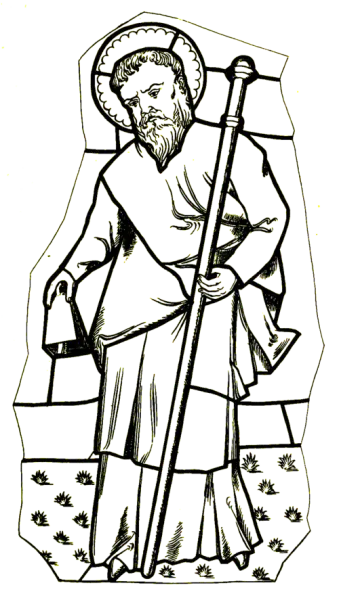
Aelhaiarn's legacy is written in the Welsh landscape and in the survival of an unmistakable name. The churches of Guilsfield and Llanaelhaearn keep his memory long after the liturgical observance lapsed, and the fifteenth-century stained glass at Plogonnec in Brittany — showing the saint with a cowbell — records that his cult, or a name like it, traveled even across the Channel. The tale of the iron brow keeps him alive as folklore as well as hagiography: a saint whose very name carries a story, and whose genealogy ties the Welsh church of the seventh century to the princes of Pengwern and the family of Beuno. His eclipse from the modern calendars is a mark of how much of the Welsh sanctorale narrowed in the modern era, and how much survives anyway in the stones and place names of the principality.Students of the Welsh saints still trace him from the Severn to the sea.
§ Introduction
Timeline
- 1550
The inland Meirionydd parish of Llanaelhaiarn is united with Gwyddelwern, leaving only a yew to mark its chapel
§ Legacy
- 1865
Churchyard expansion at Llanaelhaearn uncovers the Latin-inscribed gravestone of Aliortus of Elmet, suggesting an earlier religious settlement
§ Legacy
- 1877
The church of St Aelhaiarn at Guilsfield, mostly of the fourteenth and fifteenth centuries, undergoes refurbishment
§ Legacy
- 1892
The church at Llanaelhaearn, with twelfth-century walls, receives its most recent refurbishment
§ Legacy
- 1900
A diphtheria outbreak leads the local council to enclose, roof and finally lock away St Aelhaearn's Well
§ Legacy
- 1975
The present stone enclosure around the well is built; ownership remains disputed and the well stays inaccessible
§ Legacy
The Record
- Patron of
- Guilsfield and Llanaelhaearn
- Symbols
- Cowbell (from a fifteenth-century window at Plogonnec, Brittany)·Iron brow
- Canonization
- Pre-congregation; medieval Welsh cult, no longer observed
Prayer
Bibliography
Show 12 sources
- 1 2 3 4 5 6 7 8 9 10 11 12 13 Baring-Gould, Sabine & al. The Lives of the British Saints: The Saints of Wales and Cornwall and Such Irish Saints as Have Dedications in Britain , Vol. I, pp. 101 ff . Chas. Clark (London), 1908. Hosted at Arc
- ↑ The Church in Wales. " The Book of Common Prayer for Use in the Church in Wales: The New Calendar and the Collects Archived 15 December 2014 at the Wayback Machine ". 2003. Accessed 18 November 2014.
- ↑ The Catholic Church in England and Wales. " Liturgy Office: November 2015 ". Catholic Bishops' Conference of England and Wales, 2014. Accessed 18 November 2014.
- ↑ Bartrum, Peter C. A Welsh Classical Dictionary: People in History and Legend up to about A.D.1000 . National Library of Wales, 1993.
- ↑ Peniarth MS 75 (16th c.), cited in Baring-Gould, Vol. I, p. 111.
- 1 2 3 Ray, John. "Itinerary III" in Memorials of John Ray... with His Itineraries, etc. , pp. 169 ff. C. & J. Adlard (London), 1846.
- 1 2 Cadw . " Church of St Aelhaearn, Llanaelhaearn ". 1971. Hosted at British Listed Buildings. Accessed 21 November 2014.
- 1 2 Pennant, Thomas. A Tour in Wales , Vol. II, p. 208 . Henry Hughes (London), 1778.
- ↑ Coflein. " St Aelhaiarn's Church; St Aelhaiarn's; Guilsfield Parish Church, Guilsfield ". Royal Commission on the Ancient and Historical Monuments of Wales, 2014.
- ↑ Cadw. " Church of St. Aelhaiarn including Outbuilding to W End of N Aisle and Outbuilding on W Side of Porch, Guilsfield ". 1950. Hosted at British Listed Buildings. Accessed 21 November 2014.
- ↑ Coflein. " St Aelhaiarn Churchyard, Garden, Guilsfield ". Royal Commission on the Ancient and Historical Monuments of Wales, 2014.
- ↑ Coflein. " St Aelhaearn's Church ". Royal Commission on the Ancient and Historical Monuments of Wales, 2014.
Profile text adapted from the Wikipedia article, licensed CC BY-SA 4.0.
Pray with this saint every day
Save St. Aelhaiarn to your favorites, read the full profile, and get feast-day reminders in the Saints app.
Get the Saints AppFree on the App Store for iPhone and iPad