
c. 400-460·Feast October 19 (Eastern Orthodox)
St. Aelia Eudocia
Empress and Poet
Overview
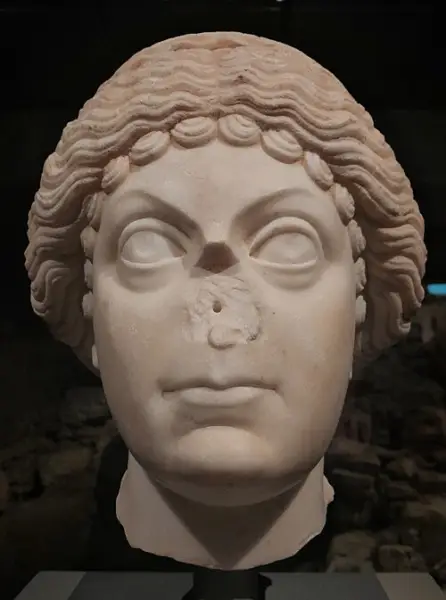
Aelia Eudocia Augusta, born Athenaïs around 400 in Athens, was the empress of the Eastern Roman Empire by her marriage to Theodosius II and is honored in the Eastern Orthodox Church as Saint Eudocia. The daughter of the Athenian sophist Leontius, she received the full classical education of the Academy's world and was left, by the story the chroniclers preserve, only a hundred coins by her father, her destiny being, he said, the greatest of any woman. Brought to Constantinople to seek justice, she was found for the young emperor by his sister Fulcheria, baptized, renamed Eudocia and married on 7 June 421. As empress she bore a daughter and turned her learning to pious poetry, composing Homeric centones that retell the Bible in verses of Homer. After an estrangement from Theodosius, she settled permanently in Jerusalem, where she built churches, endowed the city and served its people until her death in 460. There she was buried in the church of St. Stephen that she had founded.
The Complete Life
Early Life
Athenaïs, as she was first called, was born in Athens around the year 400, the daughter of Leontius, a sophist who taught rhetoric at the Academy in the last years of the great school. Her name itself was pagan, given in honor of the city's goddess, and she grew up in a household where the old culture was loved without embarrassment; the contemporary historian Socrates Scholasticus says plainly that she came from a pagan background. Her father oversaw her education once her mother had died, and she was taught by the scholars Hyperechios and Orion, receiving the full training in literature and rhetoric that the city could give. The chronicler John Malalas preserves the story of her inheritance: when Leontius died, he left his property to his sons Gessius and Valerius and a hundred coins to her, saying that her destiny would be the greatest of any woman. Her brothers refused her plea for an equal share, and her aunt sent her to Constantinople to ask justice of the emperor, a journey that ended beyond anyone's expectation.
§ Early life
Marriage and Empresshood
In Constantinople the Augusta Fulcheria, who ruled her young brother's household, was searching for a wife for the emperor, and the story of the beautiful, learned petitioner reached her. Meeting Athenaïs, she was astonished, the sources say, at her beauty and the intelligence with which she presented her grievance, and reported to Theodosius that she had found a Greek maid, a philosopher's daughter, eloquent and pure. The emperor fell in love sight unseen, and the pagan scholar's daughter was baptized a Christian, renamed Eudocia, and married on 7 June 421. The court celebrated with chariot races. The marriage, which produced the daughter Licinia Eudoxia, began in genuine affection, and the empress brought to the palace something it rarely had, the full classical culture of the old Greek world, now turned to Christian use. Her position, however, always stood between two formidable figures, the emperor and his sister, and the balance was not to hold.
§ Introduction
Poetry and Patronage
Eudocia's mission as empress was exercised through the two gifts Athens had given her, language and patronage. Her surviving work is the Homerocentones, a remarkable poem in which the verses of Homer are rearranged to retell the whole biblical story from creation to the resurrection, line by line borrowed from the Iliad and Odyssey, pious in intent and learned in execution. It is the most ambitious of the Christian cento literature and a document of the conversion of classical culture itself. Her public work followed the pattern of the Theodosian empresses: in the 420s her building activity focused on Athens, where she endowed the city, and in 438 she made a pilgrimage east, delivering speeches at Antioch that so pleased the Greeks they honored her with a statue, and coming to Jerusalem, which captured her heart. Thereafter her generosity flowed to the holy city, in churches, hospices and endowments, and her literary circle gave Constantinople a Christian literature with Attic polish.
§ Citations
Estrangement and Jerusalem
By the early 440s the empress stood accused to her husband, and, whether or not there was substance in the court gossip, the marriage broke. The famous legend of the apples, a Phrygian fruit sent by the emperor to the empress and given by her to Paulinus, the emperor's friend, was retold by the chroniclers as the cause of catastrophe: Paulinus was executed, and Eudocia, her honor defended before a synod of bishops and upheld, withdrew in about 443 to Jerusalem, where she lived for the rest of her life. The retirement became a second career. She completed the rebuilding of the church of St. Stephen, the first of the churches raised over Palestinian saints, endowed monasteries and charities, hosted pilgrims, quarreled and reconciled with the imperial court over the fate of bishops, and stood godmother to the city's Christian life. She died in 460 and was buried in her church of St. Stephen, the Athenian at rest beside the first martyr.
§ In Jerusalem (443–460)
Canonization
The Eastern Orthodox Church honors the empress as Saint Eudocia, keeping her memory among the Byzantine women of the imperial house whose piety the church counted as a form of sanctity, and commemorating her in October. Her cult belongs to the Byzantine pattern of the holy empress, of which Helena, the mother of Constantine, is the great type and Fulcheria, her rival, another instance: the church of Constantinople honored the women who built churches, endowed the poor and finished their lives in the holy places. No western canonization parallels it, and the Latin church remembers her chiefly as the patron of the theological politics of the Theodosian court, where the affairs of Nestorius and the robber council of 449 entangled her name. The Orthodox commemoration looks past the controversies to the Jerusalem years, the builder and benefactress dying far from the palace in the city she had chosen.
§ In Jerusalem (443–460)
Legacy
Eudocia's legacy divides between letters and stones. In letters, the Homerocentones survives as the outstanding Christian experiment in making the pagan epic serve the Bible, studied alike by classicists, who value it as a testimony to how Homer was read in late antiquity, and by church historians, who see in it the self-confidence of Christian Greek culture. In stones, her Jerusalem endowments, above all the church of St. Stephen, set a pattern for imperial patronage of the holy places that ran from Helena's time to the Crusades; the excavated foundations of her church still stand north of the Damascus Gate. Her life story, the wronged heiress raised to a throne, the scholar-empress, the estranged wife vindicated and exiled to the city of God, has invited retelling in every century, and modern scholarship continues to argue over the facts of her marriage, her orthodoxy and her politics. As a saint she stands for the conversion of the whole classical inheritance, beauty included, to the service of Christ.
§ Citations
Timeline
- 400
Born Athenaïs in Athens to the sophist Leontius; her exact birth year is uncertain
§ Introduction
- 7 Jun 421
Baptized and renamed Eudocia, she marries Emperor Theodosius II in Constantinople
§ Marriage
- 422
Gives birth to her first child, Licinia Eudoxia
§ Children
- 2 Jan 423
Her husband elevates her to the rank of augusta in a ceremony on 2 January
§ Children
- 431
Her second child, Flaccilla, dies young
§ Children
- 438
Sets out on a pilgrimage to the Holy Land, carrying holy relics home with her
§ Pilgrimage to Jerusalem (438–439)
- 438
Stops at Antioch that spring, addressing its senate in Greek and funding repairs to the city
§ Visit to Antioch (438)
- 443
Leaves the imperial court amid suspicion of an affair with Paulinus and returns to Jerusalem
§ Banishment
- 20 Oct 460
Dies in Jerusalem on 20 October and is buried in the Church of Saint Stephen, which she had built
§ In Jerusalem (443–460)
The Record
- Major works
- Homerocentones (Homeric retelling of the Bible)
- Patron of
- Jerusalem·Converts from paganism·Christian poets
- Symbols
- Imperial crown·Poet's scroll
- Canonization
- Venerated in the Eastern Orthodox Church as Saint Eudocia the Empress
Prayer
Bibliography
Show 12 sources
- ↑ Empress after Aelia Flaccilla adopted "Aelia" as a title, which was then shown in their coinage. Grierson, Philip; Mays, Melinda (1992). Catalogue of Late Roman Coins: From Arcadius and Honorius to the Accession of Anastasius . Dumbarton
- ↑ Kelly 2013 , p. 31.
- 1 2 3 Martindale 1980 , p. 408-409.
- ↑ Holum 1982 , p. 113.
- ↑ Lightman & Lightman 2008 .
- ↑ According to the description of her bust portrait in the Acropolis Museum.
- ↑ John Malalas, Chronicle 14.355; Potter, David. "In Her Own Words: The Life and Works of Aelia Eudocia." Classical Outlook , vol. 97, no. 4, Dec. 2022, pp. 208+.; Cheetham 1981 , p. 12
- ↑ Socrates Scholasticus, Church History 7.21
- ↑ Martindale 1980 , p. 668 ; Cuming & Baker 1972 , p. 13 ; Bradbury 2004 , p. 91, "THEODOSIUS II, BYZANTINE EMPEROR (401–50)"
- ↑ Holum 1982 , p. 118.
- ↑ Tsatsos 1977 , p. 10 .
- ↑ John Malalas, Chronicle 14.353
Profile text adapted from the Wikipedia article, licensed CC BY-SA 4.0.
Pray with this saint every day
Save St. Aelia Eudocia to your favorites, read the full profile, and get feast-day reminders in the Saints app.
Get the Saints AppFree on the App Store for iPhone and iPad