
c. 356-386·Feast September 14
St. Aelia Flaccilla
Roman Empress, Servant of the Poor
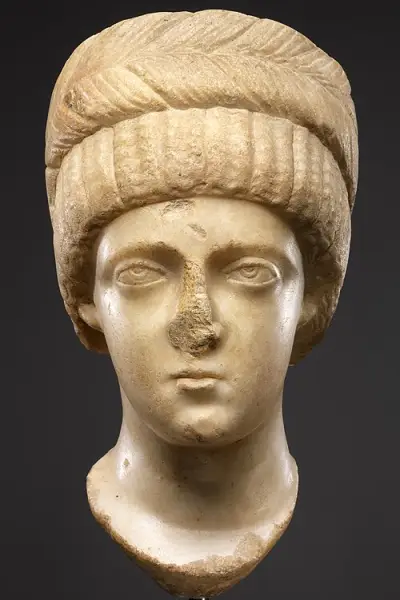
Overview
Aelia Flavia Flaccilla, Roman empress and first wife of Theodosius I, was a Hispanian Roman who became Augusta in 379 when her husband was raised to the eastern throne after the death of Valens at Adrianople. Married to Theodosius in 376 while he lived in retirement at Cauca in Gallaecia, she bore the future emperors Arcadius and Honorius and a daughter, Pulcheria. A fervent supporter of the Nicene Creed at the very court where Arianism still had powerful friends, she is credited with preventing a conference between Theodosius and Eunomius of Cyzicus, figurehead of the radical Anomoean Arians, for fear her husband might concede ground against the Nicene faith. Ambrose and Gregory of Nyssa praised her virtue, calling her a leader of justice and a pillar of the Church. Theodoret records her personal works of charity, her own tending of the disabled, and passes on her remark that while giving out money belonged to the imperial dignity, she herself rendered personal service to the Giver for the sake of that very dignity. She died in 386, shortly after her daughter, and was buried in the Church of the Holy Apostles at Constantinople; Gregory of Nyssa preached her funeral oration. She is commemorated as a saint by the Catholic and Eastern Orthodox Churches on 14 September.
The Complete Life
Family and Marriage
Aelia Flaccilla was of Hispanian Roman descent — the poet Claudian, praising her kinswoman Serena, names both women as children of Hispania. Her family is only dimly visible: a passage of the orator Themistius has been read as identifying her father as Claudius Antonius, praetorian prefect of Gaul and consul of 382, though the relationship is considered doubtful and the same words may instead make Antonius a brother-in-law of her husband. Her one clearly attested relative is a nephew, Nebridius, the son of an unnamed sister. In 376 she married Theodosius, son of the great general Count Theodosius, then living in civilian retirement at Cauca in Gallaecia after his father's mysterious execution. A first son, Arcadius, and a daughter, Pulcheria, arrived before Theodosius rose to the throne; the couple's second son, Honorius, followed on 9 September 384.
§ Family
Empress and Defender of Nicaea
When the eastern emperor Valens fell at the Battle of Adrianople on 9 August 378, the western emperor Gratian appointed Theodosius as his colleague on 19 January 379, and Flaccilla became empress with the title Augusta. She used the position as a bulwark for the Nicene faith in a court where Arianism remained entrenched. At one point she stood in the way of a planned meeting between Theodosius and Eunomius of Cyzicus — figurehead of the Anomoeans, the Arians' most radical wing — an intervention aimed at keeping the emperor from conceding anything against the creed of Nicaea. Ambrose of Milan and Gregory of Nyssa, the two most authoritative churchmen of the age, praised her Christian virtue: Ambrose hailing her as a leader of justice, Gregory calling her a pillar of the Church.
§ Empress
Charity
Theodoret of Cyrrhus, the church historian of the next generation, reports her works of charity in detail: she personally tended the disabled, going herself to the sick and the maimed rather than sending alms through servants. His account preserves her own explanation, a sentence that made her the type of the charitable empress: to hand out money belongs to the imperial dignity, but she offered up for that dignity itself personal service to the Giver. The principle — that the great are obligated to give themselves, not merely their wealth — was remembered long after her death, and the Palatium Flaccillianum of Constantinople, according to the Chronicon Paschale, bore her name.
§ Empress
Death
Flaccilla died in 386, shortly after the death of her daughter Pulcheria — a double grief for the imperial family within a short span. She was buried in the Church of the Holy Apostles at Constantinople, the mausoleum church of the emperors founded by Constantine, an honor marking her standing in the dynasty. Gregory of Nyssa, who had praised her in life as a pillar of the Church, delivered her funeral oration, a surviving work of Byzantine panegyric that is also a principal source for her reputation of holiness.
§ Introduction
Commemoration
In the Roman Catholic Church and the Eastern Orthodox Church, Aelia Flaccilla is honored as a saint; her feast falls on 14 September — a date the Western church otherwise keeps for the Exaltation of the Holy Cross. She belongs to the small company of canonized empresses, alongside Helena, Pulcheria her own daughter's namesake tradition, and Theodora, and her cult reflects the Byzantine conviction that the palace could be a place of sanctity.
§ Introduction
Legacy
Flaccilla's legacy is bound to the Theodosian settlement: the dynasty that made Nicene Christianity the religion of the Roman world owed its first years of moral credibility in part to an empress who guarded the faith and served the poor. Her sons Arcadius and Honorius divided the empire between East and West; her dynasty built Constantinople's greatest churches. For the tradition she remains the pattern of the charitable sovereign — the Augusta whose hands, in Theodoret's picture, did what her treasury could not.
§ Introduction
Timeline
- 356
Born around this year into a Hispanian Roman family
§ Introduction
- 376
Marries Theodosius, then living in civilian retirement at Cauca in Gallaecia
§ Marriage
- 19 Jan 379
Becomes Roman empress and receives the title Augusta when Theodosius is appointed eastern emperor
§ Empress
- 9 Sep 384
Gives birth to her second son Honorius, future emperor of the West
§ Marriage
- 386
Dies at Constantinople shortly after her daughter, and is buried in the Church of the Holy Apostles
§ Introduction
In Their Own Words
To distribute money belongs to the imperial dignity, but I offer up for the imperial dignity itself personal service to the Giver.
The Record
- Patron of
- Empresses and queens·Works of charity
- Symbols
- Imperial crown and diadem·Caring for the disabled and poor
- Canonization
- Pre-congregation; commemorated by the Catholic and Eastern Orthodox Churches
Prayer
Bibliography
Show 12 sources
- ↑ http://laststatues.classics.ox.ac.uk, LSA-458 (J. Lenaghan)
- 1 2 Doyle, Chris (2018-08-06). "Chronology". Honorius: The Fight for the Roman West AD 395-423 . Routledge. ISBN 978-1-317-27807-8 .
- ↑ Grierson, Mango & Ševčenko 1962 , pp. 42–43.
- ↑ Lightman, Marjorie; Lightman, Benjamin (2008). A to Z of Ancient Greek and Roman Women . Infobase Publishing. p. 140. ISBN 978-1-4381-0794-3 .
- ↑ Claudian, "Laus Serenae", 1922 translation
- ↑ Dictionary of Greek and Roman Biography and Mythology
- ↑ "Christian Settipani, Flavius Afranius Syagrius" . Archived from the original on 2011-10-03 . Retrieved 2008-04-15 .
- 1 2 3 Jones, Martindale & Morris , p. 342.
- 1 2 3 4 Roman Catholic Encyclopedia (1909), article "Ælia Flaccilla" by J.P. Kirsch
- ↑ Williams & Friell 1994 , p. 25.
- ↑ Holum 1982 , p. 22.
- ↑ Weitzmann, Kurt (1977). Age of Spirituality: Late Antique and Early Christian Art . Metropolitan Museum of Art . pp. 26– 27. ISBN 978-0-87099-179-0 .
Profile text adapted from the Wikipedia article, licensed CC BY-SA 4.0.
Pray with this saint every day
Save St. Aelia Flaccilla to your favorites, read the full profile, and get feast-day reminders in the Saints app.
Get the Saints AppFree on the App Store for iPhone and iPad