
1110-1167·Feast January 12
St. Aelred of Rievaulx
Cistercian Abbot of Rievaulx, 'The Bernard of the North'
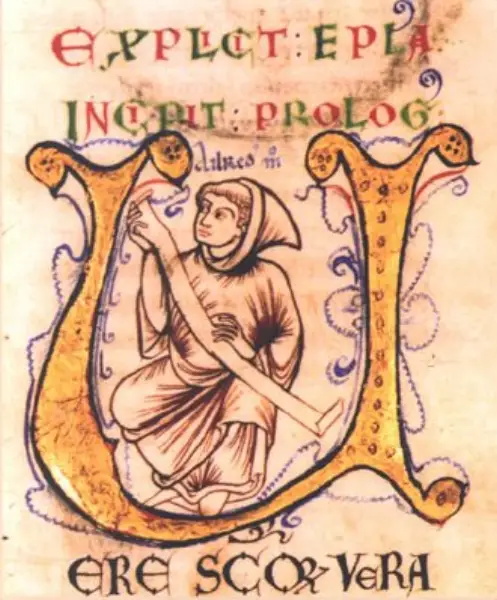
Overview
Aelred, Abbot of Rievaulx, was born in 1110 at Hexham in Northumbria, one of the three sons of Eilaf, priest of St Andrew's at Hexham, whose own father had served as treasurer of Durham — a family of hereditary churchmen in the generation after the Council of Claremont forbade the ordination of priests' sons. Probably educated at the cathedral school of Durham, he spent several years from about the age of fourteen at the court of King David I of Scotland at Roxburgh, rising to steward or master of the household. At court he was harassed by a knight whose attack included a degrading sexual slur, an incident his biographer Walter Daniel told to display Aelred's forgiveness; but around this time he developed feelings of depression and alienation, and at twenty-four, in 1134, he left the court to enter the Cistercian abbey of Rievaulx in Yorkshire. He became novice master, abbot of the daughter house of Revesby in 1143, and in 1147 abbot of Rievaulx itself, which under his rule expanded to roughly 140 monks and 500 conversi and laymen, the largest Cistercian house in England. He traveled on the order's business and his own — to the Scottish border in 1138, to Rome in 1142, and through the papal schism. His books — above all On Spiritual Friendship and The Mirror of Charity — made him the most loved spiritual writer of the English Cistercians. Afflicted in his later years by kidney stones and arthritis, he died during the winter of 1166-67, most likely on 12 January 1167.
The Complete Life
A Priest's Son of Hexham
Aelred was born in 1110 at Hexham, the great church of Wilfrid in Northumbria, into a family of hereditary churchmen: his father Eilaf was priest of St Andrew's at Hexham, and his grandfather another Eilaf had been treasurer of Durham. The family thus belonged to the old English secular priesthood on the eve of its reform out of existence — and in 1095 the Council of Claremont had ruled that priests' sons could no longer be ordained, partly to end the inheritance of benefices, and Aelred's generation of priestly families was the last. He was probably educated at the cathedral school of Durham, where Lawrence of Durham may have been among his teachers — Lawrence later sent him a hagiography of Saint Brigid — and it was likely there too that he first encountered Cicero's Laelius de Amicitia, the book on friendship he would one day answer. At about fourteen he entered a different school: the court of King David I of Scotland at Roxburgh.
The Court and the Cloister
Aelred spent several years at David's court, rising to the rank of economus — steward or master of the household — a career of real consequence in the most church-governed kingdom of the age. The court years were not happy. A knight of the king's court made him the object of personal harassment, a campaign that peaked before the king himself and stooped to a degrading sexual slur; Walter Daniel, his biographer, told the story to show Aelred's forgiveness of the knight and his gift for resolving conflict, but around this time Aelred sank into depression and a sense of alienation. It was in 1138, when Rievaulx's patron Walter Espec had to yield Wark on Tweed Castle to the Scottish king, that Aelred went with Abbot William to the border to negotiate, and the journey brought home what he later admitted: his unwillingness to leave his friends at court had held back his monastic calling. The life records his insight that Christ himself is both the source and the object of true friendship. At twenty-four, in 1134, he left the court for Rievaulx.
Abbot of Rievaulx
Aelred's rise in the cloister was quick: novice master of Rievaulx after his return from Rome in 1142, where he had represented the northern prelates opposing the election of Henry de Sully to York before Pope Innocent II; abbot of the new daughter house of Revesby in Lincolnshire in 1143; and in 1147, abbot of Rievaulx itself, which he governed for twenty years. Under his administration the abbey expanded to roughly 140 monks and 500 conversi and laymen — the greatest community of the English Cistercians, whose ruins on the River Rye still measure the scale of what he ruled. The office kept him moving: annual visitations of five daughter houses in England and Scotland, the long sea journey each year to the general chapter at Cîteaux, and a continuous engagement with the politics of the age — the Peterborough Chronicle credits his efforts in the twelfth-century papal schism with helping to secure Henry II's decisive backing for the Cistercian candidate — support formalized in 1161 with the recognition of Pope Alexander III.
On Spiritual Friendship
Aelred's masterpiece is De spirituali amicitia, On Spiritual Friendship, a Christian counterpart to Cicero's De amicitia that names Christ as both the source and the ultimate driving force of spiritual friendship — the volume from which his remembered phrase comes: God is friendship. On top of its intellectual foundation — Cicero's dialogue form, corrected by Augustine's Confessions, whose account of loving and being loved Aelred mirrors in his prologue — he drew on his personal experience to offer concrete, practical advice on how long-term friendships are built and kept alive. Brian McGuire's judgment has set the scholarly frame: for Aelred, true love possessed an honorable name and a legitimate home within good human company, above all the company of the monastery; because he made friendship central to monastic life, he stands apart from the mainstream of the tradition, surpassing every monastic predecessor before him and finding no immediate successor after. The Speculum caritatis, written reportedly at Bernard of Clairvaux's request, complements it with the theology of charity ordered in the soul. Modern discussion of Aelred's sexuality — John Boswell's reading of 1980, its critics and its defenders — has made him one of the most contested figures of medieval biography; Marsha Dutton's caution stands: the details of Aelred's life remain unknowable, and his sexual experience or struggles even more so.
The Infirmary at Rievaulx
Aelred's last decade was one of painful illness: kidney stones and arthritis are thought to have plagued him, and Walter Daniel records that in 1157 the Cistercian General Council permitted him to take his sleep and meals in Rievaulx's infirmary, and later to reside in a nearby building put up for him. He did not lay down the abbacy, governing his vast community from the margins of its sick-room — a fact his biographer thought more eloquent than any sermon. His death came in the winter of 1166-67, most likely on 12 January 1167. Walter Daniel wrote his Life shortly after, the source for most of what is known, and portrayed the man as utterly truthful, richly endowed with practical wisdom, witty and eloquent, a delightful companion, open-handed and prudent, surpassing all his fellow prelates in patience and tenderness, and brimming with sympathy for the weaknesses, both physical and moral, of others. Walter Daniel's Life, written shortly after the death, is the source for most of what is known, and its portrait of the abbot governing from the sick-room fixed the tradition.
The Bernard of the North
Aelred was never formally canonized in the manner later established, yet a cult grew up around him in northern England that the Cistercians officially recognized in 1476; his body was kept at Rievaulx, and John Leland, before the dissolution, saw his shrine glittering with gold and silver. In the Roman Martyrology's most recent official edition his feast of 12 January — the date traditionally given for his death — expresses the official position of the Catholic Church, and he appears in the calendars of the Church of England (a Lesser Festival) and the Episcopal Church. For centuries his most famous work was the Life of Saint Edward, King and Confessor; in the twentieth century the recovery of On Spiritual Friendship — and the debates around it — made him one of the few medieval abbots read by the general public, a patron invoked by ministries of friendship and, since the 1980s, adopted as patron by gay Christian organizations. Of all his afterlives, the one he might recognize is the simplest: the abbot who wrote that he could not live without friends.
Timeline
- 1110
Born in Hexham, son of the priest Eilaf, who served St Andrew's there
§ Life
- 1124
Enters the court of King David I of Scotland at Roxburgh, probably around this time
§ Life
- 1134
Leaves court at twenty-four to enter the Cistercian abbey of Rievaulx in Yorkshire
§ Life
- 1138
Accompanies Abbot William of Rievaulx to the Scottish border to negotiate the surrender of Wark Castle
§ Life
- 1142
Travels to Rome with the Archdeacon of York to oppose Henry de Sully's election as archbishop of York
§ Life
- 1142
Writes the Speculum caritatis, reportedly at the request of Bernard of Clairvaux
§ Writings
- 1143
Made abbot of Revesby Abbey in Lincolnshire, a newly founded daughter house of Rievaulx
§ Life
- 1147
Elected abbot of Rievaulx itself, an office he holds until his death
§ Life
- 1153
Writes the Vita Davidis Scotorum regis and, over the following year, the Genealogia regum Anglorum
§ Writings
- 1157
By dispensation of the order's General Council he may sleep and take meals in the infirmary at Rievaulx
§ Life
- 1161
His efforts in the papal schism help win Henry II's recognition of Pope Alexander III
§ Life
- 12 Jan 1167
Dies at Rievaulx, probably on 12 January, after years of kidney stone and arthritis suffering
§ Life
- 1476
His cult in northern England is officially recognised by the Cistercians
§ Posthumous reputation
In Their Own Words
Nothing seemed sweeter to me, nothing more pleasant, nothing more valuable than to be loved and to love.
The Record
- Major works
- Speculum caritatis (The Mirror of Charity)·De spirituali amicitia (On Spiritual Friendship)·De anima (On the Soul)·Life of Saint Edward, King and Confessor·Life of Saint Ninian·De bello standardi (The Battle of the Standard)·Genealogia regum Anglorum (historical works addressed to Henry II)
- Patron of
- Rievaulx Abbey·Friendship·The Cistercian Order
- Symbols
- Abbot's crozier·Monk's habit·Two friends embracing (from De spirituali amicitia)
- Canonization
- Never formally canonized; centre of a cult in the north of England officially recognized by the Cistercians in 1476; entered in the Roman Martyrology
Prayer
Profile text adapted from the Wikipedia article, licensed CC BY-SA 4.0.
Pray with this saint every day
Save St. Aelred of Rievaulx to your favorites, read the full profile, and get feast-day reminders in the Saints app.
Get the Saints AppFree on the App Store for iPhone and iPad