
472-573·Feast November 12
St. Aemilian of Cogolla
Hermit and Abbot, Patron of Castile
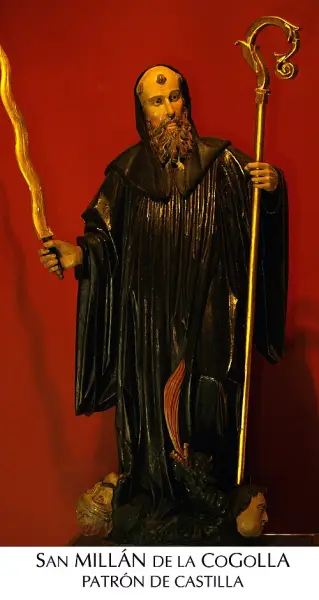
Overview
Aemilian, in Spanish Millán, was a Spanish hermit and abbot of the age of Visigothic rule, born at Vergaja, identified with Berceo in La Rioja, on 12 November 472, and remembered as a shepherd who became one of the most revered saints of the Iberian peninsula. Around the age of twenty a religious experience turned him to God's service, and he sought out the experienced hermit Felix of Bilibio, living under his direction for some years. He then lived as a hermit himself, in the mountains and along the Roman road that became the Camino de Santiago, until Didymus, bishop of Tarazona, ordained him and appointed him parish priest of Vergaja. His heavy almsgiving, his reputation for holiness or his miracles roused the opposition of his fellow priests, and Aemilian returned to the wilderness, where disciples gathered around his cell into a community. He died on 11 June 573 at a venerable age, and was buried at his hermitage; the monastery of San Millán de la Cogolla, Suso and Yuso, grew over his tomb and became one of the cradles of the Spanish language. Braulio of Zaragoza, writing a century later, is the source of the Life.
The Complete Life
A Shepherd of La Rioja
Aemilian was born on 12 November 472 at Vergaja, identified with Berceo in the upper Ebro valley of La Rioja, while Spain still lay under Visigothic rule that had only recently turned from Arianism. He was a shepherd, and the earliest iconography of the saint, carved on the famous Cloisters plaque that once roofed his reliquary, shows him doing exactly that: herding his sheep, blowing a horn, with a three-stringed lute at hand. At roughly twenty years of age he underwent a religious experience, whose character the Vita leaves undescribed, and it turned his heart toward the service of God. Looking for guidance, he made his way to Bilibio and placed himself under Felix, an experienced solitary better known by the Spanish form of his name, San Felices, spending years in his company and learning the disciplines of solitude, prayer and fasting that would carry him through a very long life. The apprenticeship of shepherd and hermit became the pattern of Spanish sanctity for centuries: physical work, silence, and attention to God in open country.
§ Life
Priest, Almsgiver, Controversial
Once he had parted from his teacher, Aemilian took up the solitary life in the hills or beside the old Roman road that was turning into the Camino de Santiago, perhaps even living as a gyrovagus — one of those wandering monks whom the early rules distrusted. Didymus, bishop of Tarazona, ordained him and appointed him parish priest of Vergaja, his home country, and there his troubles began. The Life attributes the opposition of his fellow priests to his heavy distribution of alms, his reputation for holiness, or his miracle working, in a passage refreshingly honest about clerical jealousy. Aemilian's response was the desert: he returned to the wilderness, and instead of a career he was given a community, as disciples gathered around his cell and a small monastery took shape around the hermit who had failed as a pastor. The sequence, priest at odds with his colleagues, withdrawal, unintended foundation, is one of the standard routes by which monasticism actually grew in the sixth-century West.
§ Life
A Hundred Years
Aemilian died on 11 June 573, having lived to a venerable age of about a hundred years, a longevity the Vita treats as a sign rather than a statistic. His body was laid first in his hermitage in the hills above the Cogolla valley, and the memory of his miracles, recorded after his death by Braulio, bishop of Caesaraugusta, modern Zaragoza, who wrote roughly a hundred years after the saint died, kept pilgrims coming to the tomb. The community that formed around the shrine became the monastery of San Millán de Suso, whose Mozarabic arches still stand, and the growth of the pilgrimage traffic along the nearby Camino de Santiago led in the eleventh century to the great expansion of San Millán de Yuso below, the two communities keeping separate abbots until the twelfth century. Thus a hermit's grave, in the middle of the sixth century, became one of the fixed stations of medieval Iberian devotion.
§ Life
Cult and Veneration
Aemilian is a pre-congregation saint of the ancient universal cult: his feast on 12 November is kept in the Roman Martyrology, and he is honored in the Roman Catholic, Eastern Orthodox and Anglican traditions, a breadth appropriate to a saint who belongs to the undivided patrimony of the West. His principal shrine was the monastery of the Cogolla, which held his tomb and gave him his familiar name, San Millán. That ancient house, Benedictine from the central Middle Ages onward, preserves the credit for one of the earliest volumes composed in Castilian Spanish, Gonzalo de Berceo's Vida de San Millán de la Cogolla — Berceo being the first poet of Castilian whose name is recorded. Saint Dominic of Silos, the miracle-working abbot whose own name was given to Saint Dominic of Guzmán, studied and took up religious life at San Millán — which means the Cogolla's saint stands behind two of Spain's later holinesses. The Augustinian Recollect house now at La Cogolla continues the shrine.
§ Introduction
Legacy
Aemilian's legacy extends far beyond a hermit's biography. He is a patron saint of La Rioja and of Castile, and in the battle iconography of reconquest Spain he rides beside Saint James, shown as a Benedictine on horseback with banner and sword, credited by legend with aid at the great medieval victories, an image far removed from the shepherd with his lute on the reliquary plaque. The monasteries of Suso and Yuso, UNESCO-listed today, are remembered as the cradle of the Spanish language, for the glosses written in their margins are the earliest sustained Castilian text, and Berceo's Life of the saint is the first major work of Castilian poetry. A saint whose only recorded ambition was solitude thus stands at the head of a language, a literature and a nation's devotion, which is the kind of joke providence appears to enjoy. His November feast is still kept in Spain with local festivals at San Millán.
§ Veneration
Timeline
- 12 Nov 472
Born at Vergaja, identified with Berceo in La Rioja, where he worked as a shepherd
§ Introduction
- 492
A religious experience at about twenty turns him to God's service; he joins the hermit Felix at Bilibio
§ Life
- 11 Jun 573
Dies at a venerable age; his body is first interred at his hermitage, then moved to a monastery raised in his memory
§ Introduction
- 1060
The reliquary plaque of Master Engelram is crafted, about 1060 to 1080, to carry his relics from Suso to the church of San Millán
§ Cloisters' plaque
The Record
- Patron of
- Castile·La Rioja·Shepherds (by tradition)
- Symbols
- Monk on horseback with banner and sword (in battle iconography)·Shepherd's horn and lute (Cloisters plaque)·Monastic cowl (cogulla)
- Canonization
- Pre-congregation; ancient cult, feast kept in the Roman Martyrology
Prayer
Bibliography
Show 8 sources
- ↑ "Russian Church officially adds saints of Spain, Portugal to liturgical calendar" .
- ↑ Melanie Hanan, "St Aemilian", Encyclopedia of Medieval Pilgrimage 2012 ISBN 9789004181298
- ↑ Monks of Ramsgate. "Aemilian". Book of Saints , 1921 CatholicSaints.Info. 26 November 2016 This article incorporates text from this source, which is in the public domain .
- ↑ "Bilibio, también conocido como Haro la Vieja, fue una aldea situada en la falda norte de los Riscos de Bilibio, donde el río Ebro entra en La Rioja por el lugar de Las Conchas, municipio de Haro." ( Paloma Torrijos, "Historia y Genealogì
- ↑ Holweck, Frederick George. A Biographical Dictionary of the Saints , B. Herder, 1924, p. 24
- ↑ Watkins, Basil. The Book of Saints Eighth Ed., Bloomsbury, 2015, no pagination ISBN 9780567664150
- ↑ "Panel with San Millán", The Met (Gallery 14)
- 1 2 3 4 "Panel with San Millán: Master Engelram and his son Redolfo Spanish 1060–80" . Metropolitan Museum of Art.
Profile text adapted from the Wikipedia article, licensed CC BY-SA 4.0.
Pray with this saint every day
Save St. Aemilian of Cogolla to your favorites, read the full profile, and get feast-day reminders in the Saints app.
Get the Saints AppFree on the App Store for iPhone and iPad