
died c. 304·Feast August 7
St. Afra
Penitent convert and martyr of Augsburg under Diocletian
Overview
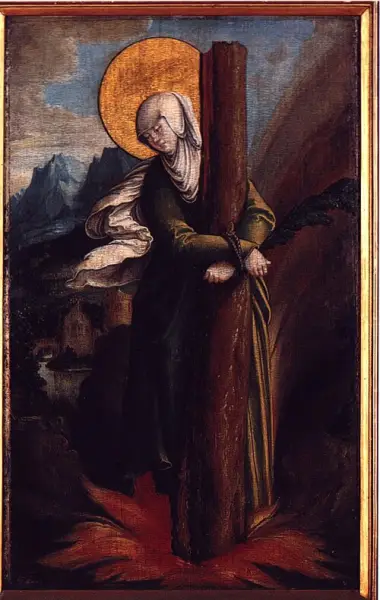
Afra of Augsburg is among the earliest martyrs whose blood watered the faith north of the Alps. By tradition her pagan family came from Cyprus in the late third century, and she had been dedicated by her mother, Hilaria, to the service of the goddess Venus — an offering that in the received account meant life as a prostitute or as a hierodule of the temple in Augsburg. Into that household, when the persecution of the emperor Diocletian began, there took shelter a fugitive: Bishop Narcissus came to Augsburg and found a roof with Afra and her mother. His teaching won the whole family to Christ, and Afra, once converted, continued to shelter the bishop at the risk of her own life. When it was learned that she was a Christian, she was brought before the authorities, ordered to sacrifice to the pagan gods, and on her refusal condemned to burn on an islet of the river Lech, about the year 304. An earlier document says she was beheaded. After her burial her mother and her maids — Ligna, Eunonia, and Eutropia — were put to death in their turn for laying her body in a burial vault. Afra is a patron saint of Augsburg, honored with Ulrich and Simpert, and her feast is kept on August 7.
The Complete Life
From Cyprus to the Temple of Venus
The woman whom Augsburg would come to honor as its patron arrived in the city, by the account of her legend, as a stranger from the Mediterranean. In the late third century her pagan family made the journey from Cyprus to Augsburg, the old Roman capital of the province of Rhaetia on the Danube frontier. Her mother, Hilaria, had dedicated her daughter to the service of the goddess Venus, and in the telling of the Acts this dedication took concrete form: Afra was said to have been a prostitute in the town, in some versions having come from Cyprus as the daughter of its very king, and to have run a brothel there or served as a hierodule attached to the temple of Venus. The tradition is not unanimous. Other ancient calendars portray her as a virgin, and the scholar Carl Egger has judged that the passio's author wove Afra's story together with that of Venerea, an Antiochene martyr whom the Martyrologium Hieronymianum lists on the same date. What all the traditions agree upon is her origin outside the Christian community and the paganism of the household into which she was born.
§ Biography
The Fugitive Bishop in Her House
The turning of Afra's life came through a guest she was hiding. When Diocletian's persecution of the Christians broke out, Bishop Narcissus of Girona fled north in search of safety and reached Augsburg, where he found refuge in the house of Afra and her mother Hilaria. Under that roof the fugitive preached the faith he was being hunted for, and through his teaching Afra and her whole family were converted to Christianity. The conversion was no private comfort but a commitment with immediate consequences, for Afra continued to conceal the bishop from the authorities, making herself a protector of one of the persecution's targets. In the economy of her legend the roles were precisely reversed: the woman the pagans had given to Venus now kept safe the Church's minister, and the temple's servant became the Church's hostess. Later tradition drew the moral explicitly, counting her among the penitent converts whose changed life proclaimed the power of the gospel, and the ancient sources preserved the memory of that hospitality as the beginning of her witness.
§ Biography
Fire on the Island in the Lech
Word spread that Afra belonged to Christ, and she found herself arraigned before Diocletian himself, commanded to offer sacrifice to the pagan gods. Her refusal drew the death sentence, and in the most widely received account she was condemned to the flames on an islet of the Lech at Augsburg, about the year 304. Her body was carried away and laid to rest far from where she died; that work of piety that drew the persecution down upon others: her mother Hilaria and her maids Ligna, Eunonia, and Eutropia were afterward put to death in their turn for interring her body in a burial vault, so that the martyrdom of Afra became the seed of a whole family of martyrs. The oldest documentation tells the story differently. An earlier document records that she was beheaded rather than burned, and the Martyrologium Hieronymianum records only that she suffered at Augsburg and found burial in the same city. Behind the varied legends stands the undoubted fact of an early martyr at Augsburg whose tomb became one of the great shrines of the German lands.
§ Biography
Patroness of Augsburg
Few early martyrs left so deep an imprint on a city. Afra ranks with Saint Ulrich and Saint Simpert as a patron saint of Augsburg, and her cult gave its name to St. Ulrich's and St. Afra's Abbey, the former Benedictine abbey standing in the south of the old city, where her shrine drew pilgrims through the Middle Ages. Her fame traveled far beyond Bavaria. At Meissen a medieval church of Saint Afra gave her name, through a community of Canons Regular, to the Sächsisches Landesgymnasium Sankt Afra zu Meißen, the celebrated Saxon boarding school that still carries it, and there stood a Church of Saint Afra at Brescia in Lombardy as well, lost to bombing in the Second World War. Her story reached written form comparatively late: the best-known account, the Acts of St. Afra, dates from the Carolingian period, and critics regard it as a compilation of two narratives — a conversion story of legendary Carolingian origin, drawn up to connect her with the founding of the church of Augsburg, and a passion narrative behind which the historical martyr of 304 may still be discerned. Her feast is kept on August 7, though some calendars list August 5.
§ Legacy
The Record
- Patron of
- Augsburg·converts·martyrs·penitent women
- Symbols
- Depicted being burnt to death·Fire·Palm of martyrdom
- Canonization
- Pre-congregation martyr, venerated by the Roman Catholic and Eastern Orthodox churches
Prayer
Bibliography
Show 6 sources
- Kirsch, Johann Peter. "St. Afra." The Catholic Encyclopedia. Vol. 1. New York: Robert Appleton Company, 1907.
- "St. Afra, Martyr, of Augsburg, Germany". Antiochian Orthodox Christian Archdiocese.
- "Afra (fl. c. 304)". Women in World History: A Biographical Encyclopedia. Gale Research Inc. 2002.
- Butler, Alban. Lives of the Saints, Vol. III (1866).
- Egger, Carl. "Santa Afra". Santi e Beati.
- Richardson, Jessica N., "Through Water and Stone: The Brescia Sarcophagus Crossing of the Red Sea", Exodus: Border Crossings in Jewish, Christian and Islamic Texts and Images (Annette Hoffmann, ed.). Germany, De Gruyter, 2020. p. 53. ISBN 9783110618549.
Profile text adapted from the Wikipedia article, licensed CC BY-SA 4.0.
Pray with this saint every day
Save St. Afra to your favorites, read the full profile, and get feast-day reminders in the Saints app.
Get the Saints AppFree on the App Store for iPhone and iPad