
1st century·Feast February 13 (Catholic); March 8 (Eastern Orthodox)
St. Agabus
Prophet of the Early Church, One of the Seventy
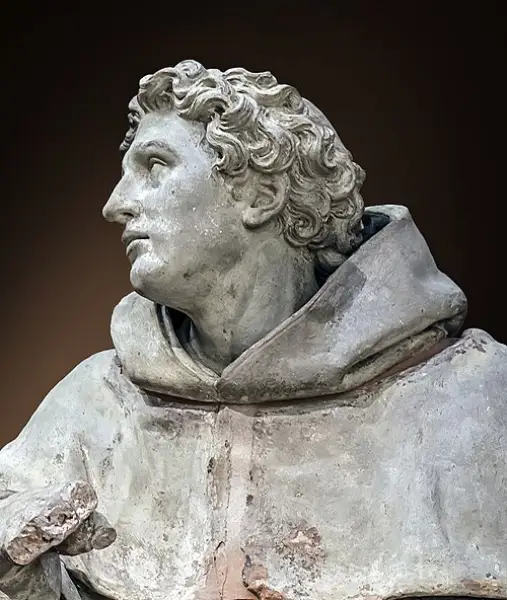
Overview
Agabus was an early Christian prophet from Syria, one of the small number of New Testament figures outside the Twelve whose words are recorded. The author of Acts names him twice. At Antioch, in the episode that first taught the young Church organized charity, Agabus predicted by the Spirit a great famine over all the world, which came to pass under Claudius, and the disciples determined to send relief to the brethren in Judea. Years later, at Caesarea Maritima about 58, he met Paul on his last journey to Jerusalem, took Paul's belt and bound his own hands and feet with it, and announced that so the Jews at Jerusalem would bind the man who owned the belt and deliver him to the Gentiles — a symbolic action in the line of Jeremiah. The tradition counts him among the Seventy (or Seventy-two) disciples commissioned by Christ, and says he was present with the apostles at Pentecost. Later legend supplies a martyrdom: arrested in Jerusalem, beaten, dragged out with a rope about his neck and stoned — or, Jesuit theologian Anthony Maas held, martyred at Antioch. The Catholic calendar keeps his feast on 13 February, the Orthodox on 8 March.
The Complete Life
A Prophet Named Grasshopper
Agabus's name is the Greek form of an Aramaic word, Ḥagab, meaning grasshopper or locust — a humble name, which some scholars have thought a nickname or even a pseudonym. That is nearly all that can be said of his origins. The Acts of the Apostles introduces him without pedigree, as one of a company: prophets who came down from Jerusalem to Antioch, the young Gentile mission at the far end of the road north. The extrabiblical tradition fills the gaps piously. He is said to have been a resident of Jerusalem, to have been among the seventy(-two) disciples whom Luke says Jesus commissioned and sent ahead of him, and even to have been with the Twelve in the upper room at Pentecost. None of this can be verified; what can be said is that a prophet attached to Jerusalem, travelling to Antioch in the decade after the crucifixion, is exactly the figure the Lucan narrative requires.
§ References
The Famine Prophecy and the Relief of Judea
Agabus's first recorded act created the Church's first recorded act of organized charity. Standing up in the assembly at Antioch, he signified by the Spirit that there should be a great famine throughout the world — the whole Roman world, as Luke understood it. The famine, Acts notes, came to pass in the days of Claudius, and the historians confirm harvest failures in the 40s, striking Egypt and Judea hard. The disciples at Antioch, Gentile and Jewish together, determined that each of them, according to his ability, should send relief to the brethren living in Judea; and they did it by the hands of Barnabas and Saul. Agabus is thus, obscurely, a founder of the diaconal tradition of the Church: the prophecy that moved the first inter-church relief fund. His patronage of prophets is the Church's summary of what he was. Without Agabus and his like, the Churches of the first generation would have had no vocabulary for the Spirit's prompting at all.
§ Biblical and traditional accounts
The Belt and the Binding
Agabus reappears in Acts 21, at Caesarea Maritima, in the house of Philip the evangelist, when Paul is on his final journey to Jerusalem. The manner of his prophecy is its whole meaning: he took Paul's belt, fastened it around his own hands and feet, and declared that this was how the Jews in Jerusalem would tie up the belt's owner and hand him over to the Gentiles. The gesture belongs to an old prophetic repertoire: Jeremiah was told to buy a linen waistband and wear it, and to interpret it as Israel bound to the Lord; the prophets acted their sermons before they spoke them. The listeners at Caesarea begged Paul not to go up; he answered that he was ready not only to be bound but to die at Jerusalem. The prophecy was fulfilled in the course of the next chapters of Acts — the arrest, the custody, the transfer to Roman hands — and Agabus's belt has stayed in Christian memory as the emblem of prophecy that costs the hearer, not the speaker.
§ Biblical and traditional accounts
Tradition and Feast
The Acts narrative leaves Agabus at Caesarea. Tradition supplies a career and an end: he traveled through many lands, preaching and winning many to the faith; the Jews of Jerusalem arrested him, beat him severely, put a rope around his neck, dragged him outside the city and stoned him — a martyrdom that mirrors the fate of the protomartyr Stephen and of the prophets before him. Anthony Maas, the Jesuit exegete, placed the martyrdom instead at Antioch. His birthplace is given in the tradition as Antioch, and Antioch is also where he first appears in Scripture, so the geography of his life is a circle no source closes. The calendar honours him on 13 February in the West and 8 March in the East, and the Church of England remembers him among the apostolic saints. He is venerated as a prophet-disciple — one of the few New Testament minor figures of whom the Book itself says, simply, that what he foretold came to pass.
§ Biblical and traditional accounts
In Their Own Words
So shall the Jews at Jerusalem bind the man who owns this belt, and deliver him into the hands of the Gentiles.
The Record
- Patron of
- Prophets
- Canonization
- Pre-congregation (apostolic-age saint of the calendars)
Prayer
Bibliography
Show 7 sources
- ↑ David Miall Edwards , in International Standard Bible Encyclopedia entry: Agabus http://biblehub.com/topical/a/agabus.htm accessed 24 September 2015
- 1 2 "The Martyrdom of St. Agabus, One of the Seventy Disciples", Coptic Orthodox Church Network
- 1 2 3 4 Maas, A. in Herbermann, Charles, ed. (1907). "Agabus" . Catholic Encyclopedia . Vol. 1. New York: Robert Appleton Company.
- ↑ Jamieson-Fausset-Brown Bible Commentary on Acts 21, accessed 15 October 2015
- ↑ Meyer, H. A. W., Meyer's NT Commentary on Acts 21, accessed 15 October 2015
- ↑ Expositor's Greek Testament on Acts 21, accessed 15 October 2015
- ↑ Jeremiah 13:1–2;11
Profile text adapted from the Wikipedia article, licensed CC BY-SA 4.0.
Pray with this saint every day
Save St. Agabus to your favorites, read the full profile, and get feast-day reminders in the Saints app.
Get the Saints AppFree on the App Store for iPhone and iPad