
died 18 August, perhaps 274·Feast August 18
St. Agapitus of Palestrina
Martyr
Overview
Agapitus, in Italian Agapito, is venerated as a martyr of Palestrina, the ancient Praeneste in the hills of Latium, who died on 18 August, perhaps in the year 274, though the latest editions of the Roman Martyrology admit the date is uncertain. According to his legend he was fifteen or sixteen years old and may have belonged to the noble Anicia family of the city. Condemned to death for being a Christian under the prefect Antiochus in the persecution of the emperor Aurelian, he was first tortured, then taken to the local arena and thrown to the wild beasts; when the animals refused to touch him, he was beheaded. He is named in the oldest martyrologies, including the Martyrologium Hieronymianum and the Fulda Martyrology. Around the fifth century Pope Felix III built a basilica over the supposed site of his martyrdom, and a cemetery grew around it; his relics were later translated to Palestrina's cathedral, and portions of them reached Besançon and other European churches. He is invoked against colic.
The Complete Life
Early Life
The legend of Agapitus makes him a boy of fifteen or sixteen at his death, a member, it has been suggested, of the Anicia family, one of the great senatorial houses of late antiquity, which had property at Praeneste, the hill city the modern world calls Palestrina. If the connection holds, he was a Christian aristocrat of the third century, a type known to us from the acts of the persecutions, in which the daughters and sons of noble houses appear again and again among the accused. A Christian child of that class in a Latin town would have been formed in the faith at home, in the household church, with the scriptures read at table and the memory of earlier persecutions part of family lore. His name, Agapetus, means beloved, a common Christian name of the era, a small sign that his parents' faith shaped even what they called him. Nothing else of his childhood survives; the legend begins, as the martyr-legends usually do, with the arrest.
§ Introduction
Trial and Martyrdom
The acts give him a trial before the prefect Antiochus in the persecution of Aurelian, the emperor who reunited the empire and, in its last years, renewed the requirement that Christians conform. The boy refused to sacrifice, was tortured, and was sent to the arena of Praeneste, where the wild beasts, in the recurring formula of the young martyrs' acts, refused to touch him. The refusal of the animals, whether memory or imagination, is the legend's way of saying that the power of the state was exhausted before the witness was; the executioners had to finish their work with the sword, and Agapitus was beheaded on 18 August, perhaps in 274. The details belong to hagiography rather than to court record, and the modern editors of the Roman Martyrology, doubting them, have reduced the entry to its hard core: at Palestrina, Saint Agapitus, martyr. The city, however, has never reduced its memory, and the boy martyr remains Palestrina's own.
§ Introduction
Burial
The Christians of Praeneste buried their martyr, and his grave became the seed of the city's Christian topography. Around the fifth century Pope Felix III built a basilica in his honor on the supposed site of the martyrdom, outside the walls, and around the basilica grew a cemetery, the ordinary way a martyr's shrine generated the dead of a whole community who wished to lie near the saint. In that basilica his relics were kept and honored for centuries. At some uncertain date the body was translated into the present cathedral of San Agapito within the city, where his major shrine remains, and in the course of the middle ages portions of the relics were carried away to Besançon in Gaul and to other churches of Europe, carrying the cult of the Latin boy into the wider church. The distribution of relics was the medieval church's way of sharing a saint, and Agapitus' travels show a cult of real breadth.
§ Veneration
Canonization
Agapitus' standing among the saints rests on the oldest stratum of the western martyrology. He is named in the Martyrologium Hieronymianum, the great fifth-century compilation that gathered the local traditions of the Roman church and the churches of the west, and in the Fulda Martyrology, which carried the same inheritance into the Frankish world. His basilica, built by a pope within two centuries of his death, is itself a formal act of recognition stronger than any decree: the fifth-century church did not build over tombs it doubted. The Tridentine calendar placed his commemoration within the octave of the Assumption, joining it to the Mass and office of those days — a privileged spot in high summer; the liturgical reforms of 1960 reduced it to a commemoration in the weekday Mass, and the modern Martyrology prunes the legend while keeping the saint. He remains in the calendars of the Roman church and the East.
§ Veneration
Legacy
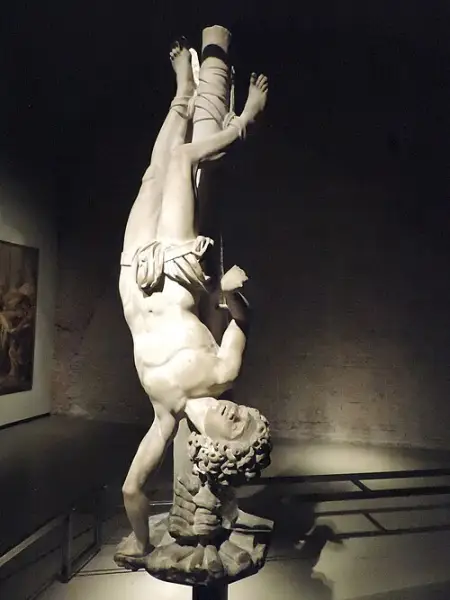
Agapitus is the patron of Palestrina, and through the city his name touches the whole history of music, for the town that keeps his cathedral gave the world Giovanni Pierluigi da Palestrina, the prince of Roman polyphony, who took his surname from the place that had taken its identity from the martyr. The church of Sant'Agapito, with the relics beneath its altar, remains the mother church of the diocese, one of the oldest continuing centers of Christian worship in the Latian hills. Statues of the boy martyr, such as Marco Antonio Prestinari's early baroque figure in Milan, show how the image of the young hero entered Christian art. His invocation against colic belongs to the medieval system of the saints' specialized patronages, charming and practical at once. For the modern church he stands in the company of the child martyrs, of whom the Roman canon preserves several names, witnesses that the confession of Christ has never asked a minimum age.
§ Introduction
Timeline
- 274
By legend a sixteen-year-old, possibly of the noble Anicia family, he is condemned as a Christian under the prefect Antiochus and Emperor Aurelian
§ Introduction
- 274
Captured and tortured in the persecution of Aurelian, he is thrown to the wild beasts in Palestrina's arena, but the animals refuse to touch him
§ Introduction
- 18 Aug 274
Beheaded on 18 August, perhaps in 274; the current Roman Martyrology declares the date uncertain
§ Introduction
The Record
- Patron of
- Palestrina and its musicians·Against colic
- Symbols
- Lamb or lion·Martyr's palm and sword·Youth in noble dress
- Canonization
- Pre-congregation; ancient cult with basilica from the 5th century
Prayer
Bibliography
Show 7 sources
- 1 2 "Saint Agapitus" . Archived from the original on 2013-12-02 . Retrieved 2008-04-04 .
- 1 2 3 4 5 6 7 Sant' Agapito Martire
- ↑ Martyrologium Romanum (Libreria Editrice Vaticana 2001 ISBN 978-88-209-7210-3 ), p. 660
- ↑ Martyrologium Romanum (Libreria Editrice Vaticana 2001 ISBN 978-88-209-7210-3 ), p. 437
- ↑ Dom Gaspar LeFebvre, O.S.B., Saint Andrew Daily Missal, with Vespers for Sundays and Feasts , St Paul, Minnesota: E. M. Lohmann Co., 1952, p. 1516
- ↑ Saint Andrew Daily Missal, with Vespers for Sundays and Feasts , p. 1516
- ↑ Rev. Bede Babo, O.S.B. et al., The Jesus, Mary and Joseph Daily Missal , New York: Benziger Brothers, Inc., 1962, p. 1041
Profile text adapted from the Wikipedia article, licensed CC BY-SA 4.0.
Pray with this saint every day
Save St. Agapitus of Palestrina to your favorites, read the full profile, and get feast-day reminders in the Saints app.
Get the Saints AppFree on the App Store for iPhone and iPad