
c. 231-c. 251·Feast February 5
St. Agatha of Sicily
Virgin and Martyr
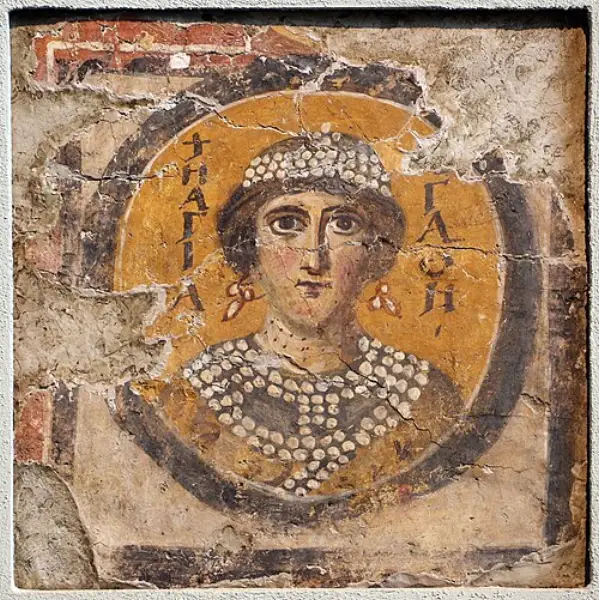
Overview
Agatha, a noble virgin of Catania in Sicily, was martyred around 251, traditionally during the persecution under the emperor Decius. Having consecrated herself to Christ, she rejected the advances of Quintianus, the Roman prefect or consul who then had her denounced as a Christian. Because she would not yield, she was sent to a brothel and, when even that failed to break her, subjected to torture: her breasts were torn with pincers and cut off, and tradition says the apostle Peter appeared in prison and healed her wounds. Brought again to the tribunal, she refused a final time to sacrifice, was stretched on the rack, and was rolled over live coals and sherds; an earthquake shook the city, and she died in prison, aged about nineteen or twenty, giving her spirit back to God. Her cult is among the oldest in the Church — her name entered the Roman Canon of the Mass — and at Catania the veil taken from her tomb is credited with turning back the eruptions of Mount Etna. She is patron of Catania, Malta, and of breast cancer patients, nurses, bakers, and victims of torture.
The Complete Life
Early Life
Agatha was born at Catania, on the east coast of Sicily beneath Mount Etna, around 231, into a family of wealth and standing in the Roman province. Her name, from the Greek for 'good,' invited the wordplay of later preachers, and Jacobus de Voragine, reading the classical tradition of etymology as a text for creative excursus, made of Agatha one symbolic origin in the Greek hagios, sacred. What the acta preserve of her actual life is brief: she was noble, she was beautiful, she had consecrated her virginity to Christ, and her refusal to marry or to compromise made her, in the world's eyes, a target. Sicily in the mid-third century was a province fully integrated into Roman life, and the persecution of Decius, which demanded sacrifice from every inhabitant of the empire, gave local magistrates the tool they needed against Christians who would not conform. The Church of Sicily was already old when she was born, with communities in Syracuse and Catania dating to the first generations of the faith, and her family's rank meant that her refusal to conform could not be ignored or hidden.
§ Introduction
Vocation and Trial
The center of the story is the rejected judge. Quintianus, a Roman official of Catania — the sources make him prefect or consul — wanted Agatha, and when she refused his advances he arranged her denunciation as a Christian under the sacrificial edict. Sent first to a brothel under the supervision of a woman named Aphrodisia, she remained unbroken; the accounts give her a steady refusal, on the ground that her body belonged to Christ. Returned to the tribunal, she was interrogated, tortured on the rack, and mutilated: her breasts were torn with iron pincers and cut off. It is one of the most physically explicit of all the martyr narratives, and its very brutality is the point the Church drew from it — that the state's power over the body does not reach the soul's vow. The acta preserve her replies in the style of the martyr dialogues: to the demand that she sacrifice, she answers that Jesus Christ is her only Lord, and the judge's growing fury measures the failure of every instrument he has.
§ Life
The Night in Prison
The acta give the story its turn in the prison. As Agatha lay in her cell after the mutilation, tradition says the apostle Peter appeared to her, accompanied by a youth carrying a torch, and anointed and healed her wounds, so that the jailers found her whole in the morning. The scene parallels the prison miracles of other martyr acts — chains broken, doors opened — but here the wonder is medical and intimate: the torn flesh restored. Brought before Quintianus again, she refused a final time to sacrifice to the gods. He ordered her stretched on the rack and rolled naked over live coals and broken potsherds; at that moment, the acta say, an earthquake shook the city, frightening the court into flight, and Agatha, carried back to prison, prayed her last words and died on 5 February, aged about nineteen or twenty. The earthquake in the acta is the story's one public sign, and it serves the same function as the darkness at Calvary: creation itself registering what is being done.
§ Life
Death and Burial
Agatha's death, like her trial, was public and unhurried; the Church received her body and buried it with honor, and within a year of her passing, the Christians of Catania were already gathered at her tomb as at a shrine. The date of her death, 5 February, became her feast everywhere, and the stone sarcophagus at Catania became the destination of one of Sicily's oldest continuous pilgrimages. The acta that preserve her trial, whatever their date and form, were in circulation early enough that her name entered the Roman Canon of the Mass — the Church's oldest eucharistic prayer — where she stands with Lucy, Agnes, Cecily, and Anastasia among the seven women of the ancient canon. A century later her tomb was already the greatest shrine of Sicily, and the itineraries of pilgrims to Catania mention her beside the apostles' graves of Rome. Sicily's Christians took her tomb as their anchor: when the volcano moved, they went to Agatha.
§ References
Canonization and Cult
Agatha belongs to the pre-congregation saints: no process, no decree, but a cult so early and so universal that its authority was never questioned, and tradition counts it confirmed by Pope Gregory the Great, who sent a piece of her veil to Sicily and spoke of her in his homilies. Within a century of her death churches were dedicated to her in Rome; her cult spread through Sicily, southern Italy, Malta, and Spain, and her feast appears in the earliest martyrologies of East and West. The great festival of Catania, with its enormous candles and the processing of her relics through the city each February, is among the largest religious festivals in Europe, and the veil taken from her tomb is carried against the lava when Etna threatens. Her name appears also in the East's liturgical books, where the Byzantine churches keep her among the great virgin martyrs on the same February day.
§ Introduction
Legacy
Agatha's legacy is twofold: a city under a volcano, and the company of wounded women. At Catania the record is concrete — tradition credits her intercession and her veil with stopping eruptions of Etna repeatedly, most famously in 253, the year after her death — so that she became the patroness against fire, earthquakes, and volcanic disaster. For the Church at large she became the patron of nurses, of bakers (the bread blessed on her feast), of bellfounders, of jewelers, and, in the modern calendar of compassion, of breast cancer patients, rape victims, and all who suffer torture. In art she carries the pincers and the plate, emblems terrible to modern eyes, and devotions to her run from Zurbarán's paintings to the prayers of the sick on her feast day. Malta keeps her as a national patron with feasts of great antiquity, and from Sicily her cult traveled with sailors and immigrants to every coast of the Mediterranean and beyond.
§ Introduction
Timeline
- 231
Born at Catania in the Roman province of Sicily
§ Introduction
- 250
During the persecution of Decius, escapes to Malta with friends and teaches children from a rock-hewn crypt at Rabat
§ Veneration
- 251
Arrested after returning to Sicily and condemned by Quintianus, praetor of Catania, to torture and imprisonment
§ Veneration
- 251
Tortured on the rack, burned and mutilated; an earthquake halts her execution and she dies in prison, probably this year
§ Life
- 252
The year after her death, a stilling of Mount Etna's eruption is attributed to her intercession
§ Patronage
- 460
Apse mosaics of about this date adorn Sant'Agata dei Goti, a Roman titular church dedicated in her honour
§ Early history
- 530
Her name appears in the Synaxarion of Carthage, a church calendar compiled around this time
§ Early history
- 1126
Her relics, including her breasts, are taken to Gallipoli, of whose cathedral she becomes patron
§ Notes
- 1551
An apparition to a Benedictine nun is credited with delivering Malta from Turkish invasion through her intercession
§ Patronage
- 5 Feb 1740
Pope Clement XII restores the independence of San Marino on her feast day, making her its patron
§ Patronage
- 2022
Her feast on 5 February receives final authorization in the Episcopal Church
§ Veneration
In Their Own Words
My sister Lucy, virgin devoted to God, why do you ask me for what you yourself could obtain for your mother? Behold, thanks to your faith, she is healed.
The Record
- Patron of
- Catania, Gallipoli, Molise, Malta and San Marino·Bellfounders, bakers, nurses and jewelers·Breast cancer patients·Rape victims and victims of torture·Against fire, earthquakes and eruptions of Mount Etna
- Symbols
- Pincers·Breasts on a plate·Veil (the veil of Catania)
- Canonization
- Pre-congregation; tradition confirmed by Pope Gregory I
Prayer
Bibliography
Show 4 sources
- ↑ 'Agatha' is the Latinized form of the Greek Ἀγαθή ( Agathe ), derived from the Greek ἀγαθός ( agathos , meaning "good"; [ 5 ] Jacobus de Voragine, taking etymology in the Classical tradition, as a text for a creative excursus , made of 'A
- ↑ The relics of St. Agatha, in particular her breasts, were stolen, on orders of the saint herself, and brought to Gallipoli in 1126. She is the patron of the cathedral of Gallipoli, of the diocese, and of the city. [ 8 ]
- ↑ The present rebuilding of the ancient foundation was by Giovanni Battista Vaccarini (1767). [ 9 ]
- ↑ The date of 460 appears in TCI, Roma e dintorni ; a letter from Pope Hadrian I (died 795) to Charlemagne remarks that Gregory (died 604) ordered the church adorned with mosaics and frescoes. [ 14 ]
Profile text adapted from the Wikipedia article, licensed CC BY-SA 4.0.
Pray with this saint every day
Save St. Agatha of Sicily to your favorites, read the full profile, and get feast-day reminders in the Saints app.
Get the Saints AppFree on the App Store for iPhone and iPad