
1814-1840·Feast September 20
St. Agatha Yi Kyong-i
Virgin and Martyr
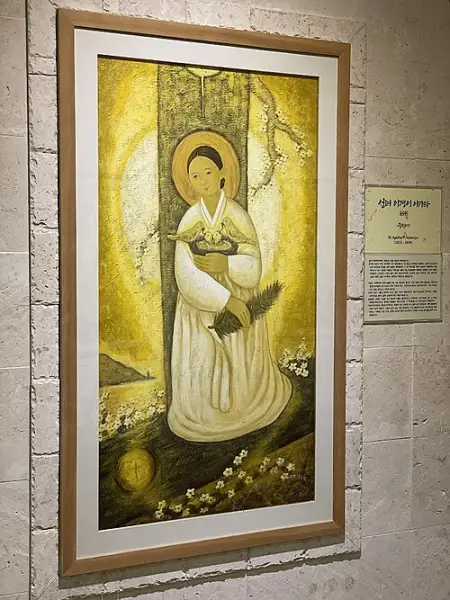
Overview
Born into a Catholic household in Korea around 1814, Agatha Yi Kyong-i came of age in a church living underground. Her marriage to a eunuch proved impossible to sustain, and on her bishop's counsel she left her husband, making a home with the young martyr Agatha Kwon Chin-i, since her mother's poverty made it impossible to keep her. She brought the rest of her family into the faith, made the rounds of hiding and imprisoned Catholics to care for them, and spoke openly of her desire to die for Christ. Swept up in the Gihae persecution of 1839-1840, she was held under house guard with Chin-i and a servant girl. Pitying guards let the three women slip away, but the servant was retaken and betrayed the hiding place, and the guards who had shown mercy were punished for it. Tortured and beaten, the women would not deny their faith. On 31 January 1840 Agatha was beheaded at Danggogae, now part of Seoul, with five other Catholics including Chin-i. A shrine at Danggogae honours the group today, and Pope John Paul II numbered her among the 103 Korean martyrs canonized in 1984.
The Complete Life
Early Life
Agatha Yi Kyong-i was born in 1814 into a Catholic household of Joseon-dynasty Korea, at a time when the faith existed under a standing sentence of death. Catholic teaching had entered the country through books rather than missionaries, and it survived in the first decades almost entirely through lay families who handed it on at home, without priests, sacraments, or churches. Yi Kyong-i belonged to this second generation of Korean Catholics, raised in a minority community that met in private houses and risked denunciation by neighbors, relatives, and officials alike. Her mother lived in deep poverty, a detail her later biographers preserved because it shaped the practical decisions of Agatha's adult life. What the record keeps of her character is a stubborn, cheerful constancy: she practiced her faith openly in a society where openness could cost a family everything, and she is remembered for a desire, spoken of plainly, to die for Christ if the persecution came to her. That desire was not unusual among the Korean Catholics of her generation, but in her case it was fulfilled within a few years.
§ Introduction
Mission and Ministry
Her married life set the pattern for her quiet apostolate. She had been given in marriage to a eunuch of the royal court, an arrangement the bishop judged no true marriage, and on his advice she separated from the man and went to live with her friend Agatha Kwon Chin-i, since her mother could not afford to keep her. In that household she found her real work. She brought the rest of her family into the Church, and she made herself useful to the wider Catholic community of Seoul, visiting imprisoned believers, carrying messages and food, and encouraging those who wavered under interrogation. Ministry of this kind was the hidden infrastructure of the Korean church: women moved between houses, sustained the communities gathered around the few clergy, and kept converts steady between the periodic waves of arrest. Agatha was not a catechist of the stamp of the great lay leaders, but she performed the works the community needed, and she did them knowing that discovery would mean torture and a public beheading.
§ References
Trial and Final Years
The Gihae persecution of 1839 to 1840 swept up the Catholic community of the capital, and Agatha Yi was arrested together with Agatha Kwon Chin-i and a servant girl. Held under house arrest, the three women found sympathy among their guards, who helped them escape; but the servant girl was recaptured and, under pressure, revealed where the others were hiding. All three were taken again, and the guards who had shown mercy were punished by their superiors. The two Agathas were then repeatedly tortured and beaten to make them deny their faith, and neither would. On 31 January 1840, at the age of twenty-seven, Agatha Yi Kyong-i was beheaded at Danggogae, now within Seoul's Yongsan district, together with five other Catholics including Kwon Chin-i. The place of execution later became a shrine honoring the group, one of the largest concentrations of canonized martyrs in Korea.
§ Biography
Canonization
Agatha Yi died in the persecution wave that produced the largest group of Korea's canonized martyrs. The cause of the Korean martyrs advanced slowly: testimony and documents were gathered across the early twentieth century, and Pope Pius XI beatified the first group of seventy-nine martyrs of the 1839 persecution on 5 July 1925. Agatha Yi Kyong-i and the other Danggogae martyrs were formally numbered among the blessed then, and on 6 May 1984 Pope John Paul II, celebrating Mass in Seoul, canonized 103 Korean martyrs, laypeople and clergy, Koreans and French missionaries together. It was the first canonization to take place on Korean soil. Her feast is kept with that of the Korean martyrs, and her name is read in the long roll of the 103 in churches throughout Korea.
§ Biography
Legacy
Agatha Yi Kyong-i's significance lies in what her life reveals about the early Korean church: that it was built substantially by laywomen. She converted no philosopher and wrote no book; her works were the visiting, encouraging, and enduring that held small communities together under threat. Her separation from an impossible marriage at the bishop's direction also shows how the first Catholic community in Korea negotiated family life and conscience in a Confucian society ordered around the household. The shrine at Danggogae keeps her memory, and Catholic historiography of Korea regularly cites her arrest and escape with Agatha Kwon Chin-i as an episode showing both the risks ordinary people took to aid prisoners and the cruelty awaiting those who were recaptured. For Korean Catholic women in particular she remains a witness that sanctity in the church of her time did not require office or learning, only fidelity carried to the end.
§ Biography
Timeline
- 1814
Born into a Catholic family in Korea
§ Introduction
- 1839
Arrested with Agatha Kwon Chin-i and a servant girl during the Gihae persecution and held under house arrest
§ Biography
- 1840
Escapes with the aid of pitying guards, then is betrayed by the recaptured servant girl and taken again
§ Biography
- 31 Jan 1840
Beheaded at Danggogae, in today's Yongsan district of Seoul, with five other Catholics including Chin-i
§ Biography
- 5 Jul 1909
Beatified by Pope Pius XI
§ Introduction
- 6 May 1984
Canonized by Pope John Paul II among the 103 Korean Martyrs
§ Introduction
The Record
- Canonization
- Beatified 5 July 1909; canonized by Pope John Paul II among the 103 Korean Martyrs in Seoul, 6 May 1984
Prayer
Bibliography
Show 8 sources
- 1 2 3 "103 Korean Martyr Saints - 이경이 아가타 Agatha Yi Kyong-i" . Catholic Bishops' Conference of Korea . 21 August 2009. Archived from the original on 14 December 2014 . Retrieved 3 June 2020 .
- ↑ "St. Agatha Kwon Chin-i" . Catholic Online . Archived from the original on 3 June 2020 . Retrieved 3 June 2020 .
- ↑ "103 Korean Martyr Saints - 권진이 아가타 Agatha Kwon Chin-i" . Catholic Bishops' Conference of Korea . 21 August 2009 . Retrieved 29 May 2020 .
- 1 2 3 Jensen, Alex (1 June 2017). "Korea's Martyred Mothers" . Columbia Magazine . Knights of Columbus. Archived from the original on 3 June 2020 . Retrieved 3 June 2020 .
- ↑ "Martyrs of Korea" . Catholic Online . Archived from the original on 3 June 2020 . Retrieved 3 June 2020 .
- ↑ "Pope Canonizes 103 Korean Martyrs: 6 May 1984" . History Channel . Archived from the original on 3 June 2020 . Retrieved 3 June 2020 .
- ↑ Kamm, Henry (7 May 1984). "Pope Canonizes 103 Martyrs in Seoul" . The New York Times . p. A-3. Archived from the original on 28 August 2020 . Retrieved 29 May 2020 .
- ↑ "2014 Pope Francis to visit Korea" . 2014 Pastoral Visit of Pope Francis to Korea . Archived from the original on 1 January 2018 . Retrieved 3 June 2020 .
Profile text adapted from the Wikipedia article, licensed CC BY-SA 4.0.
Pray with this saint every day
Save St. Agatha Yi Kyong-i to your favorites, read the full profile, and get feast-day reminders in the Saints app.
Get the Saints AppFree on the App Store for iPhone and iPad