
died 312·Feast January 23 (February 5, Julian calendar)
St. Agathangelus of Rome
Deacon and Martyr
Overview
Agathangelus of Rome, who died in 312, was a Roman deacon and martyr of the great persecution. His story cannot be told apart from Clement of Ancyra, the bishop whose follower he became: the two met while Clement was being held in a Roman prison on account of his faith, and Agathangelus bound himself to him, then — once Clement was freed or dispatched eastward — made the journey back with him to Ancyra in Galatia, the modern Ankara. There, in the reign of Diocletian, both were beheaded, sealing with blood the friendship begun in a Roman prison. Their joint feast is kept on 23 January in the Gregorian calendar and on 5 February in the Julian, used by several Orthodox churches, a double date that shows how widely their cult spread in both the eastern and western traditions. Deacon and bishop, Roman and Galatian, they were executed together, and the church has never separated them in its memory, counting Agathangelus among the deacon-martyrs who stood by their pastors to the end.
The Complete Life
Early Life
Agathangelus' life before his meeting with Clement is unrecorded. He was a Roman, or at least served the church of Rome as a deacon, which means his formation belonged to the great city church of the era of transition: a church that had survived half a century of intermittent persecution, that possessed a vast organization of deacons and deaconesses, cemeteries and clergy, and that was shortly to receive, under Constantine, the favor of the state whose hostility it had endured. A deacon of Rome in the early fourth century served at the liturgy of the pope, administered the church's charity, and carried its correspondence, an office of real responsibility often given to men of tested character. His name, Agathangelus, good angel or good messenger, is Greek in form, of a type common among the Christians of the capital, whose community was largely Greek-speaking in its origins. The persecution had made his office dangerous, and imprisonment was an experience the Roman clergy knew from within.
§ Introduction
Vocation
The defining choice of Agathangelus' life was made in a prison. Clement of Ancyra, a Galatian bishop, was held in Rome for the faith, and Agathangelus, meeting him in confinement, became his disciple, serving the prisoner and receiving his instruction. When the time came, the deacon did not remain in the comparative safety of his own city but traveled back with Clement to Ancyra, in the heart of Anatolia, where the persecution raged with local intensity. The act belongs to the oldest pattern of Christian discipleship, the follower who stays with the teacher when following becomes fatal, and it inverts every calculation of prudence: a Roman cleric, free to remain at home, chooses the journey to a provincial town and the death awaiting it. The tradition preserves no speeches of his and no miracles; it preserves only the companionship, the deacon beside the bishop, from the prison of Rome to the block of Ancyra.
§ Introduction
Martyrdom
The end came at Ancyra in 312, in the last years of the Diocletianic persecution, before the toleration that Constantine's victory in the west would soon announce. Clement and Agathangelus were beheaded together, a death the church classed among the honorable ones, the sword being the death of citizens and, by a long tradition, of the bishops of the east. The joint execution fixed the pair in devotion permanently: the calendars carry them as a couplet, and the icons show them together, bishop and deacon, each with his own palm. Ancyra's church, which the persecution had tested severely, received their bodies, and the cult spread from Galatia through the Greek and Syriac worlds and into the Latin west, surviving in communions that today read their story in different calendars but with the same names joined.
§ Introduction
Canonization and Cult
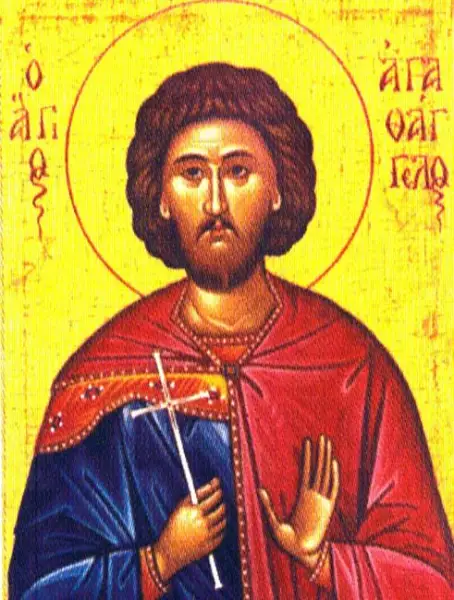
No formal canonization marks Agathangelus among the saints; he is among the martyrs whom the undivided church acknowledged by recording their deaths. His cult is venerated in the Roman Catholic Church, the Eastern Orthodox Church and the Oriental Orthodox churches, an ecumenical breadth that reflects the antiquity of the tradition: he died before the divisions, and all the heirs of the ancient church have kept him. The feast of Clement and Agathangelus on 23 January, with 5 February following in the Julian reckoning, is kept in the eastern calendars with full office, and his icon, of the type preserved in the eastern churches, shows the deacon in his dalmatic with the cross of martyrdom. For the western church he is one of the many Roman deacons whose names stand in the martyrology as evidence of what their order endured.
§ Introduction
Legacy
Agathangelus' legacy lies chiefly in his office: he is a patron figure for deacons, whose ministry of service he crowned with the highest testimony the church knows. His story also kept alive, in a small compass, the truth that the Roman church of the persecution era was bound to the churches of the east by living ties of persons, not only of doctrine: a Galatian bishop imprisoned in Rome, a Roman deacon dying in Galatia. Devotion to the pair continues in the Orthodox churches of the Turkish and Greek worlds, and among the faithful of the Syriac and Armenian traditions who inherited the Galatian calendar. For the universal church he remains a quiet argument for fidelity in friendship, the disciple who proved his office by refusing to let his bishop die alone.
§ Introduction
The Record
- Patron of
- Deacons·Prisoners for the faith
- Symbols
- Deacon's dalmatic·Palm of martyrdom
- Canonization
- Pre-congregation; ancient cult in East and West
Prayer
Profile text adapted from the Wikipedia article, licensed CC BY-SA 4.0.
Pray with this saint every day
Save St. Agathangelus of Rome to your favorites, read the full profile, and get feast-day reminders in the Saints app.
Get the Saints AppFree on the App Store for iPhone and iPad