
died c. 303·Feast May 7 (formerly May 8); January 16 (translation of relics)
St. Agathius
Martyr of Byzantium, One of the Fourteen Holy Helpers
Overview
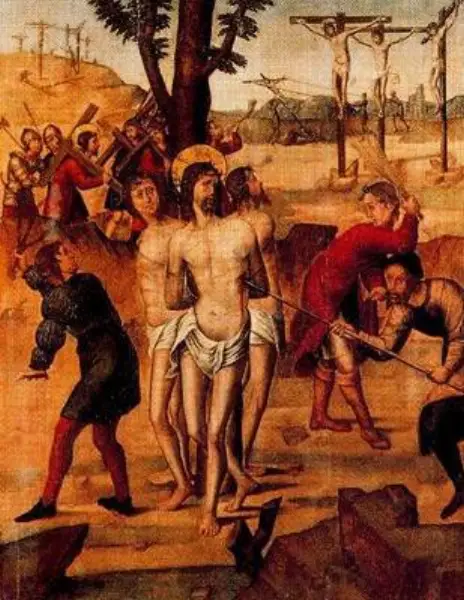
Agathius of Byzantium, also known as Agathonas, Achatius, or Saint Acacius, was a Cappadocian Greek centurion of the imperial army, martyred around 303-304. The tribune Firmus arrested him at Perinthus in Thrace on the charge of being a Christian; after torture there he was taken to Byzantium, where scourging and beheading ended his life because he would not give up his Christian faith. His death placed him among the soldier-martyrs of the Great Persecution, and his cult grew to remarkable breadth. A church in Constantinople was associated with him, and around 630 his relics were translated to a spring at Squillace in Calabria, beside the Vivarium, the monastery founded a century earlier by Cassiodorus; the people of Squillace knew him as San Agario, and his arm relic was carried to nearby Guardavalle in 1584. Relics from Squillace also reached Cuenca and Ávila in Spain, where he is San Acato. In Slovenia, where numerous churches and chapels bear his name, he was honored from the sixteenth century as patron of fighters against the Ottoman Turks; the Maniots of Greece took his defiance of pagan Rome as an emblem of their own resistance to Ottoman rule. He is venerated as one of the Fourteen Holy Helpers, invoked as patron of soldiers and of Squillace and Guardavalle, and against headache.
The Complete Life
The Centurion
Agathius was a Cappadocian Greek of the late third century who served as a centurion in the imperial army. Cappadocia, in central Asia Minor, was one of the provinces where Christianity had taken deepest root, and the army of Diocletian contained, to the emperors' fury, a great many Christians in its ranks. When the Great Persecution's edicts demanded that soldiers sacrifice to the gods, the officer class faced the choice in its sharpest form: profession and life on one side, baptism on the other. Agathius's arrest at Perinthus in Thrace by the tribune Firmus, on the single charge of being a Christian, shows which way he chose.
§ Introduction
Martyrdom
Agathius was tortured at Perinthus and then carried west to Byzantium — the town on the Bosporus that within a generation would become Constantinople, the Christian capital of the empire. There his refusal to give up the Christian faith brought him scourging and beheading around 303-304. The traditional date of his martyrdom was 8 May, on which his feast was long observed before being moved to 7 May. His death joined the roll of the military martyrs whose example, written up in the acta of the persecution, circulated through the army and the cities of the empire.
§ Introduction
Relics and Cult
Agathius's cult spread along the routes by which relics traveled. In Constantinople there stood a church linked to Acacius, perhaps bearing his name. Around 630 his relics were moved to a spring at Squillace in Calabria, close by the Vivarium, the monastery Cassiodorus had founded in the previous century; there he was called San Agario. In 1584 the bishop of Squillace, Marcello Sirleto, brought a relic of his arm to Guardavalle, founding that city's patronage. Relics from Squillace also reached Cuenca and Ávila in Spain, where he is venerated as San Acato. His major shrine today is the cathedral of Squillace, and his feast of the translation of relics is kept on 16 January.
§ Veneration
Legacy
Agathius is one of the Fourteen Holy Helpers, the band of late-antique saints to whom late medieval Europe turned in plague and danger, invoked specifically against headache and as patron of soldiers. His popularity in the borderlands of Christendom is striking: in Slovenia, whose churches and chapels carry his name in great numbers, he was regarded from the sixteenth century as patron of the fighters against the Ottoman Turks, and the Maniots of the Greek Mani Peninsula took his confrontation with pagan Roman authority as a symbol of their own centuries-long resistance to Ottoman rule. A martyr of the old empire thus became a banner saint of the centuries-long struggle at the empire's frontier.
§ Veneration
Timeline
- 303
Arrested on a charge of Christianity by Tribune Firmus at Perinthus in Thrace and tortured
§ History
- 8 May 303
Scourged and beheaded at Byzantium for refusing to renounce his faith; traditionally on 8 May
§ History
- 630
Relics relocated to a spring at Squillace in Calabria, near Cassiodorus's Vivarium monastery
§ Veneration
- 1584
A relic of his arm is brought to Guardavalle by Marcello Sirleto, bishop of Squillace
§ Veneration
The Record
- Patron of
- Soldiers·Squillace·Guardavalle·Against headache
- Symbols
- Palm of martyrdom·Centurion's armor with standard and shield·Bunch of thorns
- Canonization
- Pre-congregation; one of the Fourteen Holy Helpers
Prayer
Bibliography
Show 7 sources
- ↑ (in Greek) Ὁ Ἅγιος Ἀκάκιος ὁ Μάρτυρας ὁ κεντυρίων . 7 Μαΐου. ΜΕΓΑΣ ΣΥΝΑΞΑΡΙΣΤΗΣ.
- ↑ "CATHOLIC ENCYCLOPEDIA: Squillace" . www.newadvent.org .
- ↑ Woods, David (2001). "The Church of "St." Acacius at Constantinople" . Vigiliae Christianae . 55 (2): 201– 207. doi : 10.2307/1584527 . ISSN 0042-6032 . JSTOR 1584527 .
- ↑ "Martyr Acacius the Centurion at Byzantium" . www.oca.org . Retrieved 2024-08-16 .
- ↑ ]"}},"i":0}}]}' id="mwfg">Barnish, Samuel J., "Select Abstracts"
- ↑ "Sant' Agazio (Acacio) su santiebeati.it" . Santiebeati.it .
- ↑ "Koledar svetnikov - Ahacij in tovariši" . www.druzina.si .
Profile text adapted from the Wikipedia article, licensed CC BY-SA 4.0.
Pray with this saint every day
Save St. Agathius to your favorites, read the full profile, and get feast-day reminders in the Saints app.
Get the Saints AppFree on the App Store for iPhone and iPad