
died c. 230·Feast September 17
St. Agathoclia
Virgin and Martyr, Patron of Mequinenza
Overview
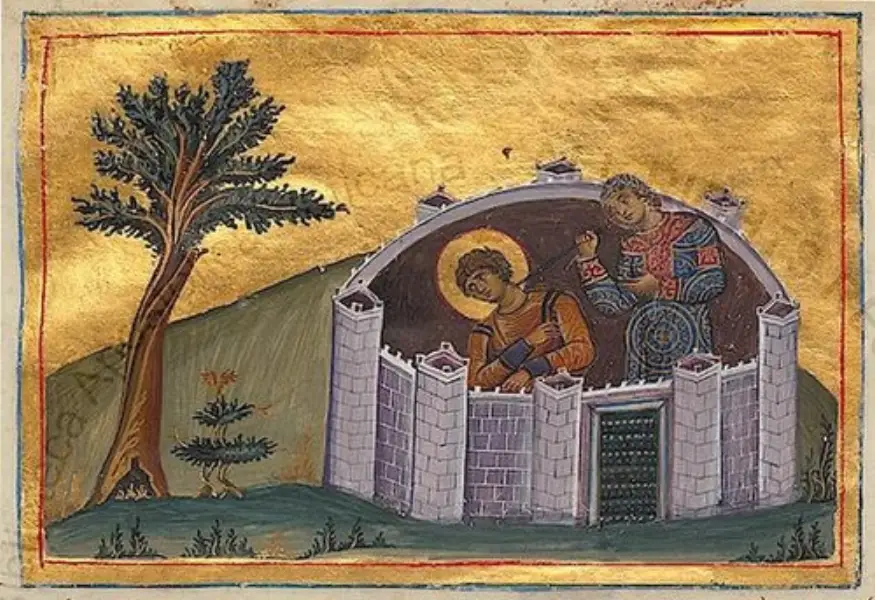
Agathoclia, a virgin martyr of the third century, is venerated as the patron saint of Mequinenza in Aragón, where her feast is kept on September 17 and where the town's festivals in her honour, from September 16 to 20, remain the great event of the local year. The tradition states that she was a Christian slave owned by two apostates from Christianity, Nicolas and Paulina, who subjected her to regular physical abuse, including whipping, in an effort to make her renounce her faith. Her refusal led to a public trial before the local magistrate, where again she would not deny Christ, and where the authorities inflicted savage injuries on her; her sentence included the cutting out of her tongue, a wound that was not in itself fatal. The accounts disagree about the manner of her death: some accounts have burning coals poured on her neck at Paulina's order, others that she was cast into the fire. The Spanish tradition connects her with Aragón, though the setting of her passion belongs to the eastern empire; the devotion of Mequinenza, with its confraternity dedicated to her, has carried her name since the middle ages and shows no sign of letting it go.
The Complete Life
Early Life
Agathoclia's life before her passion is entirely unknown, and the account that survives begins when she was already a slave in a household that had turned against the gospel. Her owners, Nicolas and Paulina, are described as converts from Christianity to paganism, which makes the drama of her story explicit: they had known the faith and rejected it, while their slave, who had every worldly reason to follow them, believed. A slave's religion in the Roman empire was generally at her master's disposal; profession of a faith her owners had abandoned was an act of independence the household could not tolerate. Her name is Greek, and the setting of her passion has suggested an eastern origin, though devotion to her in Spain is ancient and uninterrupted. Whatever her birthplace and however she came to faith, the tradition presents her as a young woman whose Christianity was her own, held against the will of those who owned her body and wanted her soul.
Vocation
Agathoclia's vocation, in the terms the martyrologies use, was to be a virgin and a confessor: to belong to Christ entirely and to say so. Her owners' campaign against her faith gave that vocation its public form. The abuse she suffered, the whippings and violence the tradition records, was intended to make renunciation easier than fidelity, and it failed. When private pressure did not work, the matter was moved to the courts: she was brought before the local magistrate, and the same refusal was required of her in public. It is characteristic of the martyr accounts that the state's stage never frightens the confessor into the recantation everyone expects. Her refusal at trial, like her refusal at home, was the substance of her witness: a slave with nothing of her own could still withhold her consent, and in withholding it she testified that Christ, not her owners, held the final claim on her.
Final Years
The passion of Agathoclia describes her sentencing and death with disturbing particularity. Found guilty, she was sentenced to mutilation, the cutting out of her tongue, which the account notes was not fatal, an attempt to silence the confession that could not otherwise be stopped. Her death then followed in one of two ways according to the sources: her mistress Paulina poured burning coals upon her neck, or she was cast into the fire and burned. Both traditions agree on fire as the instrument of her killing, and both present it as the final stage of a judicial murder that had begun in a private household. The date assigned is about the year 230. The church that received her story did not doubt its outcome: a slave girl, abused, tried, mutilated, and killed, was numbered among the victors, and her feast was kept on September 17 in the martyrologies of East and West.
Cult and Canonization
Agathoclia is a saint of the pre-congregation church, entered in the Roman Martyrology for September 17 and in the eastern synaxaria under related dates. Her cult in Spain centres on Mequinenza in Aragón, where she is invoked simply as 'La Santa' and honoured with the town's principal festivals from September 16 to 20 each year, and where a confraternity is dedicated to her. How a Phrygian or eastern slave martyr became the special patron of a town on the Ebro and Segre is a question the local traditions answer with legends of relics and translations; the fact of the devotion is not in doubt. The Martyrology, the Dominican martyrological collections, and the local cult of Mequinenza together constitute her canonization in the ancient manner: the church's memory, sustained in liturgy and popular devotion rather than by process. The town keeps her image, her festival, and her name with a devotion that eight centuries have not worn out.
Legacy
The legacy of Agathoclia is twofold. For the universal church she stands among the slave martyrs, that small and terrible company whose witness exposed the violence beneath the calm surface of the household economy of the empire, and whose inclusion in the calendar was a quiet judgement on the institution that killed them. For Mequinenza she is the centre of the year: her festivals, her confraternity, and her title of 'La Santa' express an identity that has survived sieges, the drowning of the old town under reservoir waters, and every modern turn of fortune. She is also a figure of resonance for all who suffer abuse behind closed doors, a patron of those whose testimony is disbelieved or silenced. That a mutilated slave of the third century should be the honoured name of a Spanish town in the twenty-first is as good a summary of the martyrological imagination as the church affords.
The Record
- Patron of
- Mequinenza, Aragón·Against domestic abuse (traditional)
- Symbols
- Slave's bonds·The palm of martyrdom·Tongue cut out (attribute of her passion)
- Canonization
- Pre-congregation; cult at Mequinenza, Aragón
Prayer
Profile text adapted from the Wikipedia article, licensed CC BY-SA 4.0.
Pray with this saint every day
Save St. Agathoclia to your favorites, read the full profile, and get feast-day reminders in the Saints app.
Get the Saints AppFree on the App Store for iPhone and iPad