
3rd – 4th century·Feast August 21 (Catholic); August 22 (Eastern Orthodox)
St. Agathonicus
Martyr of Nicomedia and Selymbria
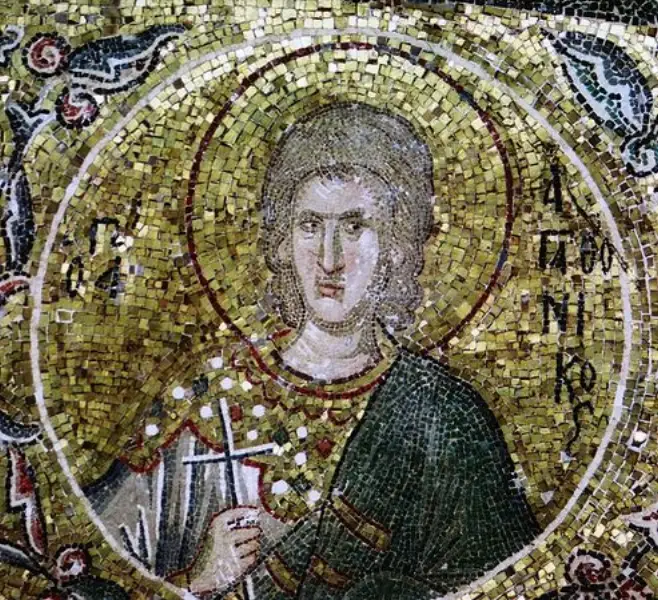
Overview
Agathonicus was a Christian of Nicomedia, the city on the Sea of Marmara that served as a residence of the eastern emperors and was one of the great killing-grounds of the Roman persecutions. He spent a period in Greece, instructing its people in the Christian faith — an evangelist rather than a mere confessor — and when the imperial governor began enforcing the orders of the emperor Maximian against the church, the circle around him was taken. His companion Zoticus was seized at Carpe, and Zoticus's followers were crucified; the prisoners were sent to Nicomedia, where Agathonicus, with the companions the acts name as Princeps, Theoprepius, Acyndinus, Severian, and Zeno, together with many more, was put on the road to Byzantium. The journey itself proved fatal to many, who died of exhaustion and abuse on the road, while others were killed at Chalcedon on the Bosphorus. The survivors were carried on to Selymbria in Thrace, where, after torture before the emperor, they were beheaded. The Catholic Church keeps their feast on 21 August and the Eastern Orthodox Church on 22 August, the double date marking a cult spread through both the Latin and Greek traditions.
The Complete Life
A Christian of Nicomedia
Agathonicus was a citizen of Nicomedia, the city in Bithynia that Diocletian had made one of his capitals and that was therefore, when the persecution came, a place where the imperial will was enforced with particular thoroughness. It was at Nicomedia that the church was visible enough to be worth destroying: the martyrologies of the city are among the fullest of the age, crowded with soldiers, officials, and ordinary believers. Agathonicus himself belongs to the evangelizing laity or lower clergy; the tradition says that residing in Greece, he instructed the Greeks in the Christian faith, crossing the Aegean, or the provincial line, to instruct converts in the faith. Such work was the church's growth mechanism, unrecorded in normal times and fatal in bad ones. When the governor began persecuting Christians in obedience to Maximian's orders, the missionary's public made him findable; his circle was rounded up, and his companion Zoticus was seized at Carpe, a minor place whose name survives only because of the arrest.
§ Introduction
The Journey of the Confessors
The acts of Agathonicus are largely a itinerary of suffering, and the itinerary is the history. Zoticus, seized at Carpe, saw his followers crucified; he and the rest were then sent to Nicomedia, where the group around Agathonicus was assembled, the named companions being Princeps, Theoprepius, Acyndinus, Severian, and Zeno, with many others unnamed. From Nicomedia the whole company was taken toward Byzantium: on that road many of them died of exhaustion and abuse, killed by the transport itself before any executioner could reach them; others were put to death at Chalcedon on the Asiatic shore of the Bosphorus. The survivors, Agathonicus among them, were marched on to Selymbria in Thrace, on the Sea of Marmara west of Byzantium, and there, after torture in the presence of the emperor himself, they were beheaded. The three-stage journey, arrest in the provinces, transit through the capitals, death in Thrace, shows the machine of the late persecution whole, and shows also how many of its victims were killed by the logistics rather than the sword.
§ Introduction
Veneration
The Catholic Encyclopedia's article on Selymbria preserves the location of the final act, and the Orthodox Church in America's menaion keeps the memory of the whole company on 22 August, the Byzantine date; the Roman Martyrology in its recent editions carries them on 21 August. The spread of the cult, from Nicomedia to Byzantium to the Thracian coast, is written into the geography of the martyrdom itself, and the two feast days are the ordinary trace of a cult that fed both the Greek and the Latin traditions. The names of the companions, Princeps, Theoprepius, Acyndinus, Severian, and Zeno, are Roman and Greek in mixed inheritance, a fair sample of the church of the early fourth century. For the historian of the persecution, the group is valuable precisely for its ordinariness: no bishop, no soldier of romance, but a teacher and his circle, arrested, transported, wasted on the roads, and finished in a provincial town, which is how most of the persecution's victims actually died.
§ Introduction
The Record
- Patron of
- Teachers of the faith·Prisoners under transport
- Symbols
- Palm of martyrdom·Cross of the crucified companions
- Canonization
- Pre-congregation (ancient cult)
Prayer
Bibliography
Show 4 sources
- ↑ "Lives of all saints commemorated on August 22" . Orthodox Church in America . Retrieved 20 December 2012 .
- ↑ Pétridès, Sophrone. "Selymbria." The Catholic Encyclopedia. Vol. 13. New York: Robert Appleton Company, 1912. 19 Dec. 2012
- ↑ Brady, John. "Orthodox Saints for August" . God is Wonderful in His Works: Orthodox Resources . Archived from the original on 3 November 2012 . Retrieved 20 December 2012 .
- ↑ "Roman Martyrology 2004 (August)" . gcatholic.org . Retrieved 2026-01-28 .
Profile text adapted from the Wikipedia article, licensed CC BY-SA 4.0.
Pray with this saint every day
Save St. Agathonicus to your favorites, read the full profile, and get feast-day reminders in the Saints app.
Get the Saints AppFree on the App Store for iPhone and iPad