
fl. c. 650–680; died after 10 March 673·Feast October 11
St. Agilbert
Bishop of the West Saxons and of Paris
Overview
Agilbert, a Frankish bishop of the seventh century, served as the second holder of the West Saxon bishopric and later as Bishop of Paris. A son of the Neustrian noble Betto, first cousin of Audoin and kinsman to the Faronids and Agilolfings — perhaps more distantly to the Merovingians — he was consecrated bishop in Francia before traveling to Britain: Bede tells us he had passed a long period in Ireland studying the Scriptures. After Cenwalh of Wessex returned to power in the late 640s or 650s, Agilbert succeeded Birinus as bishop of the West Saxons, with his see at Dorchester. The appointment foundered on language: Agilbert did not speak Old English, and Cenwalh, tiring (Bede says) of his barbarous speech, divided the see and gave half to Wine. The insult led Agilbert to resign; he went to Northumbria, where he ordained the young Wilfrid priest, and was present at the Synod of Whitby in 664 as a leader of the pro-Roman party, having Wilfrid speak on his behalf. He returned to Francia, took part in Wilfrid's consecration at Compiègne, became Bishop of Paris between 666 and 668, hosted Theodore of Tarsus, and declined Cenwalh's later invitation to return, sending his nephew Leuthere instead. He died after 10 March 673 and was buried at Jouarre, where his sister Theodechildis was abbess; his sculpted sarcophagus survives in the crypt.
The Complete Life
A Neustrian Nobleman
Agilbert was born between about 610 and 620, the son of a Neustrian noble named Betto — the western, Gallo-Roman half of the Frankish realm — into a family of extraordinary ecclesiastical density: his first cousins included Saints Audoin and Dado (the future Audoenus and Dadon, bishops of Rouen and of Rouen's circle), the future Bishop Ebregisil of Meaux, and Agilberta, second abbess of Jouarre; he was related to the Faronids and the Agilolfings, and less certainly to the Merovingian house itself. His Frankish name, the equivalent of the Old English Æthelberht, has even been taken to hint at a link with the royal family of Kent. Consecrated a bishop in Francia in the 640s or 650s, he had prepared himself, as Bede records, through a lengthy stay in Ireland devoted to scriptural study — the island being the theological powerhouse of the age, where Frankish and Anglo-Saxon noblemen went for the learning their own countries could not yet supply.
§ Introduction
Bishop of the West Saxons
Agilbert came to the West Saxon kingdom once Cenwalh was back in power — Cenwalh having been driven out by Penda of Mercia — in the late 640s or 650s — and was appointed to succeed Birinus, the Italian bishop credited with converting Wessex, whose see stood at Dorchester near Oxford. He was thus bishop of the English when he was not English, a Frank governing a Saxon church. The arrangement broke on language: Bede reports that Agilbert did not speak Old English, and that Cenwalh, tired of his barbarous speech (the barb cuts both ways in Bede's Latin), divided the see in two and gave half to Wine — though modern historians think this may be mistaken. The insult was public and professional; Agilbert resigned. He traveled north to Northumbria, where he ordained Wilfrid to the priesthood, and in 664 he sat at the Synod of Whitby as a leader of the pro-Roman party — the side that carried the day — delegating the speech to the young Wilfrid, whose powers of English advocacy he lacked and whose career he had launched.
§ Introduction
Paris and Jouarre
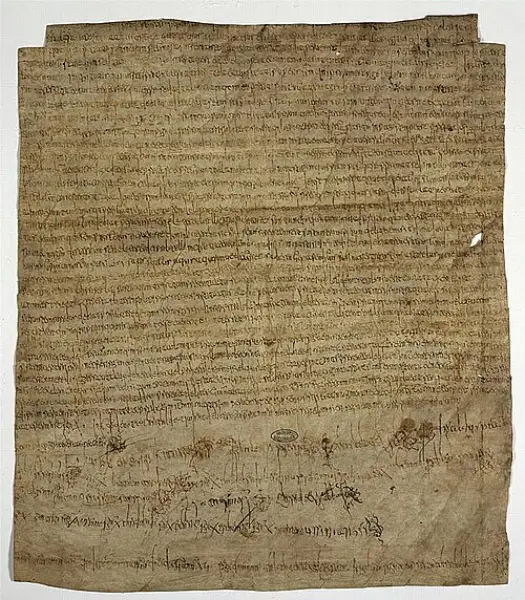
Agilbert returned to Francia, where he took part in Wilfrid's consecration as bishop at Compiègne, and between 666 and 668 he became Bishop of Paris — one of the most prestigious sees of the Frankish church, and one his family's connections made natural. There he hosted Theodore of Tarsus, the Greek from Rome who became archbishop of Canterbury: the network of the age in a single dinner party. When Cenwalh, regretting the loss, invited him to return as bishop of a refounded West Saxon see at Winchester, Agilbert declined and sent his nephew Leuthere in his place, keeping the family's hand in English Christianity by proxy. His last datable appearance is 10 March 673, when he witnessed the foundation charter of Clotilde for the abbey of Bruyères-le-Châtel; his death probably fell between 679 and 690. Jouarre, the family abbey lying east of Paris, received his body; his sister Theodechildis was its abbess, and his finely sculpted sarcophagus — like hers — can still be viewed in the crypt, among the finest surviving Merovingian carving.
§ Introduction
A Career between Churches
Agilbert's importance lies in what he connected. A Frank educated in Ireland who governed English and then Frankish sees, he belongs to the small group of men through whom the churches of western Europe were knitted together in the seventh century: the same circles that produced the Synod of Whitby, the career of Wilfrid, the missions to Frisia, and the reform of the Frankish episcopate. His English decade, though it ended in failure and insult, left the English church with a stake in his family — his nephew Leuthere and his kinsmen held Winchester after him — and his resignation of the see became part of the prehistory of the Winchester diocese, one of the oldest in England. At Jouarre his tomb became part of a family mausoleum of saints, and the abbey's crypt preserves him. His feast is 11 October, kept in the traditions that honour the missionaries of the English church.
§ Introduction
Timeline
- 610
Born in Neustria, probably between 610 and 620, son of the noble Betto
§ Introduction
- 645
Consecrated a bishop in Francia, around the 640s or 650s, after scriptural study in Ireland
§ Introduction
- 650
Appointed to succeed Birinus as bishop of the West Saxons, seated at Dorchester, under King Cenwalh
§ Introduction
- 664
Led the pro-Roman party at the Synod of Whitby, with the young Wilfrid speaking in his place
§ Introduction
- 666
Became Bishop of Paris, sometime between 666 and 668, and hosted Theodore of Tarsus
§ Introduction
- 10 Mar 673
Witnessed Clotilde's charter endowing Bruyères-le-Châtel, his last appearance in dated records
§ Introduction
- 679
Died sometime after 673, probably between 679 and 690, and was buried at Jouarre Abbey
§ Introduction
The Record
- Canonization
- Pre-congregation; venerated in Catholic and Orthodox tradition
Prayer
Bibliography
Show 11 sources
- ↑ "St. Agilbert" . catholic.org . Retrieved 23 July 2022 .
- ↑ Hunter, 1985.
- ↑ The abstract of Hammer 2011 gives his birth date as 610.
- ↑ Le Jan, pp. 382, notes 6, 388, & 390–391, table 48. Le Jan shows that Agilbert's first cousins included Saints Audoin and Dado , the future Bishop Ebregisil of Meaux , and Agilberta, the second abbess of Jouarre.
- ↑ Fouracre states: "[h]is very name was the Frankish form of Æthelberht...". Le Jan, however, takes his name to indicate kinship with the Agilolfings; Le Jan, p. 388.
- 1 2 Bede, HE , Book III, Chapter 7.
- 1 2 Kirby Earliest English Kings pp. 48-49
- ↑ Higham, p. 255.
- ↑ Eddius, VW , chapter 9.
- ↑ Bede, HE , Book III, Chapter 25; Eddius, VW , chapter 10.
- ↑ Eddius, VW , chapters 11 & 12.
Profile text adapted from the Wikipedia article, licensed CC BY-SA 4.0.
Pray with this saint every day
Save St. Agilbert to your favorites, read the full profile, and get feast-day reminders in the Saints app.
Get the Saints AppFree on the App Store for iPhone and iPad