
d. 680·Feast August 10
St. Agilberta
Benedictine Abbess of Jouarre
Overview
Agilberta, also called Aguilberta or Gilberta of Jouarre, was a Benedictine nun and the second abbess of Jouarre Abbey, in the modern département of Seine-et-Marne northeast of Paris. She was a relative of Ebrigisil and Ado, the founders of Jouarre in 660, and came from a family of Frankish church dignitaries: her brother Agilbert was bishop of Paris, and her sister Balda followed her as Jouarre's third abbess. Jouarre was still a young house in her day, founded by her relatives in 660, and she governed it as its second abbess. She died in 680 and was buried in the crypt at Jouarre, where her stone sarcophagus survives among three well-preserved early tombs — one of which is of particular scholarly interest because its stonework follows Roman burial tradition and has even been discussed as bearing Sasanian motifs. Her feast is kept on 10 August.
The Complete Life
Family and Foundation
Agilberta counted among her kin Ebrigisil and Ado, the couple who founded Jouarre in 660, and she belonged to a family remarkable in the seventh-century Frankish church: her brother Agilbert was bishop of Paris after serving in the Anglo-Saxon mission field, and her sister Balda was Jouarre's third abbess. Jouarre itself, in Brie on the Marne, was one of the double monasteries — houses of nuns governed by an abbess with a dependent community of monks — that made Merovingian Gaul so distinctive a monastic landscape.
§ Introduction
Abbess of Jouarre
As second abbess, Agilberta stood between the founding generation and the consolidation of the house, the critical period in which a new monastery's rule of life becomes habit. Nothing of her personality or administration survives in the written record, but the continuation of the community, the succession of her sister, and the later fame of the house all presume an abbess who governed well. She died in 680, twenty years after the foundation.
§ Introduction
Veneration
Agilberta is a pre-congregation saint, venerated in the Roman Catholic Church and also in the Antiochian Orthodox Church, which numbers many of the early French saints of the undivided Church. Devotion to her gathers around her place of burial, for her body rests in the crypt of Jouarre among three early sarcophagi that remain well preserved. Of these tombs, one draws particular scholarly attention on account of stonework that follows Roman funerary practice; an art-historical literature, beginning with Richard Bernheimer's study of a possible Sasanian monument in Merovingian France, has grown around the crypt's sculpture.
§ References
Legacy
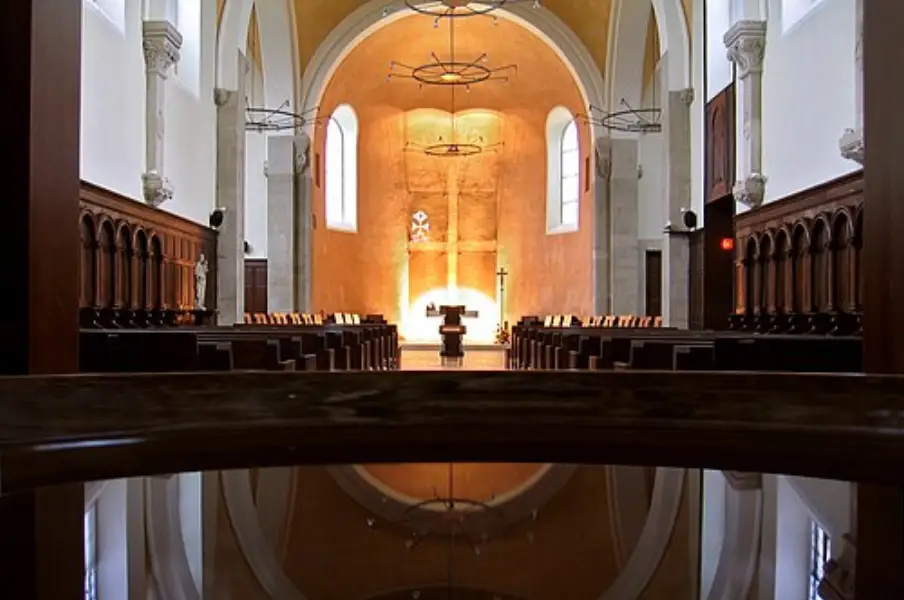
Jouarre survives today as a living Benedictine abbey of nuns, and its Merovingian crypt — the so-called crypt of Saint Paul — is one of the treasures of early medieval France. Agilberta's presence there, in a stone sarcophagus fourteen centuries old, makes her one of the few seventh-century abbesses whose grave can still be visited. Her feast on 10 August is kept in the local calendars, and her memory stands for the generations of unrecorded women who ruled the great houses of Gaul.
§ Introduction
Timeline
- 660
Her relatives Ebrigisil and Ado found Jouarre Abbey
§ Introduction
- 680
Dies in France and is buried in one of the crypt's three sarcophagi at Jouarre
§ Introduction
The Record
- Patron of
- Jouarre Abbey and its community
- Symbols
- Abbess's crozier·Benedictine habit
- Canonization
- Pre-congregation; ancient cult at Jouarre
Prayer
Bibliography
Show 6 sources
- 1 2 3 "Saint Agilberta of Jouarre" . Catholic Saints Info.org. 10 June 2012 . Retrieved 5 June 2020 .
- 1 2 "St. Agilberta" . Catholic Online . Retrieved 5 June 2020 .
- 1 2 3 "St. Agilberta of Jouarre, France" . Antiochian Orthodox Christian Archdiocese of North America . Retrieved 5 June 2020 .
- ↑ McNamara, Jo Ann; Halborg, John E.; Whatley, E. Gordon, eds. (1992). Sainted Women of the Dark Ages . Translated by McNamara, Jo Ann. Durham, North Dakota: Duke University Press. p. 279. ISBN 9780822382362 .
- ↑ Bernheimer, Richard (1938). "A Sasanian Monument in Merovingian France" . Ars Islamica . 5 (2): 221– 232. ISSN 1939-6406 . JSTOR 4520931 .
- ↑ Kibler, William W.; Zinn, Grover A. (2017-07-05). Routledge Revivals: Medieval France (1995): An Encyclopedia . Routledge. ISBN 978-1-351-66565-0 .
Profile text adapted from the Wikipedia article, licensed CC BY-SA 4.0.
Pray with this saint every day
Save St. Agilberta to your favorites, read the full profile, and get feast-day reminders in the Saints app.
Get the Saints AppFree on the App Store for iPhone and iPad