
died c. 750·Feast July 9
St. Agilulfus of Cologne
Bishop and Martyr
Overview
Agilulfus, also called Agigulf or Agilulf, was abbot of Stavelot and bishop of Cologne, and died a violent death around the year 750. Of the events of his life, apart from his name and offices, the sources frankly confess uncertainty, and the early account composed by a Malmedy monk is considered untrustworthy. Born into a good family, he studied under Abbot Angelinus at Stavelot, the Ardennes' great monastery, and not long after succeeding to its abbacy he was made bishop of Cologne. According to tradition, he tried to talk King Pepin into placing the throne outside Charles Martel's line, legitimacy being his argument, and his violent end soon after may have been the revenge of the powerful. Pope Zachary's letter of 747, praising Agilulfus for subscribing the Charta verae et orthodoxae professionis, shows the standing he enjoyed in the church of his day. He was venerated at Malmedy as abbot and martyr; in 1062 Bishop Anno translated his remains to the church of Our Lady of the Steps at Cologne.
The Complete Life
Early Life
Agilulfus was born in Germany into what the tradition calls a good family, which in the eighth century means the Frankish landed aristocracy from whose ranks both the abbots and the bishops of the realm were drawn. His education was monastic: he was formed at Stavelot, in the Ardennes, under Abbot Angelinus. Stavelot, joined in federation with Malmedy, was one of the great royal monasteries of the Austrasian church, a house of prayer that also functioned as a school, a farm, a scriptorium and a political institution; to be educated there was to be prepared for high service in the church. The boy who entered under Angelinus learned the psalter, the rule of St. Benedict, and the habits of a community whose abbot dealt with kings. He evidently showed the capacities that such a house looked for, since he succeeded to its abbacy, and since the wider church soon claimed him for the episcopate. The exact years of these steps are not recoverable.
§ Introduction
Abbot and Bishop
Agilulfus' career compressed the two great offices of the Frankish church into one life. As abbot of Stavelot he governed the federation with Malmedy, responsible for the souls, lands and learning of a major monastery; a short time after succeeding to that charge he was raised to the see of Cologne, the metropolitan church of the Rhineland mission country, where the bishops were, in that generation, still frontier pastors as well as city prelates. The combination of abbot and bishop was common in the age and is the key to his subsequent fate: it gave him standing at court and a voice in the affairs of the realm, as well as duties in two churches at once. His orthodoxy and his loyalty to the Roman see are witnessed by a letter of Pope Zachary in 747, which commends him for subscribing the Charta verae et orthodoxae professionis, a Roman profession of faith; the papal correspondence shows him in good repute at the center of the western church.
§ Introduction
The Fatal Counsel
The tradition connects Agilulfus' death with his political counsel. Tradition reports that he pressed King Pepin to divert the succession, keeping the throne out of Charles Martel's line; the Pepin in question is probably the Carolingian mayor and king-maker of that name, and the ground was legitimacy, the argument drawn from Charles' irregular marriage. Taking a position against the line that was, in fact, the future of the Frankish monarchy, the line of Pepin and Charlemagne, was ecclesiastically courageous and politically lethal, and Agilulfus' violent end came soon after. Whether the killing was revenge on the part of the powerful, as the tradition suspects, or the work of other enemies the records do not say; the church read his death as martyrdom, and the monks of Malmedy, his own community, venerated him as abbot and martyr. The historian must register the uncertainty the sources themselves declare; the church judged the whole life, not the dossier.
§ Introduction
Burial and Translation
After his death around 750 Agilulfus was honored in the abbey at Malmedy, where the community of which he had been abbot kept his memory with the title of martyr, and where the early account of his life, composed by a monk of the house, was preserved, though later scholarship deems it untrustworthy in its details. The cult was substantial enough to deserve translation: in 1062 Bishop Anno of Cologne, one of the great church-builders of the German middle ages, brought the remains from the Ardennes to the church of Our Lady of the Steps at Cologne, uniting the martyr-bishop with his see. Anno's translation was a public liturgical act that fixed the cult in the city whose church Agilulfus had governed, and the presence of the relics in Cologne gave his feast, 9 July, its standing in the calendars of the Rhineland, from which it passed into the wider German observance.
§ Introduction
Canonization
Agilulfus belongs to the pre-congregation saints, acknowledged by the local and regional church long before canonization became a papal process. His cult is witnessed at Malmedy and Cologne by the middle ages, his feast on 9 July stands in the German calendars, and the Roman Martyrology tradition carries his name. The churches that venerate him include the Roman Catholic Church and the Orthodox Church, the latter receiving the early Frankish saints as part of the undivided patrimony. The papal letter of 747, in a sense, provides the earliest external attestation of his standing, since it shows him in communion with the apostolic see and entrusted with the profession of the faith; a century later the church that remembered his violent end had no difficulty reading his life as a whole and giving him the martyr's palm.
§ Introduction
Legacy
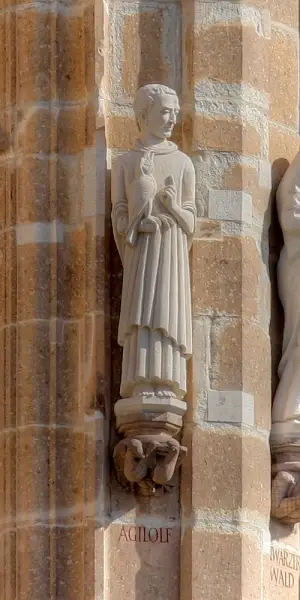
Agilulfus' legacy is twofold. Institutionally, he belongs to the story of the Rhineland church, a link in the chain of Cologne's early bishops and a reminder that the metropolitan see of Germany's Christian heartland was built by men who could pay for their fidelity with their lives; his statue stands among the figures of Cologne's city hall tower, the civic memory of the city keeping its early bishop. Spiritually, he is remembered as the churchman who spoke truth to the founders of the Carolingian dynasty at the moment of its rise, and lost. History vindicated his opponents; his own church vindicated him. That double verdict, political failure and spiritual triumph, has made him an apt patron for public servants who must give unwelcome advice, and a standing lesson that the church's calendar does not score as the world scores.
§ Introduction
Timeline
- 747
Pope Zachary's letter commends Agilulfus for subscribing the Charta verae et orthodoxae professionis
§ Introduction
- 750
Dies violently around this year, perhaps in revenge for counseling Pepin against Charles Martel
§ Introduction
- 1062
Bishop Anno brings his remains to the Church of Our Lady of the Steps at Cologne
§ Introduction
The Record
- Patron of
- The Diocese of Cologne
- Symbols
- Bishop's vestments·Palm of martyrdom
- Canonization
- Pre-congregation; cult at Malmedy and Cologne
Prayer
Bibliography
Show 4 sources
- ↑ Zimmerman, Alfonso M., "Sant' Agilulfo (Agilolfo)", Santi e Beati, July 27, 2011
- ↑ Holweck, Frederick George. A Biographical Dictionary of the Saints , B. Herder, 1924, p. 32
- 1 2 3 Thurston, Herbert. "St. Agilulfus." The Catholic Encyclopedia Vol. 1. New York: Robert Appleton Company, 1907. 23 April 2020 This article incorporates text from this source, which is in the public domain .
- ↑ "Agilulfus", Kölner Dom
Profile text adapted from the Wikipedia article, licensed CC BY-SA 4.0.
Pray with this saint every day
Save St. Agilulfus of Cologne to your favorites, read the full profile, and get feast-day reminders in the Saints app.
Get the Saints AppFree on the App Store for iPhone and iPad