
535-596·Feast December 14
St. Agnellus of Naples
Abbot, Patron of Naples
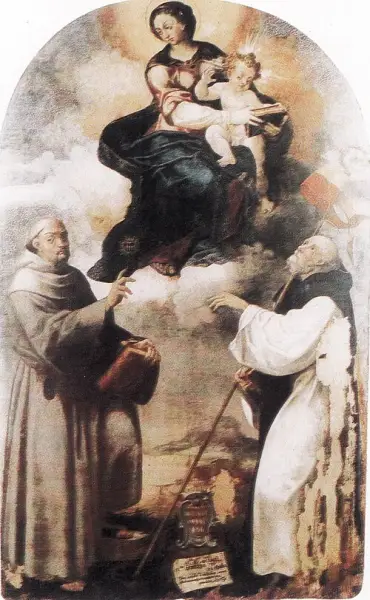
Overview
Agnellus of Naples, called Aniello the Abbot, was born in 535 into a wealthy Neapolitan family of Syracusan origin that pious tradition connects with St. Lucy. Orphaned and left a rich inheritance, he spent his youth as a hermit, first in a cave near a chapel of the Virgin Mary and then at the church of Santa Maria Intercede, the future Sant'Agnello Maggiore. His parents' death freed both his fortune and his life: he poured the one into works of charity, founding among other things a hospital for the poor, and gave the other to God in monastic profession. When the Lombards threatened Naples in 581, the terrified inhabitants called for the holy man, who is said to have appeared carrying a banner of the cross at the city's defense. Fame soon became a burden; he fled first to Monte Sant'Angelo and then to Guarcino, where he lived seven years and where his shrine still stands. Recalled to Naples, he became an Augustinian friar and priest in the monastery of Gaudiosus of Naples, and died there as abbot on 14 December 596, aged sixty-one. He is co-patron of Naples and principal patron of several towns of Campania and Lazio.
The Complete Life
A Rich Orphan of Naples
Agnellus was born at Naples in 535, into a family that had come from Syracuse and that local devotion liked to link by kinship to St. Lucy herself — a genealogy that belongs to piety rather than to record. His father Federico and mother Giovanna reared him in the Naples of the Gothic wars' aftermath, a Greek-speaking city of chapels, catacombs, and siege. Drawn to solitude from his youth, he lived as a hermit first in a cave beside a chapel of the Mother of God, then at the church called Santa Maria Intercede, which his own cult would later rename. The pattern is the familiar one of Byzantine Italy: aristocratic son, early ascetic vocation, the city watching its holy men the way other cities watched their generals. The earliest substantial source for his life is the Libellus miraculorum of Peter the Sub-Deacon, written four centuries after his death, and everything reported rests on that late foundation.
Inheritance Spent
The death of his parents made Agnellus a rich man and decided the shape of his life. He liquidated the inheritance into charity: alms, ransoms, and above all a hospital for the poor — an institution the sixth century still counted as a novelty of Christian civilization. The sources call him a Basilian monk and later an Augustinian friar, language that reflects the categories of the medieval writers more than the fluid monastic landscape of sixth-century Naples; what is constant is the substance: a man under rule, prayerful, poor by choice, and generous by habit. His holiness made him popular, and popularity in a besieged city quickly found a use for him.
The Banner in the Lombard War
In 581 the Lombards attacked Naples, and the inhabitants, according to the old account, called on Agnellus to save them. The legend that grew from that night shows the hermit appearing with a banner of the cross at the city's defense — the image that became his attribute in art and the reason for his patronage of Naples alongside Januarius and Aspren. The story belongs to the class of the saint-as-defender common to southern Italy, and it fixed his fame permanently. It also, by the account's own logic, made the city unbearable to him: unable to walk its streets without being venerated, he fled — first to the sanctuary of Monte Sant'Angelo on the Gargano, then to the hill town of Guarcino in the Ciociaria, where he lived seven years as a stranger, and where his hermitage remains a shrine and his cult a living thing.
Abbot of Gaudiosus
Recalled to Naples — the sources do not say by whom — Agnellus spent his last years inside a community rather than beside it. He joined the monastery of Gaudiosus of Naples, took priestly orders, and in time governed the house as abbot, dying there on 14 December 596 at sixty-one. It is a quiet ending after a dramatic middle: the defender of the city and the fugitive of Guarcino closing his life as a father of monks, buried among his brethren. The date of his death became his feast, kept at Naples and through the towns that claim his patronage.
Cult
Agnellus is pre-congregation: no process, no bull, only the unbroken memory of the churches that kept him. His cult centers on Naples, where he ranks among the co-patrons, and on Guarcino, whose shrine at the Eremo di Sant'Agnello preserves the seven years of his self-exile. Around these poles spread a wide patronage — Roccarainola, Rodi, Pisciotta, and others — each with its feast and its images: the abbot with the cross-banner, the crosier, sometimes the hospital he founded. The Roman Martyrology keeps his name on 14 December.
Legacy
Agnellus's legacy can be read off the map of central-southern Italy: a town named for him, shrines in two regions, co-patronage of one of Europe's great cities. The substance behind the map is the sixth-century pattern he embodies — charity institutionalized in a hospital, courage offered to a city under attack, and the paradox of a man famous enough to defend Naples who wanted nothing so much as to be unknown. Guarcino still keeps the memory of the seven quiet years; Naples keeps the banner. Between them they hold the whole of a life that the sources, late and partial as they are, present without embarrassment as both spectacular and hidden.
Timeline
- 535
Born at Naples into a rich family of Syracusan origin
§ Life
- 581
Carries a cross-banner at the defense of Naples as Lombard forces attack the city
§ Life
- 14 Dec 596
Dies at Naples aged sixty-one, as abbot of the monastery of Gaudiosus
§ Introduction
- 900
First major account of his life appears in Peter the Sub-Deacon's tenth-century Libellus miraculorum
§ Life
The Record
- Patron of
- Naples (co-patron)·Guarcino, Roccarainola, Rodi and Pisciotta
- Symbols
- Banner of the Cross·Crosier
- Canonization
- Pre-congregation; cult confirmed by long tradition in Naples and Lazio
Prayer
Profile text adapted from the Wikipedia article, licensed CC BY-SA 4.0.
Pray with this saint every day
Save St. Agnellus of Naples to your favorites, read the full profile, and get feast-day reminders in the Saints app.
Get the Saints AppFree on the App Store for iPhone and iPad