
1211–1282·Feast November 13
St. Agnes of Bohemia
Poor Clare Abbess and Foundress, Princess of Prague
Overview
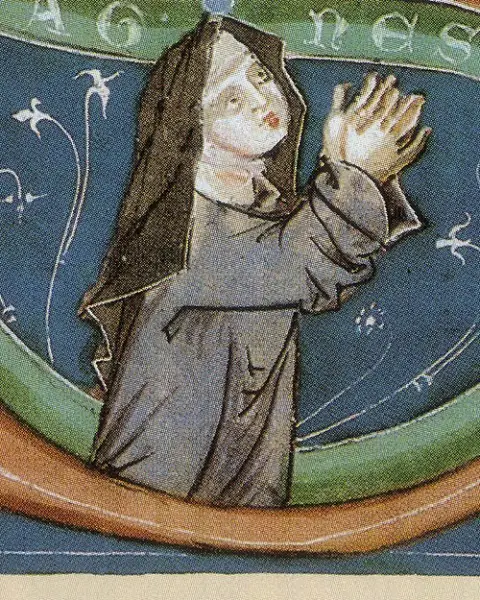
Agnes of Bohemia (Anežka Česká), born at Prague on 20 January 1211, was the daughter of King Ottokar I of Bohemia and Constance of Hungary — a first cousin of Elizabeth of Hungary and a descendant of St Ludmila and St Wenceslaus. Educated by Cistercian nuns at Trzebnica under the care of Hedwig of Silesia and then by Premonstratensian canonesses, she was traded in betrothal after betrothal: to Henry son of Emperor Frederick II at eight; then, after that contract's cancellation, toward Henry III of England — until the Emperor vetoed the match because he wanted to marry her himself. Agnes refused the whole game, sought the help of Pope Gregory IX, and devoted herself to prayer and works instead. On land given by her brother Wenceslaus I she established the Hospital of St Francis around 1232-33, houses for the Franciscans, and the first Poor Clare house north of the Alps — herself entering it in 1234 and becoming its abbess. She corresponded with Clare of Assisi for over twenty years; in 1238 she gathered the hospital's lay workers into a nursing military order — Knights of the Cross with the Red Star. She died on 2 March 1282, and was canonized — over seven centuries later — on 12 November 1989.
The Complete Life
A Princess as a Pawn
Agnes was born at Prague on 20 January 1211, daughter of King Ottokar I of Bohemia by Constance of Hungary, sister of King Andrew II — which made Agnes a first cousin of Elizabeth of Hungary, the Franciscan saint. On both sides she descended from Bohemia's royal saints: Ludmila and Wenceslaus were her ancestors. At three she was sent to Silesia to the care of Hedwig of Andechs, wife of Duke Henry the Bearded, who placed her with the Cistercian nuns of Trzebnica, the abbey Hedwig herself had founded; back in Prague she continued her education with the Premonstratensian canonesses. The education was the preliminary to diplomacy: at eight she was betrothed to Henry, the newly crowned boy-king of Germany, son of Emperor Frederick II, and was sent to the court of Duke Leopold VI of Babenberg to be raised as a future empress — until Leopold, preferring his own daughter Margaret for Henry, had the contract cancelled after six years.
§ Childhood
Refusing an Emperor
The cancelled betrothal merely opened the next negotiation: her father planned her marriage to Henry III of England, and the plan was vetoed by Frederick II — who wanted Agnes for himself. She was perhaps twenty, the most marriageable princess in central Europe, and she declined the whole market. She resolved to give her life to prayer and works of the spirit, and sought and won the backing of Pope Gregory IX against imperial pressure. The Emperor's famous remark — had she left him for a mortal man, vengeance with the sword would have followed, yet he could not take offence at her preferring the King of Heaven to him — was afterwards taken as the epitaph on her vocation. Through the newly arrived Franciscan friars, whom her brother had invited to Bohemia, she learned of Clare of Assisi and her Order of Poor Ladies, and began a correspondence with Clare that lasted more than twenty years.
§ Foundress
Hospital, Cloister, Knights
On land donated by her brother Wenceslaus I, Agnes built. Around 1232-33 she founded the Hospital of St Francis and two Franciscan friaries; next came a combined monastery and friary beside the hospital, sheltering both the friars and the Poor Clare nuns who staffed its wards — among the earliest Gothic structures in Prague and the first Poor Clare house north of the Alps. She gave it the property of the Teutonic Knights in Bohemia in 1235, entered the community herself in 1234, and became abbess the following year. In her nun's habit she cooked for the lepers and paupers and repaired their clothing. In 1238 she organized the hospital's lay workers into a new military order devoted mainly to nursing — Knights of the Cross with the Red Star, which took the Rule of St Augustine and was recognized by Gregory IX in 1236-37 — and the next year handed the hospital over to them entirely. The order still exists — the only religious order founded in Bohemia to survive, and one of the very few medieval orders of nursing knights.
§ Foundress
Forty Years in the Cloister
Agnes lived out her life as abbess of the Prague Clares, a long old age of ordinary monastic government. Clare of Assisi, writing to her across Europe with deep maternal feeling the two never met, urged her to gaze daily on the mirror of poverty and to hold to holy poverty above all — the letters are among the most personal documents of the early Franciscan movement. Contemporaries credited Agnes with visions and healings, and a prophecy that her brother Wenceslaus would be victorious against the Austrians; but her canonization case was finally made, as the modern process demands, on the heroism of her faith, hope and charity. She died at Prague on 2 March 1282, having outlived the whole founding generation of her family's church patronage. The community she governed for nearly half a century carried the first Franciscan poverty into central Europe.
§ Foundress
Seven Centuries to the Altar
Agnes was venerated soon after her death, but no process followed: over seven hundred years passed before her cause succeeded. The beatification process opened on 21 November 1872 and Pius IX beatified her in 1874; John Paul II canonized her in St Peter's Square on 12 November 1989. The date gave her cult a second life: five days later the Velvet Revolution began in Prague, and Czech Catholics embraced her as the Saint of the Overthrow of Communism — a coincidence of calendar read as an emblem of her country's liberation. The Czech Church marked her birth's 800th anniversary in 2011 with a jubilee year, and the Prague Archbishopric with the National Gallery mounted a major exhibition, 'Saint Agnes of Bohemia — Princess and Nun', in her own restored convent. Her relics had already been moved in 1874 to a new shrine, where the people of Prague had prayed to her for generations.
§ Veneration
Legacy
The convent Agnes built — the Convent of Saint Agnes, Klášter svaté Anežky — declined after the Hussite wars and was abolished in 1782 under Josephist reforms, but was restored in the 1960s and now houses the National Gallery's medieval Bohemian and Central European collections, so that her cloister has become the place where Bohemian Gothic art is kept. Her nursing order — Knights of the Cross with the Red Star — still staffs hospitals in Prague after nearly eight centuries, arguably her most concrete monument. Her long-delayed canonization made her the patroness of the Czech Republic, and her pairing of royal birth with Franciscan poverty placed her, with Elizabeth of Hungary and Hedwig of Silesia — the two women who raised and schooled her — among the great royal saints of the thirteenth century. To the people of Prague she remains Anežka, the princess at the door of the lepers' ward.
§ Legacy
Timeline
- 20 Jan 1211
Born at Prague, daughter of King Ottokar I of Bohemia and Constance of Hungary
§ Introduction
- 1226
Her father Ottokar goes to war against the Babenbergs over the cancelled betrothal
§ Arranged marriages
- 1232
Founds the Hospital of St. Francis in Prague, on land donated by her brother King Wenceslaus I
§ Foundress
- 1234
Becomes a member of the Poor Clares, the first community of the order north of the Alps
§ Foundress
- 1235
Gives the property of the Teutonic Knights in Bohemia to the hospital she founded
§ Foundress
- 1238
Gathers the hospital's lay helpers into a nursing military order, Knights of the Cross with the Red Star
§ Foundress
- 2 Mar 1282
Dies at Prague after a lifetime leading the monastery as abbess
§ Introduction
- 21 Nov 1872
Her beatification process is formally opened
§ Veneration
- 1874
Beatified by Pope Pius IX, more than five centuries after her death
§ Veneration
- 12 Nov 1989
Canonized by Pope John Paul II at Vatican City
§ Veneration
- 2011
On the 800th anniversary of her birth, Czech Catholics dedicate a year to her as the Saint of the Overthrow of Communism
§ Veneration
The Record
- Major works
- Correspondence with St Clare of Assisi (over two decades, surviving in part)
- Patron of
- Czech Republic
- Canonization
- Beatified 1874 by Pope Pius IX; canonized 12 November 1989 by Pope John Paul II
Prayer
Bibliography
Show 12 sources
- ↑ Sarah Gallick (1 December 2009). The Big Book of Women Saints . HarperCollins. p. 76. ISBN 978-0-06-195656-0 .
- ↑ David Hugh Farmer (23 September 2004). The Oxford Dictionary of Saints . Oxford University Press. p. 46. ISBN 978-0-19-860949-0 . Retrieved 17 December 2011 .
- ↑ Habig, Marion OFM (ed.) The Franciscan Book of Saints , © 1959 Franciscan Herald Press, Saint Agnes of Bohemia Archived March 14, 2016, at the Wayback Machine
- ↑ Welfs, Hohenstaufen and Habsburgs , Michael Toch, The New Cambridge Medieval History: c.1198-c.1300 , Vol. 5, ed. David Abulafia, Rosamond McKitterick , (Cambridge University Press, 1999), 385.
- ↑ Welfs, Hohenstaufen and Habsburgs , Michael Toch, 384.
- ↑ " "Saint Agnes of Bohemia", Saint of the Day , Franciscan Media" . Archived from the original on 2018-12-14 . Retrieved 2017-09-05 .
- 1 2 Donovan, Stephen. "St. Agnes of Bohemia." The Catholic Encyclopedia Vol. 1. New York: Robert Appleton Company, 1907. 5 September 2017
- 1 2 “Saint Agnes of Prague“. CatholicSaints.Info. 3 September 2017. Web. 5 September 2017
- ↑ "Order of the Knights of the Cross with the Red Star - 757 years" . Archived from the original on 2016-03-03 . Retrieved 2012-12-24 .
- ↑ Clare's Letters to Agnes: Texts and Sources . St. Bonaventure, New York: Franciscan Institute Publications. 2001. ISBN 978-1-57659-176-5 .
- ↑ "NG Prague - Convent of St Agnes of Bohemia" . Archived from the original on 2013-11-28 . Retrieved 2012-06-11 .
- ↑ Index ac status causarum beatificationis servorum dei et canonizationis beatorum (in Latin). Typis polyglottis vaticanis. January 1953. p. 3.
Profile text adapted from the Wikipedia article, licensed CC BY-SA 4.0.
Pray with this saint every day
Save St. Agnes of Bohemia to your favorites, read the full profile, and get feast-day reminders in the Saints app.
Get the Saints AppFree on the App Store for iPhone and iPad