
1268-1317·Feast April 20
St. Agnes of Montepulciano
Dominican Prioress and Mystic
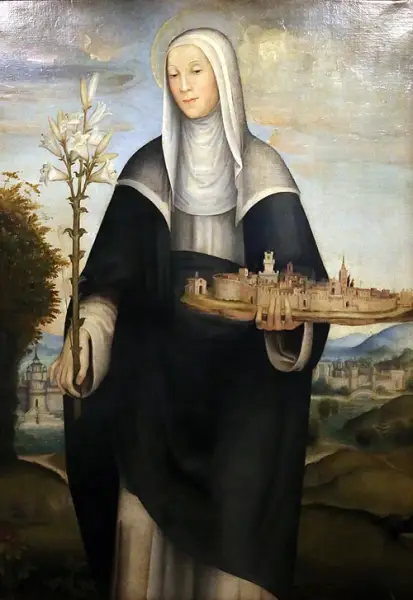
Overview
Agnes of Montepulciano, born 28 January 1268 into the noble Segni family at Gracciano near Montepulciano in Tuscany, became a Dominican prioress known as a miracle worker in her own lifetime. At nine she persuaded her parents to let her enter the local Franciscan monastery of the 'Sisters of the Sack,' receiving papal permission for so young an entry. In 1281 she went with a group of sisters to found a new monastery at Proceno, becoming bursar at fourteen and prioress at twenty, renowned for devotion to the Blessed Sacrament and a deep life of prayer. Reports of healings and even multiplications of loaves gathered around her, while she herself endured long illnesses. Recalled to Montepulciano in 1306 to head the convent there, she built a church in honor of the Blessed Mother as commanded in a vision, and after a vision of Dominic Guzman led her nuns into the Dominican Order under the Rule of Saint Augustine. She died on 20 April 1317, aged forty-nine, and was canonized in 1726.
The Complete Life
Early Life
Agnes was born on 28 January 1268 into the noble Segni family — the family that also gave the Church a pope, Innocent III — at Gracciano, a frazione of Montepulciano in the Val di Chiana, then part of the Papal States. Her vocation announced itself almost absurdly early: at nine years old she persuaded her parents to let her join the city's Franciscan convent of women, a community called the Sisters of the Sack for the coarse sackcloth habits they wore. Entry at that age was normally against Church law, and the permission of the pope was obtained to receive her — a detail that tells us both how determined the child was and how seriously the family's standing was taken. The sisters lived a simple contemplative life, and it was in that school of poverty that her prayer was formed. The town of Montepulciano, on its hill above the Val di Chiana, was a contested place between Siena, Florence, and the Papal States, and its convents were among its most durable institutions.
§ Life
Vocation at Proceno
In 1281 the lord of Proceno's castle — which stood on a fief held of Orvieto — asked Montepulciano's nuns to send sisters to establish a new monastery on his land, and Agnes was one of those chosen. At fourteen she was appointed bursar of the young community; in 1288, despite being only twenty, she was elected its prioress, on account of her devotion to the Blessed Sacrament and the depth of her life of prayer. Her years at Proceno established the pattern of her fame: the sick in mind and body seemed to recover in her presence, she was said to have multiplied loaves again and again — echoing the Gospel miracle of loaves and fishes — and she herself endured severe bouts of illness that lasted long periods. The prioress who fed others went hungry and sick herself. A bursar manages the material life of a house — bread, fuel, debts — and the office given her at fourteen shows the practical trust her community placed in her alongside her reputation for sanctity.
§ Life
Return to Montepulciano
In 1306 Agnes was summoned back to lead the monastery in her native Montepulciano, and there she remained for the rest of her life. By then she had attained a lofty degree of contemplative prayer and was credited with many visions. Two commands received in them shaped her last decade: she proceeded to raise a church in honor of the Blessed Mother, believing she had received that command years before in a mystical vision, and following a vision of Dominic Guzman she guided her monastery's nuns into the Rule of Saint Augustine, making them members of the Dominican Order. The twin acts — a church in stone and a new religious affiliation — were her mission in miniature: she built for God's honor and she bound her community to an order with deep roots in prayer and preaching. The change of rule was not small: it moved the sisters into the family of preachers, with its constitutions, its connections to the friars, and its place in the wider Dominican mission.
§ Life
Spirituality
Everything reported of Agnes's inner life centers on two poles: the Blessed Sacrament and the humility of suffering. Her devotion to the Eucharist was noted already at twenty, when the sisters of Proceno elected her prioress for it, and the visions that guided her later years — the command to build, the apparition of Dominic — grew out of long prayer before the tabernacle she had built. Around her the people of the Val di Chiana experienced her as a living spring: the mentally and physically afflicted brought to her, the loaves multiplied for the poor at her door. Yet the sources are equally firm that she spent much of her life ill, sometimes for long stretches, and she neither hid it nor made it an excuse. The combination — power going out of her, weakness dwelling in her — is the oldest pattern of Christian holiness. Her visions were never private decorations; each ended in an act — a church begun, a rule embraced — and that is why her biographers could present her as both mystic and administrator.
§ Life
Final Years and Death
Agnes died at Montepulciano on 20 April 1317, aged forty-nine, having governed her convent for the last decade of her life. The hagiographical tradition adds the customary signs — a heavenly light over the convent at her death, and a sweet-smelling substance, the 'manna' of Saint Agnes, later said to appear on the walls near her tomb — by which the people of the town knew their prioress was with God. Her body was placed in the convent church, and devotion at her tomb began at once, sustained by the Dominican family which counted her as a mother. The cell where she lived, with eighteenth-century frescoes by Nicola Nasini, and her shrine at the church of Sant'Agnese in Montepulciano remain the physical memorials of her life. The accounts of her last days report that Our Lady, accompanied by the sainted Magdalene, appeared to her as she lay dying, a fitting close to a life spent building for the Mother of God.
§ External links
Canonization
Devotion to Agnes ran steadily for four centuries before the formal process. In 1726 Pope Benedict XIII — himself a Dominican — canonized her, giving universal authority to a cult that Tuscany and the Dominican Order had never let lapse. She is honored by the Catholic Church and especially within the Dominican family as a prioress and mystic of the early fourteenth century, a contemporary and fellow-traveler of the great age of Dominican women that also produced Catherine of Siena. Her feast on 20 April, the day of her death, is kept in the Dominican and general calendars. Benedict XIII's act gave her a universal feast and confirmed the local liturgy that had grown around her tomb over four centuries of unbroken devotion. The documents of the process, with the depositions of witnesses to her miracles, are preserved and give the modern reader a rare window into a medieval canonization.
§ Introduction
Legacy
Agnes of Montepulciano stands at the head of the line of Italian Dominican mystics: the child who entered at nine, the bursar at fourteen, the prioress at twenty, the visionary who moved her community from Franciscan simplicity into the Dominican family, and the dying woman whose tomb exuded sweetness. Beccafumi painted her signs; Tiepolo set her beside Rose of Lima and Catherine of Siena in the company of Dominican saints; an eighteenth-century ivory statue of her was carved as far away as the Philippines, marking how far her name traveled with the friars. For monastic women she remains a patron of the ordinary heroic life — office, sickness, bread for the poor, and prayer without ceasing. In Montepulciano her shrine remains a working place of pilgrimage, and Dominican nuns across the world invoke her as a mother of their branch of the order. She is also a patron of the sick in her own town, where her feast is kept each spring with processions that have changed little in centuries.
§ Life
Timeline
- 28 Jan 1268
Born at Gracciano near Montepulciano into the noble Segni family
§ Introduction
- 1281
Goes with sisters sent to Proceno to found a new monastery at the lord's invitation
§ Life
- 1288
Elected prioress of Proceno at only twenty, noted for devotion to the Blessed Sacrament
§ Life
- 1306
Recalled to head the Montepulciano monastery; builds a church and leads her nuns into the Dominican Order
§ Life
- 1316
Health fails; the springs of Chianciano Terme bring her no relief and she is carried home on a stretcher
§ Life
- 20 Apr 1317
Dies at Montepulciano aged forty-nine, her body soon giving off a sweet odor
§ Veneration
- 1435
Her remains are moved to the church of San Domenico in Orvieto
§ Veneration
- 1726
Canonized by Pope Benedict XIII
§ Veneration
The Record
- Patron of
- Montepulciano·Dominican nuns·The sick
- Symbols
- Lily·Lamb
- Canonization
- Canonized in 1726 by Pope Benedict XIII
Prayer
Bibliography
Show 10 sources
- 1 2 Tiepolo, Giovanni Battista; veneziano, Museo del Settecento; N.Y.), Metropolitan Museum of Art (New York; York, N. Y. ) Metropolitan Museum of Art (New (1996). Giambattista Tiepolo, 1696-1770 : [ Venice, Museum of Ca' Rezzonico, from Se
- ↑ Fitzgerald, Edward. "St. Agnes of Montepulciano." The Catholic Encyclopedia Vol. 1. New York: Robert Appleton Company, 1907. 25 November 2021 This article incorporates text from this source, which is in the public domain .
- 1 2 3 4 5 6 "Sant' Agnese Segni di Montepulciano" . Santi Beati (in Italian).
- 1 2 3 "Dorcy, Marie Jean. St. Dominic's Family , Tan Books and Publishers, (1983)" . Archived from the original on 2013-05-27 . Retrieved 2014-03-02 .
- ↑ Monks of Ramsgate. "Agnes of Monte Pulciano". Book of Saints 1921. CatholicSaints.Info. 10 August 2018 This article incorporates text from this source, which is in the public domain .
- ↑ "St. Agnes of Montepuliciano" . Catholic News Agency . 20 April 2012. Archived from the original on 17 September 2017 . Retrieved 20 December 2012 .
- ↑ Mariani, Lorenzo Sordini (1606). Vita di S. Agnesa Vergine da Montepulciano; dell' Ordine de Predicatori, Con alcune Relazioni di cose nuovamente accadute, Raccolta dal R. P. F. Lorenzo Sordini Mariani, Predicatore Generale Nella Provinci
- ↑ Butler, Alban. "Saint Agnes of Monte Pulciano, Virgin and Abbess". Lives of the Fathers, Martyrs, and Principal Saints 1866. CatholicSaints.Info. 21 May 2017 This article incorporates text from this source, which is in the public domain .
- ↑ Martyrologium Romanum , ex decreto sacrosancti oecumenici Concilii Vaticani II instauratum auctoritate Ioannis Pauli Pp. II promulgatum, editio [typica] altera, Typis Vaticanis, A.D. MMIV (2004), p. 245 ISBN 88-209-7210-7 ""At Montepulcia
- ↑ Stracke, Richard. "Saint Agnes of Montepulciano: The Iconography", Christian Iconography
Profile text adapted from the Wikipedia article, licensed CC BY-SA 4.0.
Pray with this saint every day
Save St. Agnes of Montepulciano to your favorites, read the full profile, and get feast-day reminders in the Saints app.
Get the Saints AppFree on the App Store for iPhone and iPad