
c. 291-304·Feast January 21
St. Agnes of Rome
Virgin and Martyr
Overview
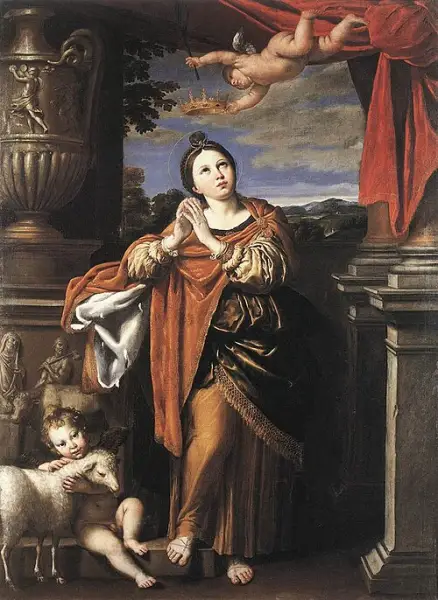
Agnes of Rome, who died on 21 January 304 at the age of twelve or thirteen, is one of the most venerated of the virgin martyrs and one of the few women saints named in the Canon of the Mass. Born in 291 to Roman nobility and raised a Christian, she was a beautiful girl with suitors among the young men of high rank. Offended by her resolute refusal to marry, since she had consecrated herself to Christ, they denounced her as a Christian in the persecution of Diocletian. Brought before the authorities, she refused her father's plea to deny God. The prefect Sempronius ordered her to be dragged, naked, through the streets and into a brothel; the acts recount how her hair miraculously grew to cover her and the men who approached her were struck blind. Sentenced to death, she was bound to a stake, but the wood would not burn, and she was killed with the sword. A few days later her foster-sister Emerentiana was stoned to death while praying at the tomb. Ambrose wrote an early account, and Damasus adorned her grave with verse. Constantine's daughter was said to be cured at her tomb, over which the great basilica on the Via Nomentana was built.
The Complete Life
Early Life
Agnes was born in 291 into the Roman nobility, and the one certain thing about her upbringing is that it was Christian: her whole manner of death, a refusal that was religiously motivated and intelligible to everyone around her, presupposes a girl formed in the faith of a household church. Her family belonged to the class that owned the villas of the Nomentana, the road along which she would be buried; her name, a Greek word meaning pure or chaste, was given, or so the ancients liked to observe, in a kind of prophecy. She was twelve or thirteen at her death, of an age when Roman girls of rank were betrothed, and the acts represent her as having several suitors among the young men of her class. Her refusal of marriage was not the shyness of a child but a decision: she had consecrated her virginity to Christ, and she said so, in a society in which such a vow, made by a daughter of good family, defied the economy of alliance in which her class lived and prospered.
§ Biography
The Conflict
The conflict that killed Agnes arose, the acts agree, from the fury of suitors she had turned away. Aristocratic young men, offended by her steadfast devotion, accused her before the authorities as a Christian, using the persecution of Diocletian as an instrument of private resentment. The machinery then turned with its usual logic. Her own father urged her to deny God; she refused. The prefect Sempronius, whose son is prominent in the legendary elaborations of the story, condemned her to be exposed in a brothel, the standard Roman punishment for Christian virgins, designed to destroy the witness by destroying what it testified to. The acts answer the sentence with wonders: her hair grew to cover her, the would-be violators were struck blind, the prefect's son, struck dead, was restored at her prayer. Whatever a modern reader makes of the marvels, the theology is exact: the state set out to take her chastity, and the church that told the story insisted that it could not. Her body was not in the power of the empire.
§ Biography
Martyrdom
Condemned to death, Agnes was taken to the stadium and tied to a stake for burning; the pile of wood, the acts say, would not catch fire, or the flames parted from her, whereupon the commanding officer drew his sword and cut off her head, or in other texts stabbed her through the throat. The Christians soaked up her blood with cloths. She died on 21 January 304, and the date has never left the calendar. Her burial beside the Via Nomentana, in her family's territory, gave the church her shrine, and the sequel fixed her image: days afterward her foster-sister Emerentiana, herself a catechumen, was found praying at the tomb, rebuked the crowd for killing her sister, and was stoned to death on the spot, the church's first instance of a martyrdom by association. The two girls, the virgin and the catechumen, lie near each other in the cemetery that bears Agnes' name, and their joint memory taught the ancient church that witness is contagious.
§ Biography
Spirituality
The early accounts of Agnes, above all Ambrose's, stress three things: her age, her steadfastness and her virginity, and the three belong together. The Fathers read her as the proof that the consecrated life is not the achievement of long ascetic training but a grace that can crown a child; Ambrose, writing within living memory of her death, marvels that she is too young to fear death and too small for the sword. Her vow, in their reading, was a marriage: she went to death as a bride, and the later liturgy kept the imagery, clothing her in the virgin's dress at her feast. The spiritual tradition that flows from her, the girls' confraternities, the Children of Mary, the custom of blessing lambs on her day and weaving their wool into the pallia sent by the pope to archbishops, is all a meditation on one idea: that the body, offered to God, is holy, and that purity is strength. Her iconography, the lamb and the sword together, says in two emblems what the acts say in pages.
§ Introduction
The Shrine
Agnes' tomb on the Via Nomentana became one of the great pilgrimage shrines of Christian Rome. Constantina, the daughter of Constantine, was reputedly healed of leprosy at her grave, and the imperial family built over the cemetery the basilica that, after rebuilding, stands today as Sant'Agnese fuori le mura, with her bones beneath the high altar; her skull is honored in Sant'Agnese in Agone on the Piazza Navona, on the traditional site of her trial in what was the stadium of Domitian. The cemetery around the tomb grew into one of the largest of the Roman catacombs, and the poetry of Damasus and Prudentius spread her fame through the Latin world. Her story, embroidered over the centuries with the legends the modern Martyrology prunes, kept its core: a girl, a refusal, a sword, and a grave that the church of Rome has never ceased to visit. On her feast two lambs are blessed at her basilica, and the wool of the pallium begins its journey to the pope.
§ Veneration
Canonization
Agnes is among the saints of the Canon of the Mass, the short list of names the Roman church has always commemorated at the heart of its liturgy, an honor she shares with only a handful of women. Her canonization, in the ancient sense, consists of that liturgical standing: named in the Canon, in the martyrologies, in the calendars of East and West, Catholic, Orthodox, Anglican and Lutheran alike, a diffusion that only the very oldest saints possess. The fathers who wrote her acts, Ambrose, Damasus and Prudentius, did so within a century of her death, and the basilica over her tomb gave her cult a material center before the age of formal process had begun. No decree was ever needed. The church's memory of Agnes is one of its longest continuous observances, and the modern Martyrology, while trimming the marvels, keeps her feast on 21 January with the full title of virgin and martyr.
§ Introduction
Legacy
Few saints have left a wider mark. Agnes is the patron of girls, of chastity, of betrothed couples and, in a modern extension full of meaning, of victims of sexual abuse, whose cause the church has placed under the protection of the girl whom the state tried and failed to violate. Hundreds of churches bear her name across every continent; the great Roman churches of her tomb and of the Piazza Navona, the English parish churches, the missions of Asia and America all keep her cult. In art, from the earliest sarcophagi to Tiepolo and Domenichino, she appears with her lamb and sword, one of the most painted figures of the tradition. The pallium of the archbishops, woven from the wool of the lambs blessed at her feast, binds her memory to the government of the whole church. And in every generation girls named for her, and readers of every age, have found in the twelve-year-old of the Nomentana the proof that the smallest can be invincible.
§ Veneration
Timeline
- 291
Born in Rome into the nobility and raised as a Christian
§ Introduction
- 304
Denounced to the authorities as a Christian by high-ranking suitors she had refused
§ Introduction
- 304
Sentenced by Prefect Sempronius, dragged to a brothel, then bound to a stake but the flames refuse to burn her
§ Biography
- 21 Jan 304
Executed in Rome, beheaded or stabbed in the throat, aged twelve or thirteen
§ Introduction
- 304
Her foster-sister Emerentiana is stoned to death while praying at her tomb a few days afterwards
§ Biography
- 354
Listed among the martyrs commemorated in the Depositio Martyrum of Filocalus
§ Veneration
The Record
- Patron of
- Girls·Chastity and virgins·Betrothed couples·Victims of sexual abuse·Gardeners·Girl Guides
- Symbols
- Lamb·Martyr's palm·Sword·Long hair
- Canonization
- Pre-congregation; named in the Canon of the Mass
Prayer
Bibliography
Show 12 sources
- 1 2 "Saint Agnes of Rome" . Understanding Faith . 2024-01-17 . Retrieved 2024-04-14 .
- 1 2 3 Ambrose (1896). Philip Schaff (ed.). Ambrose: Selected Works and Letters . The Nicene and Post-Nicene Fathers. Vol. X . Retrieved 2009-01-21 – via ccel.org.
- 1 2 "Our Patroness: St. Agnes the Martyr" . St. Agnes Parish . Retrieved 2024-04-12 .
- 1 2 3 "St. Agnes, Virgin and Martyr" . St. Agnes Cathedral. Archived from the original on 2015-01-21 . Retrieved 2013-04-24 .
- 1 2 "Jan 21 – St Agnes (d. 305) martyr" . Catholic Ireland . 21 January 2012.
- ↑ "St. Agnes of Rome" . Antiochian Orthodox Christian Archdiocese.
- ↑ "Saint Agnes of Rome, Virgin and Martyr" . Learn Religions . Retrieved 31 January 2020 .
- ↑ "Cup | British Museum" . The British Museum .
- ↑ Monks of Ramsgate (12 May 2012) [1921]. "Agnes". Book of Saints .
- ↑ " "Virginmartyr Agnes of Rome", Orthodox Church in America" .
- ↑ "The Calendar" . The Church of England . Retrieved 2021-03-27 .
- ↑ "For All the Saints" . www.anglican.org.nz . Retrieved 2021-03-27 .
Profile text adapted from the Wikipedia article, licensed CC BY-SA 4.0.
Pray with this saint every day
Save St. Agnes of Rome to your favorites, read the full profile, and get feast-day reminders in the Saints app.
Get the Saints AppFree on the App Store for iPhone and iPad