
1821-1856·Feast March 1
St. Agnes Tsao Kou Ying
Laywoman and Martyr
Overview
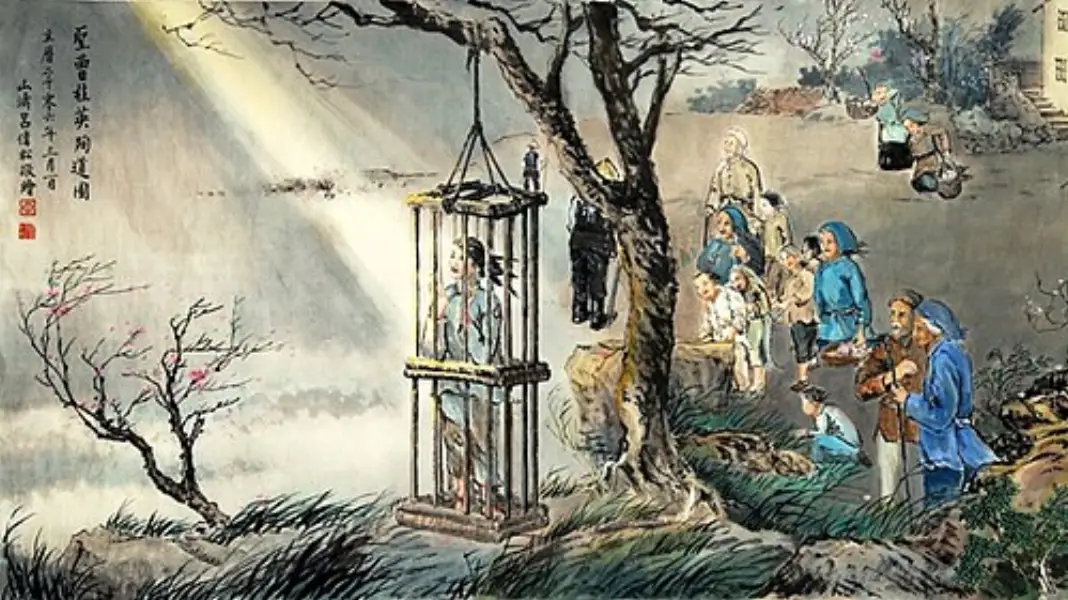
Cao Guiying was born into a Catholic household of Sichuan stock in a Guizhou village in April 1821. Orphaned young, she went to work in Xingyi, where a kindly Catholic woman took the girl in, and a visiting bishop, struck by her quick mind, arranged parish instruction for her. Marriage at eighteen brought no shelter: in-laws who despised her religion rationed her food, and when her husband died two years later she was turned out of the house altogether. A devout widow then opened her home to her, and under that example Agnes grew deep in Scripture and in the sacramental rhythm the visiting priests brought. Father Auguste Chapdelaine, recognizing how soundly she knew the faith, asked her to cross into Guangxi, where a few dozen scattered Catholic families waited. From Baijiazhai in Xilin County she made her teaching base, instructing believers, coaching housekeeping and cooking, minding children. In 1856 the local crackdown on Christians swept her up near Yaoshan. Offered release for renouncing her faith and threatened with torture when she would not, she stood firm, and the magistrate ordered her into a standing cage. There she prayed without ceasing until, after three days, she died on 1 March 1856.
The Complete Life
Early Life
Cao Guiying — rendered Agnes Tsao Kou Ying in the missionary romanization of her day — was born on 28 April 1821 in Wujiazhai, a small village of Guizhou province in Qing-dynasty China. Her people were Catholics of Sichuan stock, part of the old inland church that had survived a century of persecution largely without resident clergy. Both parents died while she was still a child, and she drifted to the town of Xingyi to earn her keep. There a Catholic woman gave her a room, and when a visiting bishop learned that the girl was alone in the world he placed her with the local parish so that she could be instructed. He found her intelligent and quick to learn, a judgment the rest of her short life bore out. At eighteen she was married to a local farmer, but the household never took her in: her husband's brother and sister-in-law treated the Christian bride as a stranger, cut her share of the food, and left her hungry. When her husband died about two years later she was simply put out of the house. She survived on odd jobs as a hired helper until a devout widow, a woman of unusual scriptural knowledge, opened her own home to her.
§ Introduction
Conversion and Vocation
Widowed and homeless before she was twenty-two, Agnes might have spent the rest of her life merely surviving. Instead the catastrophe freed her for the work that came to define her. Under the widow's roof she gave herself to study, learning the Scriptures and the teaching of the Church to a depth that surprised the priests who passed through the district on their rounds. Marriage had given her no protection, and she drew the conclusion that her life belonged elsewhere — with the scattered Catholic families of the hill country who had almost no one to teach them. When Father Auguste Chapdelaine, the French missionary then building up the church in Guangxi, saw how soundly she knew the faith, he entrusted her with a catechist's commission. That office the Church in China had learned to prize above almost any other, since foreign priests were few, hunted, and unable to stay long in one place. For a poor widow with no standing in village society to accept such a charge was an act of quiet courage: catechists were the first targets of every anti-Christian campaign.
§ Introduction
Mission and Ministry
Agnes crossed from Guizhou into Guangxi and settled at Baijiazhai in Xilin County, an upland district where a few dozen Catholic families were scattered among indifferent or hostile neighbours. From that village she served as the community's lay teacher and organizer. She instructed converts and children, prepared households for the sacraments whenever a priest could get through, coached the women in housekeeping and cooking, and minded the children — work that looks domestic enough on paper but was in fact the entire infrastructure of a church that met in private houses. She also kept the community in touch with Chapdelaine, whose presence in Guangxi was illegal from the moment he crossed the border. The province was in the grip of a campaign against Christians encouraged by officials who treated foreign religion as sedition in disguise; the same crackdown that killed Chapdelaine in late February 1856 closed on Agnes within days. She did all of this as a single laywoman, alone among strangers, in the last months of her life.
§ Introduction
Spirituality and Teaching
What held the whole enterprise together was prayer and Scripture. Agnes's formation had come not from a seminary but from a devout widow's household, where the Bible was read and the Church's teaching argued out over daily work, and she carried that formation into the mountains. The priests who visited her judged her knowledge of the faith exceptional for a laywoman of her station, and it was that judgment rather than any diploma that qualified her for Guangxi. Her holiness in the Church's eyes rests finally on the manner of her death: given repeated chances to walk away, she would not purchase life by denying Christ. The tradition that she prayed without pause through her last three days in the cage — aloud, so that guards and fellow prisoners could hear her — is the clearest window the documents preserve into an inner life otherwise hidden from history. The cage itself, an instrument designed to make the prisoner beg, became in her case the pulpit she had always lacked; the guards who fastened it expected cursing and heard the Our Father instead.
§ Introduction
Trial and Final Years
In 1856 the campaign against Christians reached the Xilin hills, and Agnes was arrested near Yaoshan in Guangxi and brought before the local magistrate. The terms offered were simple and explicit: renounce the Christian faith and go free; refuse, and face torture. She refused. When threats moved her no further, the magistrate ordered the punishment reserved for the obstinate — the standing cage, a wooden collar locked so that the prisoner could neither sit nor lie down, and is slowly exhausted and crushed until death follows. She was thirty-four years old. Left in the cage, she kept praying steadily; witnesses later recalled that she would not stop. After three days of this she died on 1 March 1856, two days after Chapdelaine himself had been put to death in the same province, one more casualty of the same edict. She was buried locally, and the small community she had taught at Baijiazhai kept her memory alive until the cause of the Chinese martyrs was taken up decades later.
§ Arrest and death
Canonization
Agnes was beatified by Pope Leo XIII on 27 May 1900, in the large group of Chinese martyrs recognized at the turn of the century. A hundred years later, on 1 October 2000, Pope John Paul II canonized her in Rome among the 120 Martyrs of China — Augustine Zhao Rong and companions — a company spanning the years 1648 to 1930 and made up of clergy, religious, and laypeople, Chinese and foreign alike, put to death under the Qing. Her own day of death, 1 March, stands as her feast, while the martyrs of China as a body are kept on 9 July; the Episcopal Church in the United States commemorates her on 19 February with Agatha Lin Zhao and with Lucy Yi Zhenmei, lay martyrs like herself of the same persecutions of the same persecutions. Her inclusion in that company mattered symbolically as well as numerically: of the 120, only a minority were Chinese laypeople, and fewer still were women. The canonization of 1 October 2000 was the largest single recognition of Chinese Catholic witness in history, and it was deliberately framed by John Paul II as an act of honor toward China rather than an accusation against it.
§ Introduction
Legacy
Agnes Tsao Kou Ying remains one of the small number of canonized Chinese Catholic saints — as recently as 2015 she was still counted among the very few — and one of fewer still who were laywomen and catechists rather than clergy or religious. A Catholic church at Markham in Ontario, that of St. Agnes Kouying Tsao, bears her name and serves a Chinese Catholic community in the Canadian diaspora. In China her memory belongs to the Catholic communities of Guizhou, Sichuan, and Guangxi, whose ancestors kept the faith through the persecutions of the nineteenth century chiefly through people like her: lay teachers, widows, and household catechists who held congregations together in the long intervals between a priest's visits. Because she died within days of Chapdelaine in the same campaign, she has come to stand for that hidden lay infrastructure without which the missionary church in the Chinese southwest could not have existed at all.
§ Introduction
Timeline
- 28 Apr 1821
Born in Wujiazhai, Guizhou, to a Catholic family of Sichuan origin
§ Early life
- 1852
Settles at Baijiazhai in Xilin County, Guangxi, as catechist to thirty or forty Catholic families
§ Missionary work
- 1856
Taken into custody at Yaoshan during a local crackdown; alone with Chapdelaine she stays in prison
§ Arrest and death
- 1 Mar 1856
Confined to a standing cage too small for sitting, she dies three days later, praying for mercy
§ Arrest and death
- 27 May 1900
Proclaimed blessed by Pope Leo XIII
§ Beatification and canonization
- 1 Oct 2000
Canonized a martyr-saint by Pope John Paul II
§ Beatification and canonization
In Their Own Words
God, have mercy on me; Jesus save me!
The Record
- Symbols
- Cage (instrument of her martyrdom)·Chinese laywoman's dress
- Canonization
- Beatified by Pope Leo XIII on 27 May 1900; canonized by Pope John Paul II on 1 October 2000 among the 120 Martyrs of China
Prayer
Bibliography
Show 6 sources
- ↑ "Agostino Zhao Rong (+ 1815) and 119 Companions, Martyrs in China (+ 1648 – 1930)" . Holy See. 1 October 2000.
- ↑ Lectionary Calendar, The Episcopal Church
- ↑ "},"date":{"wt":"<!--Not stated-->"},"website":{"wt":"[[Fu Jen Faculty of Theology of St. Robert Bellarmine|theology.catholic.org.tw]]"},"language":{"wt":"zh-hant"},"access-date":{"wt":"6 October 2023"}},"i":0}}]}' id="mwbw"/> "聖節婦曹桂英(雅妮)
- ↑ "Lesser Feasts and Fasts 2018" . Archived from the original on 2019-02-14.
- ↑ "Chinese Martyrs" . satucket.com . Retrieved 2021-05-07 .
- ↑ Boudreau, Evan. "Family of Faith is bringing pastor closer to his flock", The Catholic Register , January 31, 2015
Profile text adapted from the Wikipedia article, licensed CC BY-SA 4.0.
Pray with this saint every day
Save St. Agnes Tsao Kou Ying to your favorites, read the full profile, and get feast-day reminders in the Saints app.
Get the Saints AppFree on the App Store for iPhone and iPad