
died 262·Feast June 23 (Orthodox); formerly in the Catholic calendar
St. Agrippina of Mineo
Virgin Martyr, Patroness of Mineo
Overview
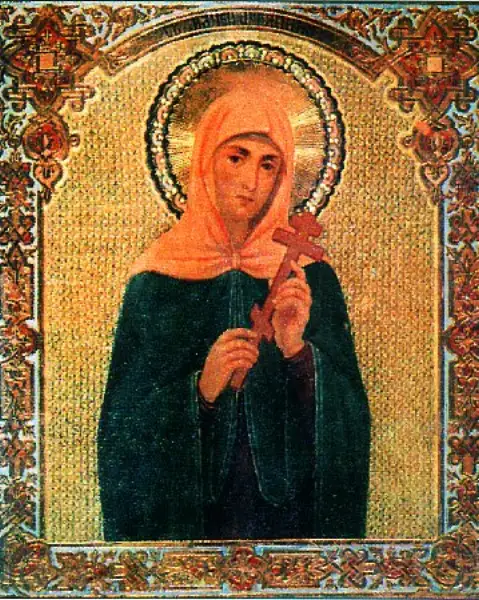
Agrippina of Mineo is a virgin martyr venerated in Sicily and, more faintly, in Greece. Her legend makes her a blonde princess of a noble Roman family, put to death for the faith under the emperor Valerian in 262 — either beheaded or scourged to death. After her martyrdom, the story continues, three devout Christian women named Bassa, Paula and Agatonica carried her body from Rome to Mineo in Sicily, their journey aided by angels. Her tomb at Mineo became a magnet for pilgrims, and the faithful called on her against evil spirits, leprosy and thunderstorms, as well as bacterial diseases and infections. Alban Butler, the great eighteenth-century hagiographer, judged the reputed acts in the Greek Menaia 'quite unreliable' and found no evidence of a cult of early date. Her feast is no longer celebrated in the Catholic Church's universal calendar, but the Orthodox Church keeps it on 23 June. Sicilian emigrants carried her cult across the oceans: her relics are said to have been translated to Constantinople, and churches under her name stand at Mineo, at Rosario in Argentina, and in Boston's North End, where immigrants from Mineo have celebrated her feast annually since 1914.
The Complete Life
A Roman Princess of the Legend
Agrippina's legend casts her as a blonde princess of noble Roman stock — the hair colour is deliberately specified, itself a mark of the romance-literature the passions borrowed from — and martyrs her during the reign of Valerian, in 262, the era of the empire's most systematic assault on the Church before Diocletian. The manner of her death is given twice over, either beheaded or scourged to death, the doubling a sign that even the communities that told the story no longer agreed on its central scene. Nothing is recorded of her family, her age, or the judge who condemned her. She belongs to the immense cohort of virgin-martyrs of the early centuries — Barbara, Lucy, Agatha and their sisters — whose tales are structured as romances of conscience: a beautiful noble girl, a refusal, a tyrant, a crown. The legend of the Roman princess martyred under Valerian was the form in which the community of Mineo received her.
§ External links
The Translation to Mineo
What gives Agrippina her place in the calendar is not her death but her journey afterwards. Three devout Christian women — Bassa, Paula and Agatonica — are said to have taken her body from Rome to Mineo in Sicily, their travels aided by angels: one of the many angel-guided translations by which the early medieval Church explained how a saint's relics came to rest where they were honoured. The theme is double. It honours the women who in fact carried the cult (the real carriers of a relic were usually the missionaries or merchants who brought it), and it asserts that the saint herself chose her resting place. At Mineo the tomb became a pilgrimage destination, and the saint took on the office that Sicilian cults love: protector of the town against its plagues — evil spirits, leprosy, thunderstorms, and in modern formulation bacterial diseases and infections. The relics were later said to have been translated again, from Sicily to Constantinople, giving her a faint second life in the Greek world.
§ Legend
Cult, Critic, and Diaspora
Alban Butler, whose Lives of the Saints set the critical standard for hagiography, said of Agrippina that the reputed acts in the Greek Menaia cannot be trusted and that proof of any early cultus is altogether wanting — a verdict as cool as any the eighteenth century ever passed. A date of 783 is nonetheless given for her canonization, meaning presumably some Byzantine or Sicilian recognition, and the Orthodox Church keeps her feast on 23 June; the Catholic Church no longer celebrates it in its universal calendar. The cult's vigour has always been local and, in the modern era, transatlantic: there are Catholic churches under her name at Mineo itself, at Rosario in Argentina, and in Boston, Massachusetts, where immigrants from Mineo have held their patronal festival in the North End every year since 1914 — one of the oldest Italian-American street feasts — with her statue carried in procession.
§ Veneration
Timeline
- 262
Martyred at Rome during the persecution of Emperor Valerian, by beheading or scourging
§ Introduction
- 783
Traditional date recorded for her canonization
§ Legend
- 1914
Emigrants from Mineo begin celebrating her feast each year in Boston's North End
§ Veneration
The Record
- Patron of
- Mineo, Sicily·Invoked against evil spirits·Leprosy·Thunderstorms·Bacterial diseases and infections
- Symbols
- Palm of martyrdom
- Canonization
- Ancient cult; the traditional date 783 is given for its confirmation
Prayer
Bibliography
Show 6 sources
- 1 2 "Saint Agrippina di Mineo", Benefit Society of Boston
- 1 2 3 Butler, Alban. Lives of the Saints
- ↑ Monks of Ramsgate. “Agrippina”. Book of Saints , 1921. CatholicSaints.Info. 13 May 2012
- 1 2 Jones, Ashley Mayrianne. "North End Celebrates Annual Feast of Saint Agrippina", BU Today . Boston University, July 31, 2015
- 1 2 "St. Agrippina, Martyr, of Rome", Antiochian Christian Orthodox Archdiocese of North America
- ↑ Ferraiuolo, Augusto. Religious Festive Practices in Boston's North End , SUNY Press, 2012, p. 132 ISBN 9781438428147
Profile text adapted from the Wikipedia article, licensed CC BY-SA 4.0.
Pray with this saint every day
Save St. Agrippina of Mineo to your favorites, read the full profile, and get feast-day reminders in the Saints app.
Get the Saints AppFree on the App Store for iPhone and iPad