
died 687·Feast September 15
St. Aichardus
Benedictine Abbot of Jumièges
Overview
Aichardus, also Achard, Achart, Aicard, or Aichard, was a Frankish Benedictine monk and abbot of the seventh century, known for his austerity, who died in 687 at Jumièges. Born at Poitiers, the son of an eminent military officer at the court and in the armies of King Chlothar II, he was given a monastic education and destined by his father for the sword; his mother Ermina, distinguished by her devotion, intervened, and he was permitted to take the habit at the abbey of Saint-Jouin-de-Marnes in Poitou, where he spent thirty-nine years. When Saint Philibert founded a dependent Benedictine monastery at Quinçay he appointed Aichardus its prior; and when Philibert died at Jumièges, Aichardus succeeded him as abbot of that great house, which counted nine hundred monks under his government. He is remembered as a model of prayer, austerity, and observance of the Rule, and, at his own request, died upon a couch of sackcloth and ashes. His dying discourse to his monks, preserved in the old collections, closes with a celebrated teaching on brotherly charity as the soul of all true religion.
The Complete Life
Early Life
Aichardus was born at Poitiers into a family of the prime nobility of Poitou. His father, whom Butler names Auschair, held high command in the court and army of King Chlothar II, the Merovingian who reunited the Frankish realms; his mother, Ermina, was distinguished for her birth, her riches, and, in the sources' phrase, a tender devotion. The boy received the education the age offered a son of such a house, and it happened to be a monastic one, for the schools that mattered in seventh-century Gaul were the abbey schools; Poitiers itself, with its memories of Radegund and Fortunatus, was one of the religious centers of the West. The plan for his future was military, following his father's career at court, and the father pressed it; the mother, whose piety the hagiographers set against the father's ambition, intervened, and the son's own wish for God prevailed. The compromise of such households was the cloister, and Aichardus took the monastic habit at the abbey of Saint-Jouin-de-Marnes, on the Thouet in Poitou, one of the oldest monasteries of Gaul.
§ Butler's account
Thirty-nine Years at Saint-Jouin
The number the tradition preserves is the length of the stay: thirty-nine years at Saint-Jouin. It is the biographical center of Aichardus's life, and it is a silence; nothing is narrated of those decades except the thing implied by their end, that a monk formed over two generations in one house, under one Rule, in prayer, manual work, and the offices, becomes the material that other founders ask for. The pull of the age was toward the new monastic colonization of the Merovingian countryside, and in his last years at Saint-Jouin it reached him: Saint Philibert, the aristocratic founder-abbot then building Jumièges into one of the great houses of the north, established a dependent monastery at Quinçay, near Poitiers, and appointed Aichardus its prior. The office made him, for the first time in the record, a builder and governor rather than a subject. From Quinçay the road ran onward to the Seine: when Philibert died, in the exile and turmoil that the politics of the age visited on abbots as on kings, the monks of Jumièges received Aichardus as his successor.
§ History
Abbot of Jumièges
Jumièges in the later seventh century was among the greatest monasteries of the Frankish world, founded by Philibert on a bend of the Seine downstream of Rouen, endowed royally, and famous for its discipline. The community Aichardus governed is counted in the sources at nine hundred monks, a figure that, whatever its exactness, belongs to the scale of the age's greatest houses. The Ramsgate Book of Saints describes his whole life as one of prayer, austerity, and faithful observance of the Rule, and Donnelly's Short Lives adds the interpretation the numbers invite: the discipline and fervor of the great community were matched only by the warmth of the charity that bound its members together. Government of such a house was itself an asceticism, and the abbot who held it while keeping his own austerities intact earned the memory the tradition gave him. His death, in 687, was arranged, the accounts say, at his own request: he asked to be laid on sackcloth and ashes, and there, in the posture of the penitent rather than the prelate, he died and spoke his last instruction.
§ Sources
The Last Discourse
The dying discourse of Aichardus has kept his name alive in the literature of monastic spirituality. Lying on the sackcloth, before the nine hundred he had governed, he closed his instruction with the words quoted above this page, preserved in Latin by the old collectors and translated by Donnelly: all the yoke of penitence, all the austerities of a lifetime in the cloister, are nothing without love for one another; even a martyr's death, without that love, would win no acceptance with God; and the love of the brothers is the soul of all true religion. The teaching is Benedictine to the root, the Rule's own insistence that the tools of God's service are handled in charity, raised here to a first principle; and it comes with a peculiar force from a man remembered chiefly for austerity, as if the tradition wished to set his fasts inside his love rather than beside them. The passage was excerpted for centuries in devotional collections precisely because it diagnosed the standing temptation of the ascetic life, the substitution of severity for charity.
§ Sources
Veneration
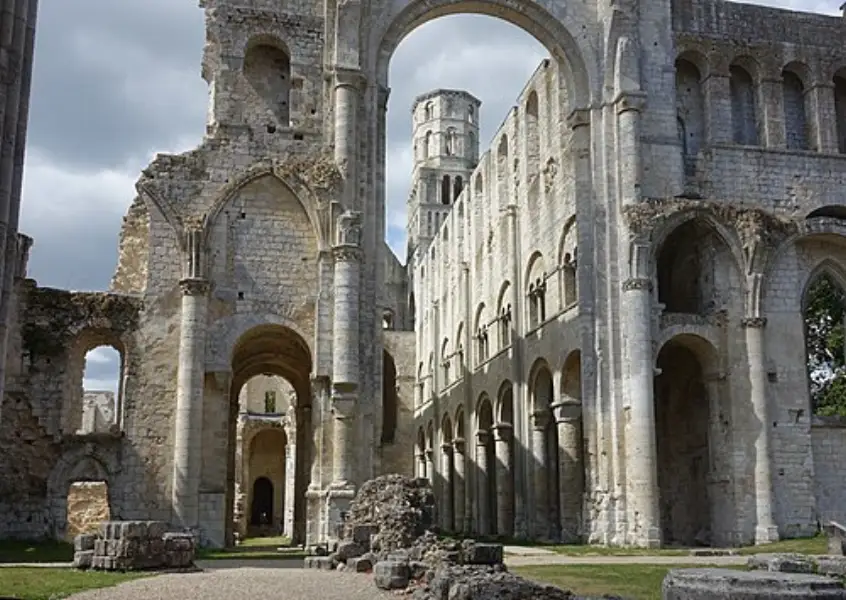
Aichardus is honored as a saint by pre-congregation tradition, with his feast on 15 September, and his memory is tied to two of Normandy's and Poitou's great monastic sites, Jumièges and Saint-Jouin. Jumièges, ruined since the French Revolution and now among the most beautiful of European ruins, preserves his name in its line of abbots; his emblem in the iconographic handbooks, an angel touching monks with a staff, seems to descend from a vision legend attached to his communities rather than from his acts. Butler's account, the fullest of the old lives, sets him in the proper company of the seventh-century reform, and the modern Book of Saints carries the summary. His attraction for the modern reader lies in the shape of the life: a man who spent thirty-nine years in one obscure obedience before he was given anything to govern, and whose last recorded act was to refuse even a mattress to die on.
§ Butler's account
In Their Own Words
Vainly will you have borne the yoke of penitence and grown old in the austere practices of the cloister if you love not one another. Without such love martyrdom itself would not render you acceptable in the sight of God. Brotherly charity is the soul of all true religion.
The Record
- Patron of
- Monks·Abbots·Those who renounce a military career for religion
- Symbols
- Angel touching monks with a staff·Abbot's crozier·Sackcloth and ashes
- Canonization
- Pre-congregation (ancient cult)
Prayer
Bibliography
Show 7 sources
- 1 2 Saint Aichardus ... CatholicSaints.info .
- ↑ St. Aichardus - Saints & Angels .
- ↑ St. Augustine's Abbey, Ramsgate 1921 , p. 10.
- ↑ Donnelly 1910 , p. 289.
- ↑ Butler 1833 , pp. 447–448.
- ↑ Butler 1833 , p. 448.
- ↑ Butler 1833 , pp. 448–449.
Profile text adapted from the Wikipedia article, licensed CC BY-SA 4.0.
Pray with this saint every day
Save St. Aichardus to your favorites, read the full profile, and get feast-day reminders in the Saints app.
Get the Saints AppFree on the App Store for iPhone and iPad