
c. 590-651·Feast August 31 (also 9 June in Lutheran calendars)
St. Aidan of Lindisfarne
Bishop and Apostle of Northumbria
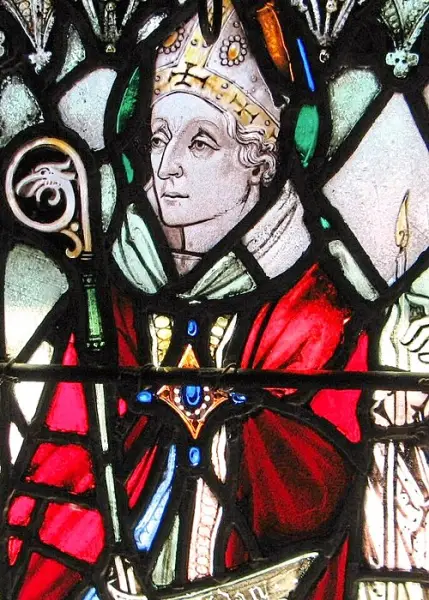
Overview
Aidan of Lindisfarne — in Irish, Aedan, 'little fiery one' — an Irish monk and missionary who died on 31 August 651, is credited with the conversion of the Anglo-Saxon people of Northumbria. A monk of Iona, the monastery Columba had founded, from relatively young age — and by Catholic tradition a disciple of Saint Senan on Inis Cathaigh — he was known for strict asceticism. When Oswald, the exiled Northumbrian prince raised at Iona, gained his kingdom's crown in 634, he asked Iona rather than the Roman-sponsored churches of southern England for missionaries. The first bishop sent, Cormac, failed by harshness and returned reporting the Northumbrians too stubborn to convert; Aidan criticized his methods and was sent in his place, becoming bishop in 635. He made his episcopal seat on the island of Lindisfarne, near the royal fortress at Bamburgh, and from it walked ceaselessly through the countryside, talking with rich and poor, instructing the children of the nobility, redeeming slaves — the ransom money given him he spent on freeing them, and made disciples of the freed. Bede's Ecclesiastical History, the source for nearly everything known of him, records his manner of life in loving detail.
The Complete Life
Early Life
Bede says virtually nothing of Aidan's early life, beyond that he was Irish and a monk of Iona from relatively young age; Catholic tradition adds a discipleship under Saint Senan on Inis Cathaigh. The name Aidan is the anglicized form of the Old Irish Aedan, 'little fiery one'. Possibly born in Connacht, he belonged to the Irish church of Columba's foundation, the Celtic branch of Christianity whose customs — the Easter date above all — would later collide with Rome at Whitby, fifteen years after his death. He was known in his own community for strict asceticism.
§ Biography
Sent to Northumbria
His opportunity came through politics. Oswald, a Northumbrian prince, had been raised in exile at Iona since 616, baptized a Christian, and vowed to bring the faith to his people; when he won the crown of Northumbria in 634, he requested missionaries from Iona rather than from the Roman-sponsored monasteries of southern England. Iona first sent Cormac, who alienated many by his harshness and returned reporting the Northumbrians too stubborn to be converted. Aidan criticized Corman's methods and was sent in his place; he became bishop in 635. Allying himself with the pious king, he fixed the seat of his diocese at Lindisfarne, near the royal fortress of Bamburgh — an island see, like Iona, governed by the tide.
§ Background
The Walking Bishop
Aidan's method was the apostolic one, as Bede describes it: he walked from village to the next, on foot and never on horseback unless compelled, courteously speaking with all he met, giving them at first the gentle milk of doctrine so that step by step they could rise to the deeper precepts. He took an active interest in the lives and communities he entered; he gave room, board and education to orphans; and any money the rich gave him went either to the poor or to ransoming those wrongfully sold as slaves — many of whom he then made his disciples, training them for the priesthood. King Oswald, whose Irish was perfect from exile, often translated for Aidan and his monks until they learned English. When invited to eat with the king, he made haste to be gone to read or write; he never gave money to the powerful, only meat, and following his example many religious of both sexes took up the Wednesday and Friday fast that lasted until the ninth hour. He built churches, monasteries and schools throughout Northumbria, and won the respect of Pope Honorius I and Felix of Dunwich despite belonging to the Irish branch of the church.
§ Missionary efforts
Final Years and the Fire of Bamburgh
After Oswald's death in 642, King Oswine of Deira gave Aidan the same steady support, and the two became close friends. The famous episode of his last years: the Mercian army under Penda ravaged Northumbria and tried to burn the royal city of Bamburgh, piling timber and thatch against the walls and setting fire when the wind favored. Aidan, on the isle of Fame two miles off, saw the flames, and lifting eyes and hands to heaven cried with tears, 'Lord, see what wickedness Penda is working!' — and the wind veered, driving the fire back on those who kindled it. Eleven days later he died, on 31 August 651, at Bamburgh, leaning against the buttress of the church whose timber he had begged from the king for the poor.
§ Missionary efforts
Veneration
Aidan was buried at Lindisfarne, beneath the abbey he had helped found. His cult after the age of Bede was thin — in the eleventh century Glastonbury monks obtained supposed relics of him, through whose influence his feast appears in the early Wessex calendars — but his standing never depended on cult. He is honored on 31 August by the Catholic Church, the Orthodox and the Anglican Communion, and on 9 June in Lutheran calendars, and proposals have been made to name him patron saint of the whole United Kingdom — Irish, Scottish and English in one life.
§ Introduction
Legacy
Aidan is the deepest single root of Christianity in northern England. From Lindisfarne came Cuthbert, Wilfrid's rivals and the monks who made the Lindisfarne Gospels; from his schools came the priests of the Northumbrian church; and from his manner — walking, gentle, poor — came the ideal that Bede held up to the bishops of his own day. The statue of him beside the ruined priory on Lindisfarne, torch in hand, keeps the picture Bede drew: the fiery little monk who converted a kingdom by being kind in it.
§ Missionary efforts
Timeline
- 590
Born in Ireland; by tradition a disciple of Saint Senan on Inis Cathaigh in his early years
§ Introduction
- 635
Sent from Iona to replace the failed bishop Corman; became bishop and made Lindisfarne his see
§ Background
- 642
King Oswald died, and Aidan's mission continued with the support of King Oswine of Deira
§ Missionary efforts
- 651
Penda's Mercian army ravaged Northumbria; his prayer is credited with turning the fire from Bamburgh
§ Missionary efforts
- 31 Aug 651
Died, and was buried at Lindisfarne beneath the abbey he had helped found
§ Introduction
In Their Own Words
Behold, Lord, how great evil is wrought by Penda!
Is the foal of a mare more valuable in your eyes than the Son of God?
The Record
- Major works
- Founded the monastery and see of Lindisfarne·Founded churches, monasteries and schools throughout Northumbria
- Patron of
- Northumbria·Firefighters (by the Bamburgh miracle, popularly)
- Symbols
- Monk with a flaming torch·Stag (attribute in art)·Lindisfarne
- Canonization
- Pre-congregation; recognized by the Catholic Church, Eastern Orthodox Church, Anglican Communion and others
Prayer
Bibliography
Show 1 sources
- ↑ Aidan is the anglicised form of the original Old Irish Áedán .
Profile text adapted from the Wikipedia article, licensed CC BY-SA 4.0.
Pray with this saint every day
Save St. Aidan of Lindisfarne to your favorites, read the full profile, and get feast-day reminders in the Saints app.
Get the Saints AppFree on the App Store for iPhone and iPad