
c. 358–453·Feast November 17
St. Aignan of Orléans
Bishop of Orléans, Defender of the City against Attila
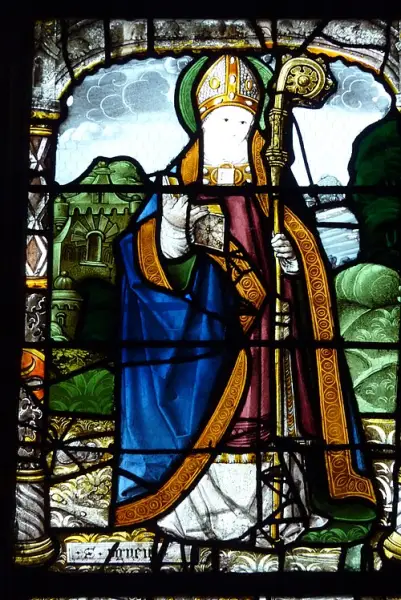
Overview
Aignan, Latin Anianus, born about 358 at Vienne in the Dauphiné to a family of Roman origin that had fled the Arian Goths, was seventh Bishop of Orléans and the hero of its deliverance from Attila in 451. A young hermit near Vienne, he went to Orléans to study under Bishop Euvertius, was ordained, and made abbot of the monastery of Saint-Laurence-des-Orgeries outside the walls; he then served as Euvertius's coadjutor and succeeded him. On his installation the city customarily released its prisoners; when the governor Agrippinus refused despite the bishop's plea, he fell ill and promptly set them free. When Attila's hordes crossed the Rhine in 451 and turned toward Orléans, the aged bishop organized the defences, mounted the walls in prayer, and traveled to Arles to beg the Roman general Aetius to intervene; the city held until relief came, and the Huns were destroyed on the Catalaunian plains. Aignan died about 453 at about ninety-five, and was buried at his old monastery, whence his relics were translated to the church that became the abbey of Saint-Aignan; part was burned by the Huguenots in 1562, and what remains lies in a carved wooden shrine there. His feast is 17 November, and he is the patron of the city and diocese of Orléans.
The Complete Life
From Vienne to Orléans
Aignan was born about 358 at Vienne on the Isère, into a family probably of Roman stock that had fled, in its homeland, from the rule of the Arian Goths — refugees, that is, from the first of the Germanic kingdoms, and on that account loyal to Nicene Catholicism with the fervor of exiles. His brother Leonianus also became an abbot; the Gallican martyrology commemorates him on 16 November, the day before Aignan's own feast. As a young man Aignan built himself a hermitage near Vienne to live in prayer and penance — the standard beginning of a Gallic episcopal saint's life, since the fifth-century Church drew its bishops disproportionately from the ascetic minority. He then went north to Orléans to study under Bishop Euvertius, prepared for the priesthood under his guidance, and once ordained was named abbot of the monastery of Saint-Laurence-des-Orgeries outside the city walls. Euvertius later promoted him to coadjutor bishop, and on Euvertius's death Aignan became the seventh bishop of Orléans.
§ Life
Bishop of Orléans
One story is told of Aignan's installation which sets the tone of his episcopate. It was customary, when a new bishop entered his city, for prisoners to be released in his honour; the governor Agrippinus refused, despite the bishop's request — and immediately fell ill, whereupon he set the prisoners at liberty. The tale is hagiographic in form, but the practice it assumes is real: the late Roman bishop had become the recognized intercessor for his city's poor and condemned, the one man whose request a governor ignored at his reported peril. Aignan governed Orléans through the middle decades of the fifth century, the decades in which the imperial government in Gaul collapsed, and the office of bishop quietly took over the functions — charity, diplomacy, defence — that the state could no longer perform. He was already old when the test came. By Aignan's day the bishop was already becoming the effective magistrate of the Gallic city, and his office its last defence.
§ Life
Attila at the Gates
In 451 Attila crossed the Rhine with his confederate hordes and devastated Gaul, passing by Paris; Orléans, on the Loire, was his next objective and the key to the south. Aignan, though advanced in age, did everything a bishop and a citizen could do. He helped the populace prepare the city's defence; he went up onto the walls and prayed above the fighting — the image his iconography fixed forever, a bishop praying on top of the walls of Orléans; and he traveled in person to Arles to ask the Roman general Flavius Aetius to intervene. Aetius came. The tradition makes the city's fall imminent — some accounts have the Huns already within the gates — when the relief arrived; Attila withdrew, and was destroyed with his allies on the Catalaunian plains. Aignan did not long survive his victory: he died about 453, aged about ninety-five, and was buried at Saint-Laurence-des-Orgeries, of which he had been abbot.
§ Siege of Orléans
Cult and Shrine
Aignan's relics were afterwards translated from the grave where he was first laid to the church of Saint-Pierre-aux-Bœufs, a monastery that took his name and became the church, and afterwards the abbey, of Saint-Aignan — the shrine around which a whole quarter of Orléans grew. The cult is pre-congregational: the city that attributed its survival to him simply kept his feast, on 17 November, and made him patron of the city and diocese. His memory was refreshed by history's rhyme: a thousand years later Orléans would again be besieged and again delivered, with a maiden rather than a bishop on its walls, and the two deliverances — Aignan against Attila, Joan against the English — are paired in the city's self-understanding. Part of his relics was destroyed by the Huguenots in 1562; what survived is kept today in a carved wooden shrine inside Saint-Aignan's church, and stained glass of the bishop at prayer keeps his emblem in the churches of the region, as at Chartres.
§ Life
Timeline
- 358
Born at Vienne in the Dauphiné to a family of probably Roman origin that had fled the Arian Goths.
§ Life
- 451
With Attila besieging Orléans, organized the city's defense and travelled to Arles to persuade Aetius to intervene.
§ Siege of Orléans
- 14 Jun 451
Attila's final assault on Orléans was broken by the approach of the Roman relief army.
§ Siege of Orléans
- 453
Died at Orléans aged about ninety-five and was first laid to rest in his old abbey church of Saint Laurence.
§ Life
- 587
By this date a basilica with a shrine to Anianus stood at Orléans, recorded by Gregory of Tours.
§ Veneration
- 1070
A monk of the abbey compiled the Miracula sancti Aniani, recounting wonders attributed to the saint.
§ Veneration
- 1116
Étienne de Garlande built a Saint-Aignan chapel on the Île de la Cité in Paris.
§ Legacy
- 1562
Huguenots burned some of his relics; the survivors rest in a carved wooden shrine at the church of Saint Aignan.
§ Life
The Record
- Patron of
- City and diocese of Orléans
- Symbols
- Bishop praying on top of the walls of Orléans
- Canonization
- Pre-congregation (ancient Gallic episcopal cult)
Prayer
Bibliography
Show 12 sources
- ↑ Catholic Online: Anianus
- 1 2 Baring-Gould, Sabine. The Lives of the Saints United Kingdom, J. Hodges., 1877. p. 378
- 1 2 Monks of Ramsgate. "Anianus". Book of Saints 1921. CatholicSaints.Info. 20 July 2012 This article incorporates text from this source, which is in the public domain .
- 1 2 Butler, Alban. "Saint Anian, or Agnan, Bishop of Orleans, Confessor". Lives of the Fathers, Martyrs, and Principal Saints 1866. CatholicSaints.Info. 18 November 2013 This article incorporates text from this source, which is in the publi
- ↑ François Le Maire, 1645: Histoire et antiquitéz de la ville et duché d'Orléans , chap. XVIII, ;p. 31( online version at Google books )
- ↑ Gregory of Tours, Historia Francorum , 2.6.
- 1 2 Hodgkin, Thomas. Italy and Her Invaders , Vol. II, Oxford, 1890
- ↑ Sidonius Apollinaris, vii.328-331, 339-341
- ↑ Loyen, André. "Le rôle de saint Aignan dans la défense d'Orléans", Comptes rendus des séances de l'Académie des Inscriptions et Belles-Lettres , Année 1969, vol. 113, n° 1, pp. 64-74
- ↑ Gregory of Tours, Historia Francorum , 2.7.
- ↑ Head, Thomas. "Saintly Patronage and Episcopal Authority at the Abbey of Micy", Hagiography and the Cult of Saints The Diocese of Orléans, 800–1200 Cambridge University Press, 1990, p. 21
- ↑ Head 1990 , p. 16.
Profile text adapted from the Wikipedia article, licensed CC BY-SA 4.0.
Pray with this saint every day
Save St. Aignan of Orléans to your favorites, read the full profile, and get feast-day reminders in the Saints app.
Get the Saints AppFree on the App Store for iPhone and iPad