
5th century-528·Feast September 12
St. Ailbe of Emly
Bishop, 'Patrick of Munster' (also St. Elvis in Welsh tradition)
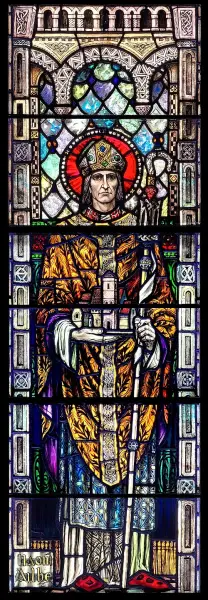
Overview
Ailbe — in Irish Ailbhe, in Latin Albeus, and in English tradition St. Elvis or Eilfyw — stands as the leading 'pre-Patrician' saint of Ireland; the death of this bishop was recorded in the early sixth century. Irish sources from the eighth century honor him as the first bishop and patron saint of Emly in Munster, and alongside others his cult won him a place among Ireland's four great patrons. The medieval Life in the Vitae Sanctorum Hiberniae tells the famous legend of his infancy: abandoned as a baby and suckled by a she-wolf, he rose from outcast beginnings to the episcopate, and in old age repaid the kindness by saving a wolf from a hunter's traps. Later Welsh sources credit him with baptizing Saint David, and very late sources give him a Welsh genealogy. Venerated in both the Roman Catholic and Eastern Orthodox churches, he is the patron of Munster and of the Archdiocese of Cashel and Emly, and — fittingly — of wolves. His feast is 12 September.
The Complete Life
Early Life and Legend
Reliable information about Ailbe's life is scant; what has come down to us is a legend of great beauty. The Life in the Vitae Sanctorum Hiberniae — the fourteenth-century Latin collection preserved in the Dublin, Oxford, and Salamanca manuscripts and edited by Charles Plummer — tells that he was born illegitimate and abandoned as an infant, and that a she-wolf found and suckled him. Discovered and raised by others, he grew into a boy of evident gifts, was educated for the church, and eventually was ordained bishop. The wolf-mother of the opening returns at the story's close, when Ailbe, meeting a hunter who has caught her, secures her release — the abandoned child remembering who fed him. Irish hagiography uses such tales as theology: the outcast is chosen, and mercy runs in both directions. Medieval readers did not ask whether the she-wolf was historical; they heard in it the story of Moses in the bulrushes and of Israel's outcasts raised up by God.
§ Sources
Bishop of Emly
Irish writings of the eighth century present Ailbe as the first bishop and, later, the patron saint of Emly in Munster, and the tradition links him with the mission that is said to have come before Patrick or to have run beside it — he is the chief of Ireland's 'pre-Patrician' saints, the man whose work in the south was so complete that Patrick's own mission could be called, in Munster, the second planting. Emly in County Tipperary became the mother church of the province, the see from which the church of Munster grew, and its cathedral status lasted until the modern merger into the archdiocese of Cashel and Emly. As 'Patrick of Munster,' Ailbe stands for the southern church's own apostolic claim. Emly's later cathedral clergy kept his memory as their founder, and the see's continued prestige through the Middle Ages rested on the antiquity his name guaranteed. Devotion to him has never wholly ceased.
§ Legendary life
Mission
The mission attributed to Ailbe is the establishment of Christian order in Munster: the founding church at Emly, the ordination of clergy, and the conversion of the local kings whose patronage the Irish church needed to take root. The Lives connect him with figures such as Aengus of Munster and, in some tellings, with Palladius, the deacon sent by Rome before Patrick. Whether or not the chronology can be reconciled, the cult's meaning is plain: the church of Munster wanted an apostle of its own, apostolic in antiquity and miraculous in character, and in Ailbe it had one. His monastic foundations and his reputation as a teacher gave the southern church its own golden age, parallel to Armagh's in the north. Whatever the facts beneath the legend, the church of the south received from his name an apostolic pedigree independent of Armagh's, and Irish historians still trace the Munster network of churches to Emly's first bishop.
§ Legendary life
The Wolf and the Saint
The most remembered strand of Ailbe's legend is his relation to the wolf, and it carries a spirituality worth naming. The beast that saved him is the beast he saves; the mercy he received as a helpless infant he repays as a powerful bishop. In the medieval imagination the wolf was the emblem of all that is feared and excluded, and the story of Ailbe — baby at the she-wolf's teats, old man freeing the hunted animal — is a miniature of the Gospel's own reversals. It is fitting that his patronage extends to wolves themselves, an oddity among the calendars that reflects a genuinely Irish sense of creation's solidarity: the wild thing that fed the saint has a claim on the saint forever. It is a spirituality of memory: the saint never forgets where he came from, and neither, the story insists, does God. His memory is still honored in the calendars that carry his name.
§ Introduction
Veneration
Ailbe belongs to the pre-congregation saints of Ireland, honored from the eighth century and never canonized by process. He is venerated in the Roman Catholic Church and the Eastern Orthodox Church, and his feast on 12 September — formerly also 13 September in some places and 27 February in others — is kept in the Irish calendars. In the old reckoning he counts among Ireland's four great patrons, and the modern Archdiocese of Cashel and Emly retains him as its patron, the last institutional vestige of the see he founded. The stained glass of Alfred Child in the Honan Chapel, Cork, preserves his image for the twentieth century. The present cathedral at Emly, now a parish church, stands on the site of the monastery he founded, and his well and holy places remain in the countryside of Tipperary. Pilgrims and readers still invoke his prayers today. His cult rests on the testimony of the communities that honored him.
§ Introduction
Legacy
Ailbe's legacy divides between Ireland and Wales. In Ireland, Emly remained the premier church of Munster for a thousand years, and his name entered the Irish language itself: Ailbhe, anglicized as Elvis and Alvy, remains a living Irish name borne by thousands who know nothing of its bearer. In Wales, the eleventh-century sources that credit Ailbhe — there called Eilfyw — with baptizing the boy who became Saint David made him a father of the Welsh church too, and very late sixteenth-century texts even gave him a local Welsh genealogy. Scholars weigh these as political legend, but they testify to the reach of his name: the saint of Emly belonged, by reputation, to the whole Irish Sea world. In an age of extinction of species, a saint who feeds and frees the wolf has found a new relevance no medieval compiler could have imagined. His name is still spoken where his work was done.
§ Introduction
Timeline
- 528
Died; the Annals of Innisfallen record this year for his death
§ Legendary life
- 784
The Law of Ailbe was issued, perhaps in answer to the Law of Patrick
§ Sources
The Record
- Patron of
- Munster·The Archdiocese of Cashel and Emly·Wolves
- Symbols
- Bishop's vestments·Wolf at his side
- Canonization
- Pre-congregation; chief of Ireland's pre-Patrician saints
Prayer
Bibliography
Show 12 sources
- 1 2 3 "Saint Elvis" in Terry Breverton 's Wales: A Historical Companion , pp. 164 f. Amberley Publishing (Stroud), 2009.
- ↑ Also formerly and in some locations 13 September and 27 February. [ 1 ]
- ↑ Challoner, Richard. A Memorial of Ancient British Piety: or, a British Martyrology , p. 127 . W. Needham, 1761. Accessed 14 March 2013.
- ↑ Plummer, Charles (1968) [1910]. Vitae Sanctorum Hiberniae [ Lives of the Saints of Ireland ] (2nd ed.). Oxford: Clarendon. p. 46 ff., vol. 1.
- 1 2 Thurston, Herbert (1907). "St. Ailbe" . The Catholic Encyclopedia . New York City: Robert Appleton Company (print); New Advent (web) . Retrieved 25 August 2008 .
- ↑ Smith, William; Wace, Henry (1880). A Dictionary of Christian Biography . London: John Murray. p. 82 .
- 1 2 "History", Emly Parish .
- ↑ Plummer, Charles (1968) [1910]. Vitae Sanctorum Hiberniae. Lives of the Saints of Ireland . Vol. II (2nd ed.). Oxford: Clarendon. pp. xxviii– xxxi, 46– 64.
- ↑ Heist, W. W., ed. (1965). Vitae Sanctorum Hiberniae, ex codice olim Salmanticensi nunc Bruxellensi. (Lives of the Saints of Ireland, from the Salamanca manuscript now of Brussels) . Subsidia Hagiographica 28. Brussels: Société des Bolland
- ↑ Sharpe, Richard (1991). Medieval Irish saints' lives: an introduction to Vitae sanctorum Hiberniae . Oxford: Clarendon. ISBN 9780198215820 .
- ↑ p.19 in Ó Riain-Raedel, Dagmar (1998). "The Question of the 'Pre-Patrician' Saints of Munster" in "Early Medieval Munster. Archaeology, History and Society", ed. M.A. Monk and J. Sheehan. Cork. pp. 17–22.
- ↑ Sharpe op.cit., pp. 115-116.
Profile text adapted from the Wikipedia article, licensed CC BY-SA 4.0.
Pray with this saint every day
Save St. Ailbe of Emly to your favorites, read the full profile, and get feast-day reminders in the Saints app.
Get the Saints AppFree on the App Store for iPhone and iPad