
died 29 December 664 or 665·Feast December 29
St. Ailerán the Wise
Scholar and Lector of Clonard
Overview
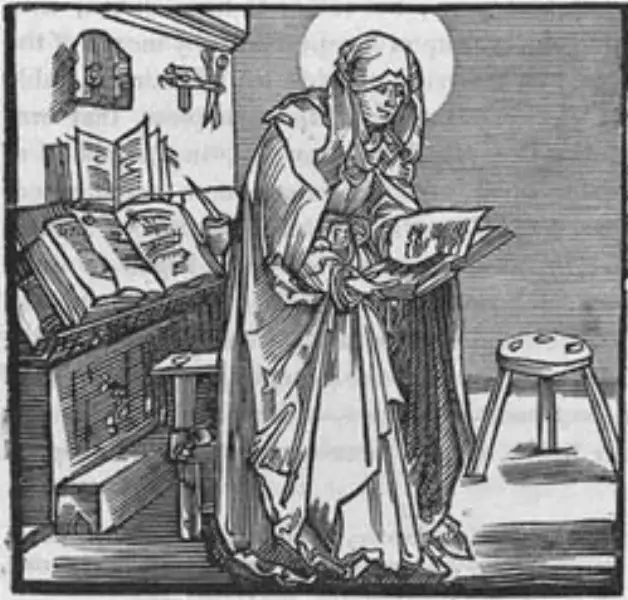
Ailerán — Ailerán Sapiens, 'the Wise' — was a seventh-century Irish scholar and saint; he died on 29 December 664 or 665, by tradition a victim of the Yellow Plague then sweeping the island. Nothing survives of his early years, but the renown of St. Finnian and his disciples drew him to the School of Clonard, and in 650 he became lector of that school, the greatest center of learning in the Ireland of its day, the university of the saints as the tradition calls it. Deeply versed in patristic literature, he knew the works of Origen, Philo, Jerome and Augustine, an armory of learning carried to the edge of the world by manuscripts copied in Irish houses. He was reckoned the most distinguished scholar of Clonard's seventh century. John Colgan attributes to him numerous works, including the Fourth Life of St. Patrick, a Latin litany, and Lives of Brigid and Féichín of Fore. His masterpiece is the Mystical Interpretation of the Ancestry of Our Lord, an allegorical exposition of the genealogy of Jesus in Matthew, which the Benedictine editors printed among the Fathers. He died as lector, in the year of the great plague.
The Complete Life
Early Life
Nothing is recorded of Ailerán's origins or family, a silence common among the Irish saints, whose lives were written for the liturgy rather than the archive. What drew him out of obscurity was a school: Clonard, the monastery in Meath founded by St. Finnian in the sixth century, had become by Ailerán's youth the most celebrated center of learning in Ireland, a place to which students came in such numbers that the tradition speaks of thousands, and from which the scholars of a whole generation went out to teach the island. He was attracted there, the sources say, by the fame of Finnian himself and of his various disciples, the great company of the saints of the second generation of Irish monasticism. In that community the curriculum was the full inheritance of Christian Latinity: the scriptures with their commentators, the Fathers, the computus, the metrical arts, and the discipline of exact copying. Ailerán proved the finest product of that training, and the epithet the tradition gave him, the Wise, was the Irish church's title for its scholars of the first rank.
§ Introduction
Vocation
In 650 Ailerán was made lector of Clonard, the office of the school's principal teacher, charged with the instruction of the monks and students in the scriptures and the Fathers. The lector in an Irish monastery of that rank stood at the center of the community's intellectual life: he read and expounded at the divine office, trained the copyists and interpreters of the manuscripts, and carried the house's tradition of learning. Ailerán's learning, the sources emphasize, was patristic: he knew Origen and Philo, Jerome and Augustine, authors whose works could reach Ireland only through the patient labor of generations of scribes, and whose presence in his citations is evidence of the extraordinary library that the Irish houses had assembled at the far end of Europe. His vocation was thus the scholarly one in its monastic form, the sanctification of the intellect, and his sanctity was understood by his church to consist precisely in that: the Wise is a saint's title in Ireland, not merely a scholar's.
§ Biography
Works
The works attributed to Ailerán by John Colgan, the seventeenth-century Franciscan who collected the Irish saints' writings, give the measure of his activity: the Fourth Life of St. Patrick, a Latin litany, and Lives of St. Brigid and St. Féichín of Fore, in other words, the historiography and devotion of the Irish church, written by its finest scholar. His masterpiece survives: the Mystical Interpretation of the Ancestry of Our Lord Jesus Christ according to the Genealogy in Saint Matthew, an exposition that reads every name in Christ's genealogy as a figure of the mysteries of faith, in the tradition of allegorical exegesis that ran from Origen through Gregory. The Benedictine editors of the Fathers printed it in their great collection, admitting, in a phrase the tradition loves, that though Ailerán was no Benedictine, he unfolded the meaning of holy Scripture with such learning and ingenuity that anyone who studied the sacred volume would welcome its publication. A Short Moral Explanation of the Sacred Names may be a fragment of a larger work.
§ Works
Final Years
Ailerán died on 29 December, in 664 or 665, of the Yellow Plague, the pandemic that swept Ireland and Britain in the 660s and carried off so many of the monks that the annals read like a casualty list. His death is recorded in the Annals of Ulster, the chroniclers of the northern half of Ireland noting the passing of the scholar as an event of the first importance, which tells us how his contemporaries ranked him. He died in office, as lector of Clonard, having taught through the years in which the Irish church, in the aftermath of the Easter controversy's early rounds and the spread of its missions to Britain and the continent, had great need of exactly the kind of learned, patient exposition at which he excelled. His grave is not certainly known; his memory was kept where his works were read, in the schools of Ireland and in the libraries of the continent, whither the manuscripts traveled.
§ Introduction
Canonization
Ailerán belongs to the vast pre-congregation company of the Irish saints, canonized by the consensus of the churches that read his works and kept his feast. His cult is attested in the Irish calendars, principally at Clonard and in the houses descended from its tradition, and his feast on 29 December has been kept in the Irish observance since the early middle ages. The publication of his great work among the Fathers by the Maurists gave him, in effect, a European canonization, placing an Irish scholar of the seventh century in the company of the doctors, an honor hardly matched by any other Celtic author. The modern church, which has recovered the study of the Celtic tradition, counts him among the saints of learning, and his name stands in the martyrologies as the type of the scholar-monk: the man whose sanctity was scholarship, offered without remainder.
§ Introduction
Legacy
Ailerán's legacy is the tradition of Irish Christian scholarship. He demonstrates, against any notion that the early Irish church was a church of ascetics only, that the island's monasteries sustained a fully patristic learning, at a level comparable to the best of the continental schools, and that at the very moment when learning on the continent was at its lowest ebb. His allegorical genealogy remains in print and in study, a curiosity to some, but a genuine monument of medieval exegesis to others, and the clearest single proof of what the school of Clonard could produce. He stands too for the ministry of teaching: lector, not abbot or bishop, he exercised his sanctity in the classroom and the scriptorium, and the church that honors him honors all who instruct. For Ireland, whose history would be written by monks with pens as much as by kings with swords, he is a patron of the first thing that made the island famous.
§ Introduction
Timeline
- 650
Becomes lector of the School of Clonard, drawn there by the fame of St Finnian and his disciples
§ Biography
- 29 Dec 664
Dies of the Yellow Plague on 29 December; the Annals of Ulster record his death
§ Biography
The Record
- Major works
- Mystical Interpretation of the Ancestry of Our Lord Jesus Christ·Fourth Life of Saint Patrick (attributed)·A Latin litany (attributed)·Lives of Saint Brigid and Saint Féichín (attributed)·A Short Moral Explanation of the Sacred Names
- Patron of
- Scholars and students·Theologians
- Symbols
- Book and scroll·Teacher's chair
- Canonization
- Pre-congregation; ancient Irish cult
Prayer
Bibliography
Show 7 sources
- ↑ "Saint Aileran the Wise of Clonard, December 29" .
- 1 2 Grattan-Flood, William. "St. Aileran." The Catholic Encyclopedia. Vol. 1. New York: Robert Appleton Company, 1907. 20 Sept. 2012
- ↑ "Ailerani Interpretatio Mystica Progenitorum Domini Iesu Christi" . Archived from the original on 6 April 2012.
- ↑ "Aileran" .
- ↑ Curtin, D. P. (1 June 2020). The Mystical Interpretations . Dalcassian Publishing Company. ISBN 9781960069764 .
- ↑ "Monasticism in Ireland - History of West Cork" . www.libraryireland.com .
- ↑ Ailerani Interpretatio Mystica Et Moralis Progenitorum Domini Iesu Christi . Four Courts Press. 10 August 1995. ISBN 9781851821938 – via Google Books.
Profile text adapted from the Wikipedia article, licensed CC BY-SA 4.0.
Pray with this saint every day
Save St. Ailerán the Wise to your favorites, read the full profile, and get feast-day reminders in the Saints app.
Get the Saints AppFree on the App Store for iPhone and iPad