
died between c. 209 and c. 304 (date disputed)·Feast June 22
St. Alban
Protomartyr of Britain and patron of converts
Overview
Alban is venerated as the first-recorded British Christian martyr, the protomartyr of Britain, and one of just three martyrs named in the earliest records of Roman Britain, together with Julius and Aaron. A citizen of Verulamium, the modern St Albans, he was converted by the priest he sheltered from persecution: when soldiers came to seize the fugitive cleric, Alban exchanged clothes with him and gave himself up in his guest's place. Hauled before a judge who was offering sacrifice to the pagan gods, he refused every imposed rite, confessing instead the one living Creator of everything that exists, and was scourged and condemned to death. On the way to his execution the river parted before him, his first executioner was converted and died beside him, and on the summit of a flower-covered hill the sentence was carried out, a spring rising where he had prayed for water. The date of his passion is disputed, with serious candidates ranging from 209 under Septimius Severus to the persecutions of Decius or Valerian around 251-259, and to 304 under Diocletian. His cult is attested from the fourth century, Germanus of Auxerre visited his shrine in 429, Bede told his story to all England in 731, and the abbey at St Albans remains the great monument of his memory. He is invoked for converts, refugees, and torture victims, and his feast is kept on 22 June.
The Complete Life
A Citizen of Verulamium
Almost nothing certain is known of Alban before the act that made him famous. The sparse records testify that he was a Roman citizen living in Verulamium, the prosperous town that stood where St Albans lies today, at some point around the turn of the third and fourth centuries; of his background and age the sources confess their silence. He was, by the earliest accounts, a pagan, comfortable enough in the civic religion of the empire until the persecution swept up the Christians of Britain. What kind of man he was before his conversion can only be inferred from what he did afterwards: a householder with room to shelter a stranger, a citizen with the standing to be tried and sentenced publicly, and a neighbour whose courage would persuade an executioner on a hillside. His city mattered to his story. Verulamium lay astride the Roman road network of Britannia, and the river valley below its walls gave the martyrdom its unforgettable geography, a bridge clogged with onlookers, a stream that dried at a martyr's prayer, a flowering slope above the water. The town took his name in time, and the hill of his death, Holywell Hill, still carries the memory of the spring that legend says opened at his feet.
§ Life and hagiography
The Guest in the Upper Room
Alban's conversion came through an act of ordinary hospitality with extraordinary consequences. During the persecution of the Christians, a cleric fleeing his pursuers knocked at Alban's door, and the citizen took him in and hid him for a number of days. The priest, whom later tradition called Amphibalus, a name that is simply the Latin for a cloak, gave himself to prayer and vigil without pause, and his host watched too. Alban found himself drawn into emulation of the faith and piety he saw before him, and soon he was a Christian, converted not by argument but by the sight of a man at prayer. The disguise of the story was quickly revealed: word reached the local ruler that a fugitive was being sheltered in Alban's house, and soldiers were dispatched to search it. When they came to lay hands on the priest, Alban dressed himself in his guest's cloak and garments and stepped forward to meet the soldiers as though he were the man they hunted. The gesture condensed the whole gospel into a single act, the laying down of one's life for a friend, performed with a fugitive's garment as its only vestment. It also sealed his fate, for the soldiers understood at once that they had found not a hiding priest but a standing substitute, and they marched him off to the judge.
§ Bede's account
Trial and Scourging
The judge before whom Alban was brought was, by the account Bede preserves, standing at the altar in the very act of offering sacrifices when the prisoner arrived. Told that this citizen had given himself up in a Christian's place, he erupted in fury that Alban would shelter a man who despised and blasphemed the gods, and he sentenced the substitute to undergo every punishment intended for the escaped cleric unless he submitted to the ceremonies of the old gods. Alban refused. To the demand for sacrifice he answered with the confession the abbey at St Albans still repeats in prayer: that the God he adored was the true and living Maker of all that exists. The magistrate, enraged, ordered him scourged, calculating that the lash would break the firmness of his resolve, yet the confessor bore the torment patiently, and even joyfully, and the calculation failed. Torture had been the empire's instrument for manufacturing apostasy for centuries, and here it produced the opposite effect, hardening a fresh convert into a confessor. When the judge finally grasped that no whipping would move him, he abandoned the pretence of persuasion and pronounced the sentence of death. A citizen who would not burn incense would lose his head, and the execution party set out from the town with its prisoner in their midst.
§ Bede's account
The Parted River and the Spring
The journey to execution became the setting for the wonders that fixed Alban's passion in the memory of English Christianity. Coming to a fast-flowing river, believed to be the Ver, the party found the bridge choked with a crowd of curious townspeople eager to watch the spectacle, and the crossing impossible. Burning to reach the place of his victory without delay, the saint lifted his gaze heavenward, and the stream ceased to flow, so that he and his captors crossed on the dry bed. The miracle decided one witness on the spot: the executioner cast down his sword at the saint's feet, moved by divine inspiration, praying that he might suffer with Alban or die in his place. On the flower-covered hillside five hundred paces on, the new convert thirsted with his master and prayed for water, and a spring broke from the ground at his feet. There both heads fell, Alban's and the converted executioner's, refused and accepted together; the second executioner's eyes, the legend adds, dropped to the ground with the martyr's head, so that no one could glory in the deed. Whatever history underlies these scenes, their theology is exact: grace is contagious, courage converts bystanders, and the earth itself seems to keep account of where the blood fell.
§ Bede's account
The Hill of the Holy Well
Alban's last hour was spent on a gently sloping hill, carpeted with wildflowers and overlooking a beautiful plain, which Bede judged a fittingly beautiful place to be sanctified by a martyr's blood. There the sentence was carried out, and there the story of his death immediately began to bear fruit. In later legend the severed head rolled down the slope, and a well sprang up where it came to rest, the holy well that gave Holywell Hill its name and that still lies at the bottom of the hill at St Albans. The judge, astonished by the report of the miracles, ordered the persecutions to cease and began himself to honour the saint's death, so that the martyrdom converted in a day what the sword could not: the magistrate who had sentenced a Christian ended by venerating one. The hilltop outside Verulamium became the centre of the cult, marked at first perhaps by a simple memorial over the place of execution. Whatever else empire and church did in Britain afterwards, that slope was never again simply ground. It was the place where the first British Christian had died for the name of Christ, and the English church built upon it, century after century, the great abbey that still bears his name.
§ Other legends
Honoured from the Beginning
Alban belongs to the apostolate of the unnamed and the undisputed: a pre-congregation saint whose cult is attested almost as far back as Christian memory in Britain runs. The earliest possible witness is Victricius of Rouen's De Laude Sanctorum of about 396, which names no one but praises an unnamed martyr who told rivers to draw back in his haste to die, an allusion many historians have read as a reference to Alban. By the early fifth century the cult was secure enough that Germanus of Auxerre, in Britain in 429 to combat Pelagianism, visited the martyr's tomb, prayed there in thanksgiving for his victory over the heresy, and carried away bloodstained earth from the site. Constantius of Lyons recorded the visit soon after, crediting the martyr with a calm voyage home; Gildas named Alban of Verulamium in the sixth century, and Bede gave the passion its classic English form in 731. The fundamental Passion of Alban itself survives in manuscripts traceable to the circle of Germanus at Auxerre. No pope ever canonized him because no pope needed to: the protomartyr was fixed in the calendar by the uninterrupted testimony of the churches of Britain, Gaul, and the Rhineland, which have kept his feast on 22 June from the early middle ages to the present day.
§ Sources
The Abbey, the Pilgrimage, and the Wider Cult
The abbey founded by Offa of Mercia around 793 on the site of the martyrdom grew into the premier abbey of medieval England; sacked by the Danes around 890, rebuilt by the Normans from 1077, and dissolved in 1539, its church rose again in 1877 as the cathedral of the new Diocese of St Albans. Its cult spread across the Channel early and widely: Cologne's church of St Pantaleon received relics said to be the martyr's from Empress Theophanu around 984, Mainz, Basel, and the Alpine valleys kept his feast, and a thigh bone reached Farnborough Abbey in the 1950s. In 2002 Cologne returned a shoulder blade to the restored thirteenth-century shrine in the cathedral. Each 22 June the Church of England keeps his Lesser Festival, venerated across the Anglican, Roman Catholic, and Orthodox communions, and honoured in the Fellowship of Saint Alban and Saint Sergius, named partly for him. Each summer the cathedral stages the Alban Pilgrimage on the weekend nearest his feast, with giant puppets re-enacting the martyrdom through the streets of the modern city. Churches from Copenhagen to Washington keep his name, and converts, refugees, and torture victims claim him as patron.
§ Veneration
Timeline
- 304
Alban is beheaded on a hill outside Verulamium after sheltering a fleeing priest; the true date is disputed, with 209 and c. 251 also argued
§ Bede's account
- 396
Victricius of Rouen writes De Laude Sanctorum, which many historians read as the earliest surviving allusion to the British martyr
§ Sources
- 429
Germanus of Auxerre visits Alban's shrine during his mission against Pelagianism in Britain
§ Life and hagiography
- 480
Constantius of Lyons composes the Vita Germani, recording Germanus's visit to the martyr's tomb and crediting Alban with a calm voyage home
§ Sources
- 570
Gildas names the martyr Alban of Verulamium in his account of the British persecution
§ Sources
- 731
Bede publishes his full account of the passion in the Ecclesiastical History of the English People
§ Bede's account
- 793
Offa of Mercia establishes a Benedictine abbey and monastery at the site of the martyrdom
§ Cult
- 890
The abbey founded by Offa is probably sacked and destroyed by the Danes
§ Cult
- 984
Relics honoured as Alban's are brought from Rome by Empress Theophanu and placed in the church of St Pantaleon at Cologne
§ On continental Europe
- 1077
The Normans begin rebuilding the abbey church at St Albans
§ Cult
- 1539
St Albans Abbey is dissolved under Henry VIII
§ Cult
- 1877
The former abbey church becomes the cathedral of the newly established Diocese of St Albans
§ Cult
- 2002
Cologne's church of St Pantaleon gives St Albans Cathedral a shoulder blade venerated as the martyr's bone
§ Cult
In Their Own Words
I worship and adore the true and living God who created all things.
Their own merits and the intercession of Alban the Martyr secured for them a calm voyage; and a good ship brought them back in peace to their expectant people.
The Record
- Patron of
- converts·refugees·torture victims
- Symbols
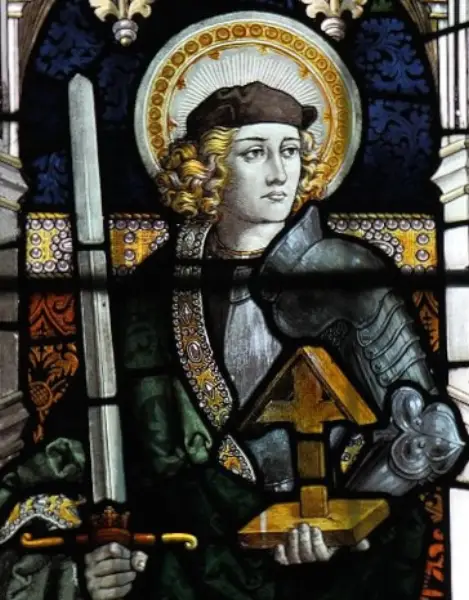
- soldier bearing a very large cross and a sword·head resting in a holly bush·executioner's eyes falling to the ground
- Canonization
- Pre-congregation; venerated as the first-recorded British Christian martyr since ancient times
Prayer
Bibliography
Show 8 sources
- "Saint Alban, Protomartyr of Britain". www.oca.org. Retrieved 16 July 2025.
- Bede. "Ecclesiastical History of the English People". Internet History Sourcebook. Fordham University. Retrieved 3 November 2013.
- Clark, Gillian (1999). "Victricius of Rouen: Praising the Saints". Journal of Early Christian Studies. 7 (3): 383.
- Morris, John (1968). "The Date of Saint Alban". Hertfordshire Archaeology. 1.
- Sharpe, Richard (2001). "The Late Antique Passion of St Alban". In Henig, M. and Lindley, P. (eds.), Alban and St Albans. Leeds.
- Wood, Ian (2009). "Germanus, Alban and Auxerre". Bulletin du centre d'études médiévales d'Auxerre. 13. Retrieved 19 November 2014.
- Lane Fox, Robin (1986). Pagans and Christians in the Mediterranean World from the Second Century AD to the Conversion of Constantine. London: Penguin Books. ISBN 978-0-14-102295-6.
- "Relic of St Alban returns". BBC. 29 June 2002. Retrieved 20 November 2025.
Profile text adapted from the Wikipedia article, licensed CC BY-SA 4.0.
Pray with this saint every day
Save St. Alban to your favorites, read the full profile, and get feast-day reminders in the Saints app.
Get the Saints AppFree on the App Store for iPhone and iPad