
died c. 400 (dates contested, c. 380 – c. 483)·Feast June 21
St. Alban of Mainz
Priest, Missionary, and Martyr
Overview
Alban of Mainz, Latin Albanus or Albinus, is venerated as a Catholic priest, missionary, and martyr of the late Roman period who died in or near Mainz, though no contemporary source about him survives and the accounts that do survive contradict one another in dating, geography, and events. The oldest substantial witness is the Martyrologium of Rabanus Maurus of about 845, which keeps him distinct from the English Alban of Verulamium: an Alban from Mainz who in the reign of Theodosius set out from the island of Namsia with the saints Theonestus and Ursus, came to Milan, went out into Gaul, and, after Ursus was martyred at the city called Augusta, reached Mainz with Theonestus, where, preaching the word of God, he fulfilled his martyrdom and was buried near the city. The later Passio sancti Albani, written in the 1060s by the schoolmaster Gozwin, adds that he was one of four disciples of Theonestus, fled Vandal Africa, was formed by Ambrose of Milan, and was beheaded at Mainz by Arians while preaching the Trinity, afterward carrying his head in his hands to the place of his burial. Scholars date his death variously between about 380 and 483. He is invoked for hernia, epilepsy, gravel, and kidney stones.
The Complete Life
A Saint without Contemporary Sources
Honesty requires the first word to be a warning: nothing at all is known for certain about Alban of Mainz, of whom no contemporary source survives. What exists are two medieval texts and a long scholarly argument. The older is the Martyrologium of Rabanus Maurus, compiled about 845, which enters on 21 June an Alban from Moguntia, Mainz, who in the days of the emperor Theodosius went forth from the island of Namsia with the saints Theonestus and Ursus, reached Milan, passed into the provinces of Gaul, and, after Ursus met his martyrdom in the city of Augusta, came with Theonestus to Mainz, where, preaching the word of God, he fulfilled his own martyrdom and was buried near the city. Even in this sober entry the uncertainties are visible: Namsia is unidentifiable, though some equate it with Naxos; Augusta could be Trier, Augsburg, or Aosta. The name Alban itself has prompted guesses that he came from some city called Alba, or from Albania; the sources do not say.
§ Martyrologium of Rabanus
The Passio of Gozwin
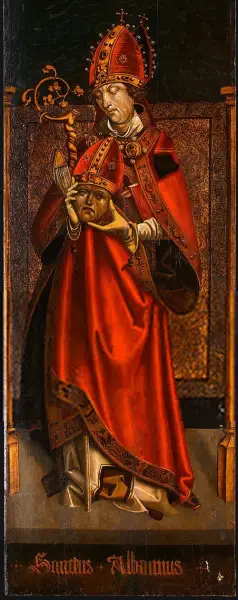
The second source, the Passio sancti Albani of the schoolmaster Gozwin, written in the 1060s or 1070s, is longer and richer, and its riches are the historian's problem. In Gozwin, Alban is one of four disciples of Theonestus, with Ursus, Tabraha, and Tabratha; the five clerics flee North Africa under the persecution of the Arian Vandal king Huneric, travel to Ambrose of Milan, who instructs them in theology and dispatches them to win back the Arians of Gaul and Germany; Ursus is killed at Augusta primae Retiae, and Alban is beheaded at Mainz by local Arians as he preached the Catholic doctrine of the Trinity, afterward, the legend concludes, carrying his head in his hands to the place he wished to be buried. The chronology is impossible, Huneric reigned eighty years after Ambrose died, and Heinz Thomas demonstrated in 1970 that the whole Passio was composed to serve the primatial claims of Siegfried I, archbishop of Mainz, against Trier, fiction in the service of jurisdiction. Yet it fixed Alban's image permanently: the cephalophore, the head-carrying saint, has been his iconography ever since.
§ Passio sancti Albani of Gozwin
Reconstructions and Confusions
Because the sources conflict, the reconstructions diverge. Watkins places his death around 400; Hirschel argued for about 483; a tenth-century vita of Theonestus implies Alban died at Mainz before 30 October 380. Papebroch, the Bollandist, concluded that Alban was killed by Arians on 21 June 404, under bishop Aureus of Mainz; Butler, surveying the older scholars, noted that Papebroch and Mabillon made him an African bishop banished by Huneric, while Ruinart and Georgi held he was not African at all, an opinion Butler shared. Schaab in 1844 had him arriving at Mainz in 404 and beheaded at the Gartenfeld. Alongside the scholarly argument runs the popular confusion with the other Albans: the English Alban of Verulamium, killed about 300 and likewise depicted with his head in his hands, with whom Thomas More and Thierry Ruinart still muddled him; Alban of Rome or Cologne; Alban of Silenen; Albinus of Angers; Albin of Vercelli. Rabanus, in 845, had already distinguished the Mainz and English martyrs by their feasts, 21 and 22 June.
§ Confusion with Alban of Verulamium
Cult
Whatever the history, the cult is real and old. Alban is venerated as a saint in the Roman Catholic Church, and the Eastern Orthodox calendars carry him as well; his feast is 21 June, the day fixed in Rabanus Maurus. Mainz kept his shrine and his patronage of the sick, particularly those suffering from hernia, epilepsy, gravel, and kidney stones, an inventory of afflictions characteristic of the German local cults, which assigned to their saints the ailments their region knew. A Tyrolean painting of about 1500 to 1525 shows him in the canonical form, habited and holding his severed head, the attribute he shares with the greater Alban of England and with Denis of Paris. The archbishops of Mainz, whose primatial propaganda had produced the fullest life of him, stayed the chief guardians of that cult through the later Middle Ages, and the city's calendar kept his day.
§ Introduction
Legacy
Alban of Mainz is today a case study in how saints are made and unmade by sources. His cult served the ninth century's need for a local martyr, the eleventh century's need for a jurisdictional argument, and the sick of Mainz's need for a healer; it survived all three functions and stands in the calendar still. Modern hagiography, from Butler to current scholarship, handles him with a candor that would have surprised Gozwin: a saint whose only certain facts are a name, a city, a feast, and a manner of death, surrounded by a fog of chronologically impossible narrative. The student who wants to know how the Bollandists worked, or how a political Passio is detected and dated, will find in Alban one of the classic exhibits. The sick who prayed to him for the stone and the seizure were not consulting the footnotes; and the church that keeps his feast keeps, with it, the memory of an unknown preacher who died, somehow and somewhere in Mainz, for the faith he proclaimed.
§ General
Timeline
- 325
The First Council of Nicaea condemns Arianism, the backdrop of Gozwin's later account of Alban
§ Passio sancti Albani of Gozwin
- 380
A tenth-century vita of Theonestus claims Alban was martyred at Mainz before Theonestus died near Altinum on 30 October
§ Dating
- 400
Watkins' reconstruction dates Alban's death at Mainz, killed by local Arians, to around this year
§ Dating
- 21 Jun 404
Papebroch's date: Alban beheaded by Arians while Aureus was bishop of Mainz
§ General
- 483
Hirschel's alternative dating, placing the beheading at Gartenfeld in the era of Vandal king Huneric
§ Dating
- 786
A map of Fulda of this year seems already to mention a chapel in Mainz dedicated to Alban
§ Legacy
- 804
A church and monastery are built in Mainz to honour Alban
§ Legacy
- 805
Charlemagne has the monastery, later Saint Alban's Abbey, renovated around this time
§ Legacy
- 845
Rabanus Maurus records the Mainz martyr in his Martyrologium, distinguishing him from the English Alban
§ Martyrologium of Rabanus
- 1047
Albert II, Count of Namur, founds the collegiate church of St. Alban at Namur
§ Legacy
- 1070
Gozwin writes the Passio sancti Albani in the 1060s or 1070s, serving Archbishop Siegfried's primatial claims
§ Passio sancti Albani of Gozwin
- 1557
The monastery of Saint Alban's Abbey is devastated and never renewed
§ Legacy
- 1559
The new Diocese of Namur expands the collegiate church into St Aubin's Cathedral, which claims his relics
§ Legacy
The Record
- Patron of
- Hernia sufferers·Epilepsy·Gravel and kidney stones
- Symbols
- Holding his head in his hands (beheaded)
- Canonization
- Pre-congregation (ancient cult at Mainz)
Prayer
Bibliography
Show 1 sources
- ↑ XI KAL. In Moguntia natalis Albani martyris, qui sub Theodosio imperatore de insula Namsia pergens cum sancto Theonesto et Urso Mediolanum venit, indeque exiens, auxiliante Domino, pervenit ad Gallias, et in servitio Dei manens ad martyri
Profile text adapted from the Wikipedia article, licensed CC BY-SA 4.0.
Pray with this saint every day
Save St. Alban of Mainz to your favorites, read the full profile, and get feast-day reminders in the Saints app.
Get the Saints AppFree on the App Store for iPhone and iPad