
1583-1642·Feast January 21 (also October 25 with the Forty Martyrs)
St. Alban Roe
Benedictine Priest and Martyr
Overview
Alban Roe, born Bartholomew Roe at Bury St. Edmunds in Suffolk on 20 July 1583 and brought up a Protestant, became a Benedictine monk and was executed at Tyburn on 21 January 1642 for the crime of priestly ministry in England. The story of how he came to the faith was a strange one: an attempt to talk a jailed Catholic over to Protestantism backfired when he lost the debate, and the disquiet this stirred in him ended at last in his becoming a Catholic. He entered the English College at Douai in 1607, was expelled in 1610 for his explosive temperament, organized an appeal that let him join the English Benedictine priory of St Laurence at Dieulouard in Lorraine in 1613, was professed in 1612 and ordained in 1615, and became a founder member of St Edmund's Priory in Paris, taking the name Alban of St Edmund. On the English mission he was arrested and deported, returned, was imprisoned until 1623, released through the Spanish ambassador Gondomar, returned again and spent seventeen years in the Fleet prison, ministering by day from his cell by night, playing cards in alehouses for penance-stakes, and making converts. Transferred to Newgate in 1641, he was tried and condemned under the 1584 statute, and hanged at Tyburn.
The Complete Life
A Suffolk Protestant
Bartholomew Roe was born at Bury St. Edmunds in Suffolk on 20 July 1583 and brought up a Protestant; with his brother James he converted to Catholicism, and both became Benedictine monks. What brought him over was a dispute he came off second best in: setting out to talk a Catholic prisoner into becoming a Protestant, he ended up out-argued, and Challoner relates that from then on Roe knew great disquiet of mind about religion until reading and talks with Catholic priests fully convinced him where he had gone wrong and moved him to embrace the ancient faith, after which he longed to pass the treasure on to those around him. In 1607 he entered the English College at Douai. His character was not typically monastic: explosive and unpredictable, given to rubbing authority the wrong way, and yet, in the judgment of the tradition, marked above all by cheerfulness and tenacity, with a sanctity that nobody who met him questioned. He was expelled from Douai in 1610 for contempt of discipline and superiors and for misleading other youths, and he did not leave quietly, organizing a campaign that a significant body of monks backed.
§ Conversion
Dieulouard and the Mission
The expelled student found his way anyway: in 1613 he joined the English Benedictine priory of Saint Laurence at Dieulouard in Lorraine, the house that continues today as Ampleforth Abbey, and there is no record of his being at all troublesome. He was professed in 1612 and ordained in 1615, and became a founder member of the new English Benedictine priory of Saint Edmund in Paris, the ancestor of today's Douai Abbey, taking the religious name Alban of St Edmund. His vocation was that of the missionary monk of a suppressed church. The dissolution of the monasteries had deprived English Benedictines of lifelong stability in community, scattering them into small groups and isolated individuals, and some became withdrawn contemplatives while others turned practical and individual, focused on the mission. Alban belonged to the second kind, and his whole subsequent life was spent in and out of English prisons, a monk whose monastery was the Fleet.
§ Conversion
Seventeen Years in the Fleet
After ordination in 1615 Roe joined the missions and worked in London, was arrested and deported soon after landing, came back in 1618, and spent the years down to 1623 in prison, until Gondomar, the Spanish ambassador, secured his freedom and a second exile. Returning two years later, he was incarcerated for seventeen years in the Fleet prison. Conditions there were relaxed enough that he could minister by day if he returned to his cell at night, and he used the liberty fully: zealous for conversions and lacking a church, he would sit in taverns dealing cards to the customers — a practice the constitutions of the English Benedictine Congregation allowed, so long as what was wagered was not money but brief prayers. Puritans were scandalized by such goings-on, yet against a man already behind bars they could do little. He also received visitors in his cell, taught them prayers, and made many converts, and Challoner notes his translation of several pious tracts into English, some printed and some left in manuscript.
§ Ministry and arrest
Trial and Tyburn
In 1641, as the political climate collapsed toward civil war, Roe was transferred to close confinement in Newgate, the strict prison from which few emerged. When he came to trial in 1642, the treason charge against him rested on the Jesuits, etc. Act of 1584, since he was a priest — the very law that made the exercise of ministry a hanging crime. Challoner tells how at first he would not enter a plea; it later came out that the key witness for the prosecution was a lapsed Catholic Roe himself had once assisted, and hoping to bring the man back to the faith he pleaded innocent, while protesting at being judged by twelve ignorant jurymen indifferent to the spilling of his blood. He was executed at Tyburn on 21 January 1642, at fifty-eight, one of the last of the Elizabethan and Stuart missionary priests to die there, and his manner at the scaffold matched his life, cheerful to the end. The oath and the scaffold could not take from him the community he had gathered in prison.
§ Trial
Canonization
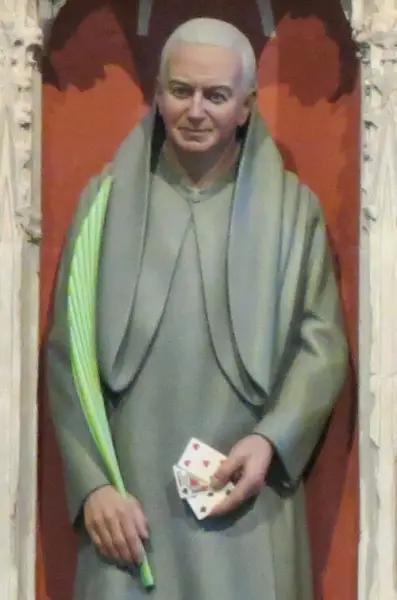
Alban Roe was beatified by Pope Pius XI on 15 December 1929 among a large group of English and Welsh martyrs, and canonized by Pope Paul VI on 25 October 1970 as one of the Forty Martyrs of England and Wales, the representative body of the hundreds killed between 1535 and 1679 for the Catholic faith. His liturgical commemoration is kept on 21 January, the day of his death, and with the Forty on 25 October. His iconography is among the most distinctive of the forty: a Benedictine holding a hand of playing cards, in memory of the alehouse ministry, with the noose and the martyr's palm. Ampleforth Abbey, the successor of his Dieulouard house, honors him in a particular way, and his trial and its records, studied by historians of the recusant period, keep the details of his temperament, the expulsions and campaigns as well as the constancy, unusually alive.
§ Introduction
Legacy
Alban Roe's legacy is the picture of sanctity that does not look the part. Expelled from seminary for indiscipline, sharp-tongued to the end of objecting to his jurors, he was yet unquestionably holy to everyone who dealt with him, and the Church canonized him without retouching the record. His card games for penance-stakes have become the standard illustration of pastoral ingenuity under persecution, and his seventeen years of ministry from the Fleet prison illustrate how the English mission actually worked in its long middle period, when priests lived semi-openly under lax warders. As one of the Forty Martyrs he belongs to the shared inheritance of English and Welsh Catholicism, and his January feast keeps a midwinter reminder of the Tyburn scaffold. The cards he holds in his images have taught generations of Catholics that the weapons of the Church can look like recreation, and that a merry man can be a martyr.
§ Introduction
Timeline
- 20 Jul 1583
Born Bartholomew Roe at Bury St. Edmunds, Suffolk, and brought up a Protestant
§ Introduction
- 1607
Enters the English College at Douai to study for the priesthood
§ Conversion
- 1610
Expelled from Douai for contempt of its discipline and superiors
§ Conversion
- 1612
Professed as a Benedictine
§ Ministry and arrest
- 1613
Joins the English Benedictine Priory of St Laurence at Dieulouard in Lorraine
§ Conversion
- 1615
Ordained a priest and joins the English mission, working in London
§ Ministry and arrest
- 1618
Returns to England and is imprisoned
§ Ministry and arrest
- 1623
Released and re-exiled through the intervention of the Spanish ambassador Gondomar
§ Ministry and arrest
- 1625
Returns again and is incarcerated for seventeen years in the Fleet prison, ministering from his cell
§ Ministry and arrest
- 1641
Transferred to close confinement in Newgate prison
§ Trial
- 1642
Convicted of treason under the 1584 statute against priests, for simply being one
§ Trial
- 21 Jan 1642
Drawn to Tyburn with Thomas Reynolds and hanged, preaching cheerfully to the crowd
§ Martyrdom
- 15 Dec 1929
Declared venerable by Pope Pius XI and beatified in Rome one week later
§ Canonisation
- 25 Oct 1970
Pope Paul VI canonizes him in Rome with the Forty Martyrs of England and Wales
§ Canonisation
In Their Own Words
There is more trouble with a few fools than with all the wise; if you pull down, I will build up; if you destroy, I will rebuild.
The Record
- Major works
- Pious tracts translated into English (some printed, some in manuscript)
- Patron of
- Ampleforth Abbey·Prisoners (by tradition)
- Symbols
- Benedictine habit·Noose around the neck·Playing cards·Heart in hand
- Canonization
- Beatified 15 December 1929 by Pope Pius XI; canonized 25 October 1970 by Pope Paul VI among the Forty Martyrs of England and Wales
Prayer
Bibliography
Show 12 sources
- ↑ "Book of Martyrs," New York: Catholic Book Publishing Co., 1948
- ↑ Benedict's Disciples, ed.D.H.Farmer, 1980, ISBN 0-85244-011-1 , p255; chapter "Three Seventeenth Century Martyrs" by Dom Geoffrey Scott of Douai Abbey.
- ↑ Blessed Alban Roe, Dom James Forbes of Ampleforth, 1960, p3.
- ↑ Scott, p246-247.
- ↑ Memoirs of Missionary Priests, Bishop Challoner, 1878, p129.
- ↑ Scott, p256.
- ↑ Scott, p256.
- ↑ Forbes p5.
- ↑ Scott, p257, and Forbes p11.
- ↑ The English Benedictine Congregation, Dom Bernard Green of Ampleforth, ISBN 0-85183-297-0 , p13
- ↑ Challoner, p132
- ↑ Bartholomew Roe, quoted in 1919 Online Catholic Encyclopaedia, www.newadvent.org/cathen/13109d.htm
Profile text adapted from the Wikipedia article, licensed CC BY-SA 4.0.
Pray with this saint every day
Save St. Alban Roe to your favorites, read the full profile, and get feast-day reminders in the Saints app.
Get the Saints AppFree on the App Store for iPhone and iPad