
1845-1916·Feast June 17
St. Albert Chmielowski
Founder of the Albertines, Painter and Servant of the Poor
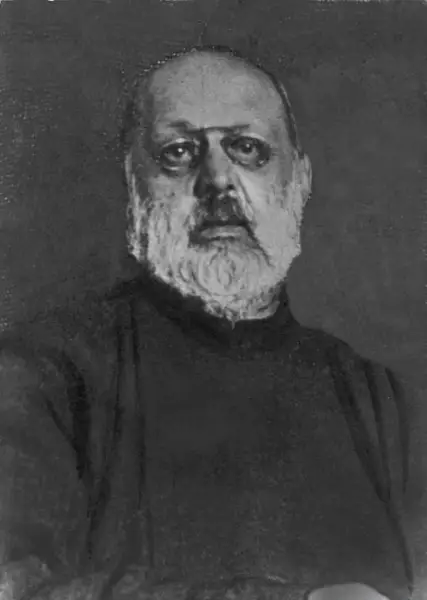
Overview
Adam Hilary Bernard Chmielowski, born 20 August 1845 at Igołomia near Kraków into a szlachta family, became a painter, a disabled veteran, a Franciscan tertiary, and finally Brother Albert, founder of the Albertine Brothers and Sisters, servants of the homeless and destitute. Orphaned young, he studied at the Puławy Polytechnic Institute before joining the January Uprising of 1863; in a battle that October a Russian grenade killed his horse and so damaged his leg that it had to be amputated — without anesthesia, at which he asked for a cigar to pass the time. Escaping captivity in a coffin, he carried a wooden leg and the Polish cause for the rest of his life. A talented painter of religious subjects and landscapes, he gradually gave up art and property, moved into a homeless shelter in Kraków, and in 1887 founded the Albertines, who combined Franciscan poverty with service to the most rejected. He died on Christmas Day 1916 and was canonized in 1989.
The Complete Life
Early Life
Adam Hilary Bernard Chmielowski was born on 20 August 1845 in Igołomia, on the outskirts of Kraków in Congress Poland, the eldest of four children of Wojciech Chmielowski and Józefa Borzysławska, a family of the landed gentry bearing the Jastrzębiec coat of arms. Because of the lack of a priest in those turbulent times, he was baptised by a layman on 26 August 1845, the formal rite following on 17 June 1847 — the date he would later keep as his feast. His father died when he was eight, his mother when he was eighteen, and the family's care fell to their aunt Petronela. After home schooling he studied agroforestry at the Puławy Polytechnic Institute, expecting to manage his late parents' estate. Poland's vanished statehood redirected him: like many young men of his generation, he came to believe that his life belonged to the national cause. The triple name he received — Adam, Hilary, Bernard — was the gift of three godfathers, a custom of the gentry, and the boy bore it through revolution, fame, and the shelter alike.
§ Life
Soldier and Painter
In 1863 Chmielowski joined the January Uprising against Russian rule. In a skirmish fought on 1 October, a Russian grenade killed the horse beneath him and shattered his leg so badly that it had to be amputated. Carried to a woodman's cabin, he was found by Finnish soldiers allied with Russia; their captain, who had heard the rumors that Chmielowski was invulnerable to gunfire, told him the leg must come off. By one account he asked for a cigar, 'Give me a cigar' — something, he said, to help him pass the time — and the operation then went ahead successfully without anesthesia. Secretly taken out of the hospital concealed in a coffin, he was in time given a wooden prosthesis, and he offered up the loss of his limb for God's sake and for the cause of an independent Poland. Painting, his other love, became his profession: he studied in Warsaw and Munich and won real regard for religious pictures and landscapes. The rumor among the Russian soldiers that he was invulnerable to gunfire was, his biographers note, disproved at the cost of his leg; the suffering he offered up instead became the seed of everything that followed.
§ Insurgent for his country
Brother to the Homeless
The turn from art to the poor came gradually, through his confessor and through his own disgust at the contrast between his success and the misery of partitioned Poland. In the mid-1880s Chmielowski gave away his possessions and moved into the municipal shelter for the homeless in Kraków, the so-called shelter at the railway station, cooking, washing, and tending the men whom the city wished to forget. In 1887 he took the grey habit of a Franciscan tertiary and founded the Congregation of the Albertine Brothers; a community of Albertine Sisters followed. Their rule joined strict poverty — the brothers owned nothing, begged their food — to permanent service among the homeless, the hungry, and the incurable. By the time of his death the Albertines ran shelters, kitchens, and asylums across Polish lands, works which continued through war and communism to the present. His reputation for sanctity grew as much from what he refused as from what he did: he refused comfortable chaplaincies, refused to distinction of the artist's life, and finally refused ownership of anything at all.
§ Introduction
Spirituality
Brother Albert's spirituality was Franciscan to the bone: poverty as solidarity, not as ascetic display. His most quoted insight is that one must be 'good as bread' — available, broken, and given — and his houses were organized around the bodily presence of Christ in the poorest guest. He kept his painting hand at the service of the same truth; among his last works is the image of Christ the Ecce Homo, beaten and blindfolded, which he gave to the shelter chapel. The one-legged veteran who had offered his amputation to God turned suffering into a program: whatever pain came, it was offered; whatever person came, he was Christ. John Paul II, who as a young man wrote a play about him called Our God's Brother, presented Albert as the answer to the social question of his century — not theory, but presence. The Ecce Homo he painted in the shelter shows the blindfolded Christ with face bruised, and Brother Albert was said to have modeled it on the faces around him.
§ Introduction
Final Years
Brother Albert spent nearly thirty years in the shelters of Kraków, and cancer of the stomach marked his final year. He died on Christmas Day 1916, aged seventy-one, in the shelter he had made famous, with the poor he served around him; the city that had once watched him paint its churches now buried a beggar-brother with universal respect. His communities carried on through the First World War, the Second, and the communist decades — at times forbidden, never dissolved — and the cause for his beatification was introduced in the 1940s on the initiative of Kraków's cardinal. At his death the poor of the city mourned him as one of their own. The information process that Cardinal Adam Stefan Sapieha opened in 1946 drew its testimony from witnesses who had eaten at his table and slept in his shelters, and the apostolic process that followed was overseen by Cardinal Karol Wojtyła himself.
§ Introduction
Canonization
Albert Chmielowski was beatified by Pope John Paul II in Kraków on 22 June 1983, during the pope's second visit to his native city, and canonized in St. Peter's Square on 12 November 1989. For John Paul II the cause had a personal depth: as a young priest and playwright in Kraków he had written Our God's Brother about the painter-turned-brother, and he would speak of Albert as one of the figures who taught him what sanctity looks like in modern times. The canonization placed in the Church's calendar a saint of the industrial era's casualties: the homeless, the crippled veteran, the man reduced to a number. He is among the few saints of whom a pope wrote a play, and John Paul II spoke of him in his homily at the canonization as a man who made the social question a question of the heart. The diocese of Sosnowiec and the town of Puławy number him among their patrons, and Polish harvests and travellers are commended to him still.
§ Introduction
Legacy
The Albertine Brothers and the Albertine Sisters (Servants of the Poor) serve today in Poland and beyond, running shelters, hospices, and works for the poorest, still in grey habits and still without property. Albert's own paintings hang in Polish museums and churches, a career interrupted by charity, and the Ecce Homo he painted for the shelter has become an icon of Polish devotion. He is the patron of painters and of the Diocese of Sosnowiec, and his feast on 17 June — the date of his formal baptism — keeps the anniversary of a life that ended on Christmas morning among the poor. Every shelter opened by an Albertine community since 1916 stands in the line of the converted painter who decided that a picture of Christ was worth less than a meal for Christ. His remains, twice exhumed, were laid to rest in 1949 in a Discalced Carmelite church in Kraków — the order whose books, John of the Cross above all, he had loved best — and in 1938 Poland decorated him with the Order of Polonia Restituta.
§ Introduction
Timeline
- 20 Aug 1845
Born at Igołomia on the outskirts of Kraków, eldest of four children
§ Introduction
- 26 Aug 1845
Baptised by a layman six days after his birth, no priest being available
§ Life
- 17 Jun 1847
Received a formal church baptism
§ Life
- 1853
Left fatherless at the age of eight
§ Life
- 1859
Lost his mother as well; their paternal aunt Petronela took charge of the family
§ Life
- 1 Oct 1863
Wounded in a battle of the January Uprising; his shattered leg was amputated without anesthesia
§ Insurgent for his country
- 1870
Enrolled at the Munich Art Academy, where he befriended leading Polish painters
§ Painting interlude
- 24 Sep 1880
Entered the Jesuit novitiate at Stara Wies but soon withdrew, judging that path not his
§ Religious vocation
- 25 Aug 1887
Joined the Third Order of Saint Francis and took the religious name Albert
§ Religious vocation
- 25 Aug 1888
Made perpetual vows and founded the Servants of the Poor for the homeless
§ Religious vocation
- 15 Jan 1891
Founded a parallel women's congregation, the Albertine Sisters, alongside Maria Jablonska
§ Religious vocation
- 25 Dec 1916
Died of stomach cancer at noon in the Kraków shelter he had established
§ Death
- 15 Sep 1932
His remains were exhumed and placed in a metal coffin
§ Death
- 10 Nov 1938
Posthumously awarded the Order of Polonia Restituta
§ Legacy
- 31 May 1949
Exhumed a second time; his remains were moved to a Discalced Carmelite church
§ Death
- 27 Jan 1966
Cause formally introduced under Pope Paul VI, who proclaimed him a Servant of God
§ Sanctity
- 20 Jan 1977
Declared Venerable by Paul VI after confirmation of his heroic virtue
§ Sanctity
- 22 Jun 1983
Beatified by Pope John Paul II during a visit to Kraków
§ Sanctity
- 12 Nov 1989
Canonized by Pope John Paul II in Saint Peter's Square
§ Sanctity
In Their Own Words
Give me a cigar — that will help me pass the time.
The Record
- Major works
- Paintings including religious works and landscapes of Poland
- Patron of
- Painters and artists·Servants of the poor·Soldiers and volunteers·Harvests and travelers·Puławy and the Diocese of Sosnowiec
- Symbols
- Grey Franciscan habit of the Albertines·Wooden leg·Painter's brush
- Canonization
- Beatified 22 June 1983 in Kraków by Pope John Paul II; canonized 12 November 1989 in St. Peter's Square
Prayer
Bibliography
Show 8 sources
- ↑ St. Albert Chmielowski: The Painter Who Became an Advocate for the Poor
- 1 2 3 4 5 "17 June: St. Albert Chmielowski" . UCAN. Archived from the original on 20 December 2016 . Retrieved 19 December 2016 .
- 1 2 3 4 5 6 "Saint Albert Chmielowski" . Saints SQPN. 23 January 2011 . Retrieved 20 September 2012 .
- 1 2 3 4 5 "St. Albert Chmielowski: The Painter Who Became an Advocate for the Poor" . National Catholic Register. 17 June 2016 . Retrieved 19 December 2016 .
- 1 2 3 4 5 6 "Saint Albert Chmielowski" . Santi e Beati . Retrieved 19 December 2016 .
- 1 2 3 4 5 "Spiritual Newsletter" . Abbey of Saint-Joseph de Clairval . 24 May 2005. Archived from the original on 21 December 2016 . Retrieved 19 December 2016 .
- ↑ H. Stępień, M. Liczbińska (1994). "I. Królewska Akademia Sztuk Pięknych...". Artyści polscy w środowisku monachijskim w latach 1828-1914 (materiały źródłowe) (II ed.). Kraków: Agencja Wydawniczo-Reklamowa Chors. p. 10. ISBN 83-903086-1-4
- ↑ "Saint of the day: Albert Chmielowski" . Archived from the original on 2020-01-27 . Retrieved 2020-01-27 .
Profile text adapted from the Wikipedia article, licensed CC BY-SA 4.0.
Pray with this saint every day
Save St. Albert Chmielowski to your favorites, read the full profile, and get feast-day reminders in the Saints app.
Get the Saints AppFree on the App Store for iPhone and iPad