
died 800·Feast January 8 (also commemorated in Bavaria)
St. Albert of Cashel
Bishop and Pilgrim
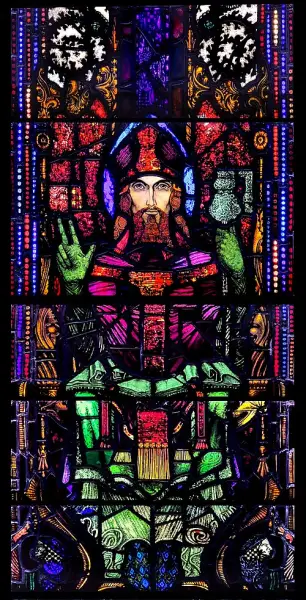
Overview
Albert of Cashel is traditionally held to have been an eighth-century Englishman who worked as an evangelist in Ireland, chiefly around the city of Cashel in Munster, where he may have been a bishop. His twelfth-century life in Latin describes him with the famous paired phrases natione Anglus, conversatione Angelicus — an Angle by race, an angel in his way of living. Leaving Ireland, he took his missionary labors to Bavaria, laboring there with St. Erhard of Regensburg, and suffering in old age from arthritis of the back and hips. Late in life he set out with Erhard on pilgrimage to Jerusalem, and on the return journey he died at Regensburg in the year 800. His grave is in the church of Niedermünster at Regensburg, where his memory has been honored ever since. His cult was formally confirmed when Pope Leo XIII canonized him on 19 June 1902. His historical existence has been questioned by some scholars, and his traditional title of Archbishop of Cashel is disputed, since the diocese is not attested before 1118.
The Complete Life
Early Life
Albert's origins lie in England, and the striking formula of his twelfth-century biography, natione Anglus, conversatione Angelicus, is the earliest thing the tradition preserves of him, a pun on the Angle and the angel that Bede had already made famous for the English people as a whole. An Englishman who crossed to Ireland in the eighth century traveled the well-worn road of the Irish mission field, for the English church of that era, though newly organized, sent scholars and preachers to the Irish schools and monasteries, and men moved constantly between the two islands. What drew Albert to Munster, and to Cashel in particular, is unrecorded: Cashel was the royal seat of the kings of Munster, a rock fortified place of growing importance, into which the church was then being woven. There he worked, by tradition, as an evangelist, and possibly as a bishop, the uncertainty of the title reflecting the sparse records of the eighth-century Irish hierarchy.
§ Life
Mission
Albert's mission ran, unusually, through three lands. In Ireland he worked mainly around Cashel, evangelizing in the country of the Eóganachta kings. Then, in a second career, he crossed to the continent and labored in Bavaria, the duchy then being organized and Christianized under its early bishops, where his companion and associate was St. Erhard of Regensburg, the Bavarian bishop-saint. The presence of an Irish-trained English missionary in Bavaria is entirely typical of the age, when the Hiberno-Scottish mission carried learning and preaching through the German lands. In old age, afflicted with arthritis of the back and hips, he joined Erhard in pilgrimage to Jerusalem, the journey that every medieval saint wished to make if strength allowed, and he had enough strength for the going but not the return: he died at Regensburg in 800. The mission that began in England and ran through Ireland and Germany ended, fittingly, between Jerusalem and home.
§ Life
Canonization
Albert's cult was ancient in Bavaria, centered on his grave at Niedermünster in Regensburg, but its formal standing in the universal church came late and, in a sense, retrospectively: Pope Leo XIII canonized him on 19 June 1902, confirming with modern process what the churches of Bavaria and Ireland had believed for a millennium. The act belongs to the era of the great confirmations, when Rome reviewed the local cults of the medieval world and gave those with adequate foundations a place in the universal calendar. At the same time, modern scholarship has pressed questions: some have doubted his existence altogether, pointing to the lateness of his biography, and others dispute the title of Archbishop of Cashel, since the diocese of Cashel is not attested before 1118. The church's judgment, in canonizing him, weighed the tradition as a whole; the historian's task of weighing the details continues, and both can be reported honestly.
§ Life
Legacy
Albert's legacy is shared by two lands. At Regensburg, one of the great medieval cities of Germany, his tomb at Niedermünster has been a place of honor for twelve centuries, and the Bavarian church counts him among its early missionary saints, the international company that planted Christianity along the Danube. In Ireland, Cashel keeps his name among its saints, and the tradition of the archbishopric, whatever its historicity, reflects the city's later glory as an ecclesiastical metropolis whose medieval cathedral on the rock is among the splendors of Ireland. Pilgrims with arthritis, the ailment of his old age, have found in him a patron who knew their pain and walked anyway. He stands, finally, for the whole missionary generation that treated Europe as one field: an Englishman taught in the Irish manner, preaching in Germany, buried on the road from Jerusalem.
§ Life
Timeline
- 800
Dies at Regensburg on the return journey from his pilgrimage to Jerusalem with Erhard
§ Life
- 19 Jun 1902
Canonized by Pope Leo XIII
§ Life
The Record
- Patron of
- Cashel, Ireland·Regensburg, Bavaria·Arthritis sufferers
- Symbols
- Bishop's vestments·Pilgrim's staff
- Canonization
- Cult confirmed; canonized 19 June 1902 by Pope Leo XIII
Prayer
Bibliography
Show 7 sources
- ↑ Alber of Cashel at Catholic.org.
- ↑ Albert of Cashel at saints.sqpn.com.
- ↑ Albert of Cashel at heiligenlexikon.de.
- ↑ Albert of Cashel at saints.sqpn.com.
- ↑ "St. Patrick Catholic Church" . Archived from the original on 4 March 2016 . Retrieved 15 February 2014 .
- ↑ "Was Saint Albert really Saint Ailbe or a made-up Saint?" . Archived from the original on 22 February 2014 . Retrieved 15 February 2014 .
- ↑ Albert of Cashel at saints.sqpn.com.
Profile text adapted from the Wikipedia article, licensed CC BY-SA 4.0.
Pray with this saint every day
Save St. Albert of Cashel to your favorites, read the full profile, and get feast-day reminders in the Saints app.
Get the Saints AppFree on the App Store for iPhone and iPad