
1166-1192·Feast November 24
St. Albert of Louvain
Bishop of Liège, Cardinal and Martyr
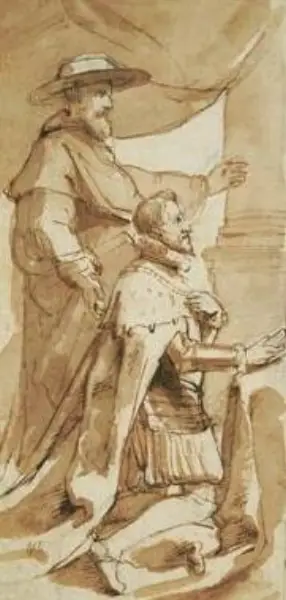
Overview
Albert of Louvain, born in 1166 as the second son of Duke Godfrey III of Leuven and Margareta van Limburg, and brother of Henry I, Duke of Brabant, was Prince-Bishop of Liège and a cardinal, assassinated at Reims on 24 November 1192 at twenty-six. Educated at the cathedral school of Saint-Lambert in Liège, he gave up his offices and took the cross once word of Jerusalem's fall reached Liège in 1187, and had himself knighted; Cardinal Henry of Albano restored his ecclesiastical status the following year. He became archdeacon of Liège, received the subdiaconate in 1191, and was that same year elected Bishop of Liège, though under the canonical age of thirty, in an election Gilbert of Mons described as a power struggle between his brother Henry and Count Baldwin V of Hainaut, who had a rival group of canons elect Albert de Rethel. The Emperor backed a third candidate, Lothar of Hochstaden. Albert appealed to Rome; Celestine III made him cardinal in May 1192, ordained him deacon on 30 May, and he received priesthood on 19 September and consecration the next day from Cardinal Guillaume de Champagne, celebrating his first Mass at Reims on 21 September. He was murdered at Reims on 24 November 1192 by German knights, and was canonized in 1613.
The Complete Life
A Duke's Son
Albert de Louvain was born in 1166, the second of two sons of Duke Godfrey III, count of Leuven, and his first wife Margareta van Limburg; his elder brother was Henry I, duke of Brabant. His schooling came in the cathedral school attached to Saint-Lambert in Liège, the mother church of the diocese he would one day govern, and he was marked out from childhood for an ecclesiastical career, as younger sons of the high nobility were. The crusading cause seized him young: in 1187 word came to Liège that Jerusalem had fallen to Saladin, and Albert gave up his offices and took the cross, and had himself made a knight — a remarkable course for a man in minor orders, showing how strongly the crusade still drew the young aristocracy. Cardinal Henry of Albano, the papal legate, restored his ecclesiastical status the following year. In 1188 Albert became archdeacon of Liège, a substantial dignity, and received the subdiaconate in 1191. He was twenty-five when the see of Liège fell vacant.
§ Biography
A Disputed Election
Albert was chosen bishop of Liège in 1191, though still short of the canonical age of thirty, and the choice was widely approved; but Gilbert of Mons, chancellor of Count Baldwin V of Hainaut, was present at the election and portrayed it as a contest for power between Henry, Albert's brother, and Baldwin. Baldwin, however, rejected the outcome and arranged for a second panel of canons to choose his own kinsman Albert de Rethel, a maternal uncle of the Empress Constance; the Emperor, presented with a disputed election, backed a third man, Lothar of Hochstaden, provost of the church of Saint Cassius in Bonn and brother of Count Dietrich of Hochstaden. Albert carried the dispute to Rome and appealed to Pope Celestine III, who settled it in his favor in the most decisive way possible: in May 1192 he made Albert a cardinal, ordained him deacon at Rome on 30 May 1192, and Albert then received priestly ordination on 19 September 1192 from Cardinal Guillaume de Champagne, episcopal consecration the following day, and celebrated his first Mass in Reims Cathedral on 21 September.
§ Biography
Murder at Reims
Two months later, on 24 November 1192, Albert was assassinated at Reims, stabbed by German knights, and died at twenty-six. The killing at once provoked a rising of the princes of Lower Lorraine under Albert's brother Henry, duke of Brabant, and their uncle the duke of Limburg; the alliance eventually grew to embrace the archbishops of Cologne and Mainz among other princes, and it ravaged the lands of Dietrich of Hochstaden, whose brother Lothar had been the man the Emperor favored. Lothar, meeting the fury of the people of Liège, ran to the imperial court, and Pope Celestine excommunicated him. The assassins, among them one Otto of Barenste, likewise escaped to the imperial court, where Emperor Henry appears to have done nothing in particular against them, and historians continue to argue over what part he did or did not play in planning the murder. The young cardinal's remains lay at Reims until 1921, when they were transferred to Brussels.
§ Aftermath
Canonization
The reputation of Albert's holiness spread quickly after his death, and he was hailed as a martyr, a victim of imperial power and family politics — a verdict that in time opened his cause for canonization. Pope Paul V declared him a saint on 9 August 1613 and fixed his feast for 24 November, the anniversary of his death. The chief source for his life, the Vita Alberti episcopi Leodiensis, was most likely composed in 1194 or 1195 by an unnamed monk of Lobbes working from material provided by Abbot Werrich, who had known Albert well; panegyric though it is for a murdered bishop, it was judged generally accurate by Raymond H. Schmandt. A different and cooler viewpoint is found in the Chronicon Hanoniense of Gislebert of Mons, written shortly after 1196 by the chancellor who had watched the election from Baldwin's side, so that the saint's short career is unusually well and variously documented. Belgium, which has few canonized bishops of the middle ages, keeps him among the chief of them.
§ Sources
Legacy
Albert of Louvain's legacy is that of a martyr of church freedom in the age of the investiture conflict's long aftermath: a bishop-elect who appealed from emperor to pope, was made cardinal, and was dead within two months of his consecration. His family, the dukes of Brabant, turned his murder into a political instrument, and the coalition his blood cemented marked the limit of imperial interference in the Lotharingian church. Venerated as a martyr though he died by assassination rather than judicial execution, he tests and illustrates the elasticity of that category in the medieval Church. The Canadian city of St. Albert in Alberta was named in his honor by the nineteenth-century missionary settlement, and his feast on 24 November is kept in the dioceses of Belgium, where a twenty-six-year-old cardinal's grave in Reims and a translated body in Brussels keep the memory of the violent autumn of 1192. His career, half crusader and half cardinal, remained a favorite subject of Brabantine historiography.
§ Introduction
Timeline
- 1166
Born at Louvain, second son of Duke Godfrey III and his first wife Margareta van Limburg
§ Biography
- 1187
On news of Jerusalem's fall, gave up his offices, took the cross, and was knighted
§ Biography
- 1188
Cardinal Henry of Albano restored his ecclesiastical status; he became Archdeacon of Liège
§ Biography
- 1191
Received the subdiaconate and was elected Bishop of Liège, though below the canonical age
§ Biography
- 30 May 1192
Made a cardinal by Pope Celestine III and ordained a deacon in Rome
§ Biography
- 19 Sep 1192
Ordained to the priesthood by Cardinal Guillaume de Champagne
§ Biography
- 20 Sep 1192
Received episcopal consecration the following day
§ Biography
- 21 Sep 1192
Celebrated his first mass in Reims Cathedral
§ Biography
- 24 Nov 1192
Killed by three German knights outside Reims, who crushed his skull with swords; buried at the cathedral
§ Biography
- 9 Aug 1613
Canonized by Pope Paul V in Rome, who fixed his feast on the date of his death
§ Canonization
- 1921
His body, which had reposed at Reims, was translated to Brussels
§ Canonization
The Record
- Patron of
- St. Albert, Alberta, Canada (city named in his honor)
- Symbols
- Cardinal's red·Bishop's crozier·Sword of his knighthood
- Canonization
- Canonized 9 August 1613 by Pope Paul V; venerated as a martyr
Prayer
Bibliography
Show 6 sources
- 1 2 3 "ALBERT DE LOUVAIN (ca. 1166-1192)" . Cardinals of the Holy Roman Church. Archived from the original on 7 April 2015 . Retrieved 5 April 2015 .
- 1 2 3 "Schmandt, Raymond H. "The Election and Assassination of Albert of Louvain, Bishop of Liège, 1191-92." Speculum 42.4 (1967): 639-60" . Archived from the original on 18 June 2015 . Retrieved 14 June 2015 .
- ↑ "Saint Albert Cardinal de Louvain" . Catholic Hierarchy . Retrieved 5 April 2015 .
- ↑ Bredero, Adriaan H. (1994). Christendom and Christianity in the Middle Ages . Wm. B. Eerdmans Publishing. ISBN 978-0-8028-4992-2 .
- ↑ "St. Albert's Namesake" . Archived from the original on 30 April 2021 . Retrieved 31 January 2020 .
- ↑ Ma, Kevin (15 March 2023). "FROM THE ARCHIVES: The Saints called Albert, or which St. Albert? Or who was St. Albert?" . St. Albert Gazette . Retrieved 1 July 2024 .
Profile text adapted from the Wikipedia article, licensed CC BY-SA 4.0.
Pray with this saint every day
Save St. Albert of Louvain to your favorites, read the full profile, and get feast-day reminders in the Saints app.
Get the Saints AppFree on the App Store for iPhone and iPad