
c. 1240-1307·Feast August 7
St. Albert of Trapani
Carmelite Priest
Overview
Albert of Trapani, born Alberto degli Abati about 1240 at Trapani in Sicily and dying at Messina on 7 August 1307, was an Italian Carmelite priest, the first formally canonized saint of his order. The sole child of the nobles Benedetto degli Abati — an admiral in the fleet of Frederick II — and Giovanna Palizi, he was the answer to his parents' vow: married in 1214 and sterile, they had promised that a son would be consecrated to the Blessed Virgin Mary of Mount Carmel. When his father later thought of arranging a marriage for the boy, his mother recalled the vow. Educated by the Carmelites, he entered the convent in 1258 and was ordained at Trapani, and moved on to the order's Messina house, where he preached as a mendicant to the Sicilians. Out of a desire to be poor in the spirit of Christ he practiced severe austerities, even putting bitter wormwood into his food and drink to deaden his sense of taste — and was known for his powers of healing, for exorcisms, and for a positive working relationship with Jews, whom he assisted and some of whom he converted; on one occasion he rescued three Jews who were drowning near Agrigento. In 1301, during the siege and blockade of Messina, he celebrated Mass for the city's deliverance, and three grain ships ran the blockade; the siege was lifted.
The Complete Life
Early Life
Alberto degli Abati was born around 1240 at Trapani, the sole child of nobles: his father Benedetto held the post of admiral in the fleet of Frederick II of Hohenstaufen, while his mother was Giovanna Palizi. The marriage, contracted in 1214, had been sterile, and the couple had promised that any son granted to them would be given over to the Beata Vergine Maria del Monte Carmelo — a promise that waited decades for its fulfillment. In childhood his father thought of arranging a marriage for him; his mother recalled the promise to her husband, and the direction of Albert's life was settled. The Carmelites gave him his education, and he turned his heart toward studies for the priesthood.
§ Life
Carmelite and Preacher
Albert entered the convent in 1258 and was ordained at Trapani, and moved from there to the order's Messina house, where he preached as a mendicant to the Sicilians. His career in the order rose steadily: provincial for Trapani from 1280 to 1287, provincial for Messina from 1287 to 1296, and then provincial superior for the Sicilian region until his death a decade later. He sometimes practiced exorcisms. The pattern is that of the great thirteenth-century friars — itinerant preaching, healing, administration — in the newest of the mendicant orders.
§ Life
Austerity and the Jews of Sicily
Two things mark Albert's remembered character. First, austerity: seeking to conform himself to the poverty of Jesus Christ, he took on severe austerities, carrying them so far as to put bitter wormwood into his food and drink to deaden his sense of taste — a domestic, almost humorous asceticism that made every meal a small discipline. Second, and rarer for his century, his relations with the Jews of Sicily: he labored at their side, brought some to conversion while cooperating with the rest and looking after their needs, rescued three from drowning near Agrigento, and is recorded as curing a Jewish boy of epilepsy at Sciacca. In an age of forced sermons and expulsions, a friar known for working with Jews is worth noticing.
§ Life
The Siege of Messina and Death
In 1301 Messina was under siege and blockade after Duke Robert of Calabria entered the conflict. Albert responded to the pleas for succor and celebrated Mass as a plea for God's deliverance; when the Mass ended, three grain-laden ships slipped through the blockade, and Messina was spared starvation, and Duke Robert lifted the siege. Albert died at a convent in Messina in 1307, aged sixty-seven. Tradition records a dispute at his funeral: the people wished to honor him as a saint, the priests to sing a normal Requiem; the quarrel closed when angels appeared, taking the people's side and confirming the friar as a confessor of the faith.
§ Life
Canonization
In 1454 Pope Nicholas V approved his beatification, and his canonization followed on 31 May 1476 at the hands of Pope Sixtus IV — though some sources give the canonization to Callixtus III on 15 October 1457, a conflict in the record left standing. His remains were moved in 1309 or, most sources say, 1317; relics of the saint are preserved at the Whitefriar Street Carmelite Church in Dublin. His liturgical feast includes the dipping of a relic into the water of Saint Albert's Well, water from which has been drunk by the sick for centuries.
§ Life
Legacy
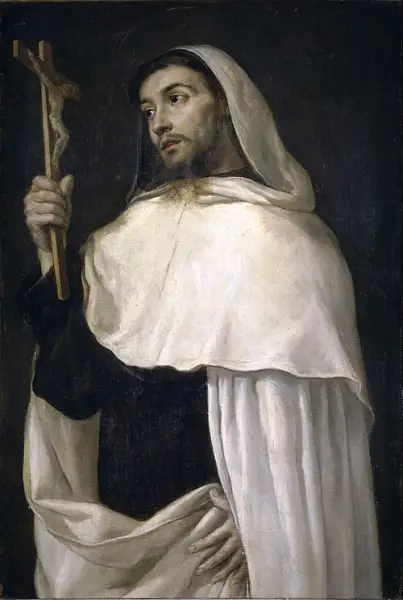
Albert of Trapani holds a singular place in Carmel: the first canonized saint of the order, honored a generation before its great reformers, the patron of Trapani, Palermo and Carmelite schools. For Sicily he remains a civic protector — the friar whose Mass saved Messina — and his iconography, in paintings like Antonio de Pereda's, carries the lily and the Carmelite scapular into the baroque churches of the island.
§ Introduction
Timeline
- 1240
Born at Trapani, the only child of the nobles Benedetto degli Abati and Giovanna Palizi
§ Life
- 1258
Entered the Carmelite convent; later ordained at Trapani and moved to the order's house at Messina
§ Life
- 1280
Began seven years as provincial for Trapani
§ Life
- 1287
Became provincial for Messina, serving in that office until 1296
§ Life
- 1296
Named provincial superior for his order's whole Sicilian region, holding the post until his death
§ Life
- 1301
His Mass during the blockade of Messina was followed by grain ships running the siege, which Duke Robert lifted
§ Life
- 7 Aug 1307
Died at a convent in Messina
§ Introduction
- 1317
His remains were translated, a transfer most sources place in this year though some give 1309
§ Life
- 1454
His beatification received the approval of Pope Nicholas V
§ Life
- 15 Oct 1457
Some sources credit Pope Callixtus III with a verbal canonization or beatification of him
§ Life
- 31 May 1476
Pope Sixtus IV approved his canonization in a papal bull
§ Life
- 1623
A gate in Messina was named in his honor
§ Life
The Record
- Patron of
- Trapani·Palermo·Carmelite schools·Against fevers (by tradition of the well water)
- Symbols
- Carmelite habit·Lily·Relic dipped in the water of St. Albert's Well
- Canonization
- Beatified 1454 by Pope Nicholas V; canonized 31 May 1476 by Pope Sixtus IV
Prayer
Bibliography
Show 4 sources
- 1 2 3 4 5 6 "St. Albert of Trapani, Priest (Feast)" . Order of Carmelites. 7 August 2017. Archived from the original on 29 September 2022 . Retrieved 9 October 2017 .
- 1 2 3 4 5 6 7 "Saint Albert of Sicily" . Saints SQPN. 11 August 2017 . Retrieved 9 October 2017 .
- 1 2 3 4 5 Fr. Giovanni Grosso, O.Carm. "Albert of Trapani: A Saint of Yesterday for Today" . Order of Carmelites . Retrieved 9 October 2017 .
- 1 2 3 4 5 6 "Sant'Alberto degli Abati (from Trapani)" . Santi e Beati . Retrieved 9 October 2017 .
Profile text adapted from the Wikipedia article, licensed CC BY-SA 4.0.
Pray with this saint every day
Save St. Albert of Trapani to your favorites, read the full profile, and get feast-day reminders in the Saints app.
Get the Saints AppFree on the App Store for iPhone and iPad