
c. 1200-1280·Feast November 15
St. Albertus Magnus
Bishop of Regensburg, Doctor of the Church
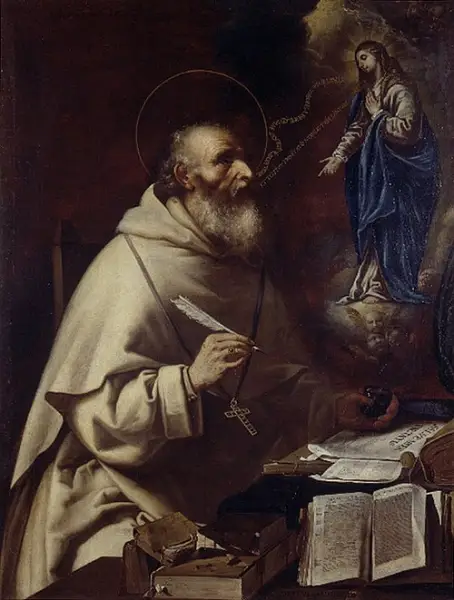
Overview
Albertus Magnus — Albert the Great, Albert of Cologne — born around 1200 at Lauingen in Bavaria, joined the Dominican Order at Padua after studying the liberal arts, and became the most encyclopedic mind of the thirteenth century: philosopher, theologian, natural scientist, and teacher of Thomas Aquinas. He lectured at Paris and Cologne, commented on virtually the whole of Aristotle at a time when the newly recovered Greek and Arabic learning alarmed Europe, and insisted that the truths of nature cannot contradict the truths of faith. His scientific treatises covered minerals, plants, animals, the heavens, and the art of alchemy; the discovery of arsenic as an element is credited to him. Made bishop of Regensburg by consecration in 1260, he reformed the diocese and then obtained release to go back to teaching. He died at Cologne on 15 November 1280. Beatified in 1622, he was canonized and declared a Doctor of the Church by Pius XI in 1931, who named him patron of students of the natural sciences.
The Complete Life
Early Life
Albert was born around 1200 at Lauingen on the Danube in the Duchy of Bavaria, of the noble but not powerful family of the counts of Bollstädt, as tradition names them. Educated in the liberal arts — perhaps at the cathedral school of Augsburg and then at the University of Padua, where he encountered the new Aristotle filtered through Arabic commentators — he joined the recently founded Order of Preachers around 1223, against his family's expectation of a knightly or episcopal career. The choice was for the life of the mind at the service of preaching: the Dominicans were the teaching order, and Albert would spend the next half century in its schools. His early teaching posts in Germany — Hildesheim, Freiburg, Ratisbon, Strasbourg — were the apprenticeship of a mind that would later attempt to master every science then known. The date of his birth is not certain; the tradition of around 1200 fits the schedule of his later career, and his tomb inscription gives his age at death as about eighty.
§ Biography
Vocation: Aristotle and the Pulpit
The decisive work of Albert's maturity was the reception of Aristotle. The Greek philosopher, recovered through Arabic Spain and Sicily, arrived in the universities as both a treasure and a scandal — a complete system of knowledge with no reference to Scripture. Many wanted him banned; Albert, with the support of his order, chose the harder task of reading all of him. Sent to the University of Paris around 1245, he commented on the entire Aristotelian corpus — logic, physics, the heavens, minerals, plants, animals, the soul, ethics, metaphysics — paraphrasing, correcting, and supplementing from his own observation, and stating plainly that the truth of nature, rightly established, cannot contradict the truth of faith, since both come from God. In 1248 he was sent to Cologne to found the studium generale of the German province, and there his most famous student joined him: Thomas Aquinas, the silent young Italian whom the classmates called the dumb ox.
§ External links
Mission: Bishop, Teacher, Peacemaker
Albert's mission was carried out in three registers. As a teacher, he built the curriculum of the Dominican schools and trained a generation that included Aquinas, and his defense of his student's orthodoxy after Thomas's death — walking to Paris to defend the deceased master's memory against the condemnations of 1277, an old man leaning on his staff — was itself an act of teaching. As a bishop, consecrated to Regensburg in 1260 at the pope's command and against his own desire, he governed a bankrupt and sprawling diocese for two years, reforming its finances and visiting every parish on foot, and then obtained permission to resign — the first German bishop in centuries to do so — and return to his books. And as a churchman he served repeatedly as mediator and legate, preaching the crusade in Germany and Bohemia with little success and considerable disillusion. His years as provincial of the German Dominicans, 1254-1257, took him on foot across a province stretching to the Baltic, an administration he bore alongside his writing.
§ Biography
Science and Sanctity
The heart of Albert's spirituality was the unity of truth. He held that the world is intelligible because it was made by Reason, and therefore that observation — going to look, weighing, measuring, asking the thing itself — is a religious act. His scientific writings are full of the empirical temper that later centuries would prize: he kept and dissected, he grew plants to test the authorities, he noted where Pliny was wrong, and in the De mineralibus he recorded observations that include the isolation of arsenic, the element credited to him. The same temper governed his theology. His Summa and his commentaries on Dionysius and the Psalms taught that grace perfects nature rather than abolishing it, and his famous defense of Aristotle's usefulness to theology opened the road that Aquinas would pave. Legend made him a magician, as it made all learned medieval men; the truth is more wonderful, a saint who loved facts.
§ External links
Final Years
After resigning Regensburg in 1262, Albert returned to Cologne and to teaching, though he continued to be dragged into public affairs — the crusade preaching, the election of Rudolf of Habsburg, the Council of Lyons in 1274. His last years darkened: in 1278 his memory and strength began to fail, so much so that he who had known everything could no longer recognize what he had written, and in 1277 he had lived to see parts of his own and Aquinas's teaching caught up in the condemnations at Paris. He died at Cologne on 15 November 1280, in his eighties, and was buried in the Dominican church of St Andrew, where his shrine remains. Aquinas had died six years before; the master followed the student. The story that he was present, senile, at the defense of Aquinas's memory in Paris in 1278 is legend; the old man did go, and the gesture was remembered when the facts were not.
§ Biography
Canonization
Albert's cult at Cologne was old and steady, but formal honors came slowly: he was beatified by Gregory XV in 1622, and only on 16 December 1931 did Pius XI canonize him and at the same time declare him a Doctor of the Church, on the six-hundredth anniversary of his death. The timing was deliberate. Pius, facing a modern world that had set science against faith, gave the Church as its patron of the natural sciences the one scholastic who had actually practiced them, and spoke of Albert's encyclopedic learning as proof that the Church is not the enemy of reason. The title 'the Great' — Doctor Universalis — had been his for centuries; Rome confirmed what Cologne had always said. Pius XI also granted him the title of patron of students of the natural sciences, and the encyclical of that year linked his cult to the Church's blessing on honest scientific work.
§ Introduction
Legacy
Albert's legacy divides into a scholarly and a spiritual line. Scholarship credits him with the decisive appropriation of Aristotle for the Latin West, the foundation of an empirical tradition in natural science, pioneering work in minerals, plants, and animals, and the formation of Thomas Aquinas. His collected works run to dozens of volumes, and modern editions of the pseudo-Aristotelian and Albertinian corpus still occupy historians of science. Devotionally, he is the saint of the laboratory: the patron invoked by scientists, medical technicians, and philosophers, and the standing answer to the claim that faith must fear inquiry. The Albertinum in Cologne, the university named for him, and his altar beneath the reliquary in St Andrew's keep the great doctor present in the city he taught. On his feast the Church asks God for the mind that seeks causes, and the humility to keep seeking them. Devotion to him has never wholly ceased.
§ Biography
Timeline
- 1200
Probably born at Lauingen in Bavaria; his age at death suggests a birth before 1200
§ Biography
- 1223
Enters the Dominican Order, probably at Padua, and studies theology at Bologna and elsewhere
§ Biography
- 1245
Becomes master of theology under Guerric of Saint-Quentin, then holds the Chair of Theology at Paris
§ Biography
- 1254
Made provincial of the Dominican Order, defending it against the Paris secular faculty
§ Biography
- 1258
His celebrated arbitration, the 'big verdict', reconciles the burghers of Cologne with their archbishop
§ Biography
- 1259
At the Dominican General Chapter of Valenciennes, helps set the order's program of studies
§ Biography
- 1260
Pope Alexander IV appoints him bishop of Regensburg, an office he fills on foot
§ Biography
- 1260
Authors the Speculum astronomiae and De Fato, his fullest statements on astrology
§ Astrology
- 1263
Pope Urban IV relieves him of the see and sends him to preach the Eighth Crusade in German lands
§ Biography
- 1265
The program he shaped is put into practice at Santa Sabina in Rome, seed of the Angelicum
§ Biography
- 1274
Grieved by the death of his former pupil Thomas Aquinas, whose orthodoxy he defends
§ Biography
- 1278
His health enters the decline that precedes his death
§ Biography
- 15 Nov 1280
Dies in the Dominican convent at Cologne
§ Introduction
- 1483
A later exhumation finds only a skeleton remaining
§ Biography
- 1622
Beatified in Rome by Pope Gregory XV
§ Introduction
- 16 Dec 1931
Pius XI declares him a saint and Doctor of the Church at Vatican City
§ Introduction
- 1941
Declared patron saint of natural scientists
§ Introduction
In Their Own Words
Natural science does not consist in ratifying what others have said, but in seeking the causes of phenomena.
Do there exist many worlds, or is there but a single world? This is one of the most noble and exalted questions in the study of Nature.
The Record
- Major works
- Commentaries on Aristotle (natural science, logic, metaphysics)·De mineralibus·De vegetabilibus·De animalibus·Summa theologiae (Summa de mirabili scientia Dei)
- Patron of
- Natural scientists, medical technicians, philosophers, and students of science·Cologne and the Order of Preachers
- Symbols
- Dominican habit·Mitre·Book and quill
- Canonization
- Beatified 1622 by Gregory XV; canonized and declared Doctor of the Church on 16 December 1931 by Pope Pius XI
Prayer
Bibliography
Show 1 sources
- ↑ Latin : Albertus Teutonicus, Albertus Coloniensis
Profile text adapted from the Wikipedia article, licensed CC BY-SA 4.0.
Pray with this saint every day
Save St. Albertus Magnus to your favorites, read the full profile, and get feast-day reminders in the Saints app.
Get the Saints AppFree on the App Store for iPhone and iPad