
died c. 250·Feast December 16
St. Albina
Virgin martyr of Caesarea honoured at Gaeta
Overview
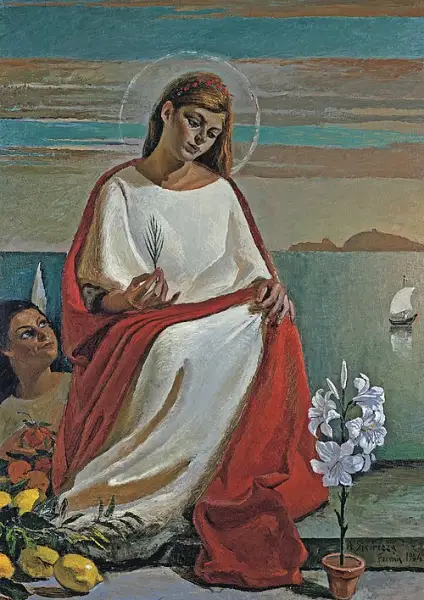
Albina is honoured among the virgin martyrs of the early Church, and the tradition that has prevailed in her cult identifies her as a young woman of Caesarea in Palestine who gave her life for the faith in the middle of the third century, during the persecution of the emperor Decius, around the year 250. Two ancient accounts of her death have come down side by side. The Greek tradition holds that she was martyred in her native Caesarea; the Roman Martyrology follows a second account, according to which she was brought to Italy and put to death in the town of Formia, on the coast of Latium. Whichever version is followed, her remains were soon an object of devotion: they are kept today in the cathedral of Gaeta, the Italian city whose Christians have venerated her for centuries, and the Greek tradition relates that they were carried there miraculously. She is the Albina honoured in Italy, the martyr shown in sacred art with the palm of victory in her hand, and the Church keeps her feast on 16 December. The name Albina, drawn from the Latin word for white, belonged to several holy women of the early centuries, and this martyr of Caesarea and Formia stands first among them in the devotion of the Italian church.
The Complete Life
A Name Written in White
Albina was a common name in the ancient world, drawn from the Latin word for white and echoing, at its deepest root, an Etruscan goddess of the dawn; it was borne by Roman matrons and provincial girls alike, and the saints who carried it have always had to be told apart with care. The Church's memory preserves several different women of the name, each with her own feast and her own story, and the martyr honoured in Italy belongs among them. She was, by the tradition the Roman Martyrology records, a young woman of Caesarea in Palestine, the great port city where Roman authority and Christian community lived side by side on the eastern edge of the Mediterranean. Of her family, her upbringing, and the circumstances that brought her to the attention of the persecutors, the old books are silent; what they preserve is her witness and its outcome. In an age when a Christian name could cost a young woman everything, she kept hers, a name that quietly preached the whiteness of a soul washed clean and, in the end, the whiteness of a robe dipped in the blood of the Lamb. The palm leaf in her hand in the paintings of her is the iconography's shorthand for that victory.
§ Saint Albina
Martyr of the Decian Persecution
Albina gave her life for Christ in the middle of the third century, about the year 250, when Decius sat on the imperial throne and the empire attempted for the first time to force every subject to sacrifice to the gods. Two traditions describe where and how she died. The Greek account keeps her in her native Caesarea, the city whose church would soon number among its martyrs some of the most celebrated confessors of the age. The Roman Martyrology, however, follows a second report, according to which the young woman was brought to Italy and killed in the town of Formia, on the Latin coast. The disagreement is ancient and honest, the kind that arises when a martyr's fame travels faster than reliable information, and the Italian church resolved it not by choosing but by keeping: both Caesarea and Formia claimed her, and Gaeta, hard by Formia, claimed her relics. What neither tradition disputes is the substance. A young Christian woman of Caesarea stood before the machinery of the Decian persecution and did not bend, and her death was remembered at both ends of the Mediterranean as a victory. The white of her name and the palm of her iconography say the same thing in different languages: she conquered by dying.
§ 3rd century
Relics at Gaeta and Sisters in Memory
Albina's remains are kept in the cathedral of Gaeta, the city that has made her martyrdom its own; according to the Greek tradition they were carried there miraculously, a claim that speaks to the antiquity and warmth of the local devotion rather than to anything that can be verified. In her honour the Church keeps her feast on 16 December, and she is the Albina most widely venerated in Italy. Her story, however, cannot be told without her sisters in name. A second-century Albina suffered death along with her brother Paxentius under Marcus Aurelius, and the relics of the two were sent from Rome to Paris, where they rested in the Priory of Saint-Martin-des-Champs; her feast is 23 September. Another Albina was beheaded as a Roman citizen among the martyrs of Lyon in 177. A fourth, the mother of Saint Marcella, died at Rome on 4 March 387, in the house where Athanasius of Alexandria may once have found lodging, though the Bollandists judged her calendar entry poorly supported. An Albina martyred at Rome with many others is commemorated on 17 February. The white name thus flowers across the calendar, and the martyr of Gaeta stands as the brightest of its blossoms.
§ 2nd century
Timeline
- 177
An Albina who was a Roman citizen is beheaded among the Martyrs of Lyon
§ 2nd century
- 250
The young woman of Caesarea suffers martyrdom under the emperor Decius, by one tradition at Caesarea and by another at Formia in Italy
§ 3rd century
- 4 Mar 387
Albina, the Roman matron mother of Saint Marcella, dies in Rome
§ 4th century
The Record
- Symbols
- palm of martyrdom
- Canonization
- Pre-congregation; her martyrdom is recorded in the Roman Martyrology
Prayer
Bibliography
Show 3 sources
- Dunbar, Agnes Baillie Cuninghame (1904). A Dictionary of Saintly Women. Bell. p. 39.
- "St. Albina". Saints & Angels. Catholic Online. Retrieved 22 October 2014.
- Monks of Ramsgate (17 May 2012). "Albina". Book of Saints, 1921. Saints.SQPN.com. Retrieved 21 October 2014.
Profile text adapted from the Wikipedia article, licensed CC BY-SA 4.0.
Pray with this saint every day
Save St. Albina to your favorites, read the full profile, and get feast-day reminders in the Saints app.
Get the Saints AppFree on the App Store for iPhone and iPad