
c. 470-550·Feast March 1
St. Albinus of Angers
Bishop and Confessor
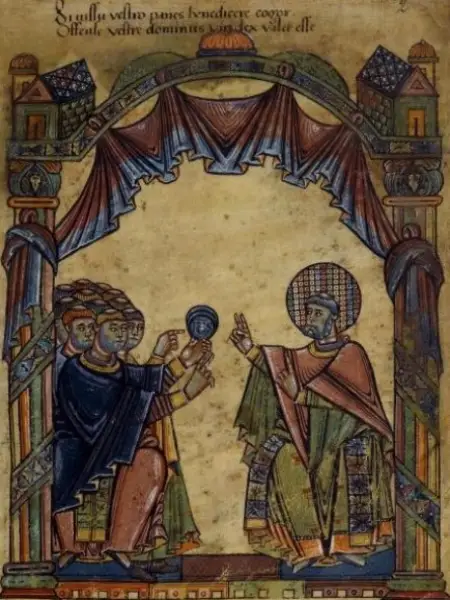
Overview
Albinus of Angers, in French Saint-Aubin, born around 470 to a noble Gallo-Roman family at Vannes in Brittany, was a monk from 504 and abbot of Tintillac, whose reputation spread through the twenty-five years of his rule. In 529 he was elected, against his wishes, bishop of Angers, where he campaigned against incestuous marriages contracted within the Frankish nobility, took part in the Third Council of Orléans of 538 with the permission of King Childebert, and sought counsel from St. Caesarius of Arles when he saw laxity in his fellow bishops. The traditions of his episcopate remember him chiefly as a man who came to the aid of everyone in distress, spending diocesan money to ransom hostages seized by the pirates of the Loire, and as a bishop who dared to confront the king himself over a woman of Douillé named Etherie whom Childebert had imprisoned, visiting her in prison where a soldier who tried to stop him fell dead at his feet. He died on 1 March 550 and was buried at Angers; the abbey of Saint-Aubin arose beside the church dedicated to him in 556, and Venantius Fortunatus wrote his life.
The Complete Life
Early Life
Albinus was born around 470 at Vannes, in the western part of Roman Gaul that was becoming Brittany, into a noble Gallo-Roman family of the old senatorial class. His world was the late imperial society of the Loire country, in which the great landowning families were turning Christian and monastic at once, placing their sons and daughters in the new religious houses as earlier generations had placed them in the civil service. He entered monastic life as a young man and was, from 504, abbot of Tintillac, governing the house for some twenty-five years with a reputation that spread well beyond its walls: the sources credit him with the strict observance, the care of the poor and the discipline of a community that prospered under him. When the see of Angers fell vacant in 529, the clergy and people looked for a man of exactly this formation, and the monk who had governed a monastery for a quarter century was elected bishop against his own strongly expressed wishes, the classic reluctant episcopate of the Gallican church.
§ Introduction
Episcopate
Albinus' episcopate at Angers, from 529 to 550, was marked by two kinds of courage. The first was moral: he campaigned against the incestuous marriages contracted within the Frankish nobility, unions within the prohibited degrees that powerful families arranged for the consolidation of property, a battle that placed him against the great of his province and that he fought with the canons in hand. The second was evangelical: he used the funds of the diocese to free hostages taken by the pirates who raided up the Loire, ransoming his people with the church's own substance. He took part in the Third Council of Orléans in 538, assembled with King Childebert's permission, one of the councils in which the Gallican church framed its law; and when he perceived laxity among his brother bishops, he sought the counsel of Caesarius of Arles, the great reforming metropolitan of the age, a humility that the sources record with approval.
§ Episcopate
The Royal Confrontation
The tradition preserves one dramatic episode above all. King Childebert had imprisoned a woman named Etherie, of Douillé near Angers, and Albinus, unable to secure her release by petition, went to visit her in prison. A soldier who tried to prevent the bishop's entry fell dead at his feet, a legend that expresses in the idiom of the age the plain fact that the bishop's right of access to prisoners was held to be superior to the king's walls; the king, impressed or alarmed, allowed Albinus to bail the woman out. Another legend has him praying through the night for men imprisoned in the tower of Angers until a great stone fell from the wall and set them free. The stories, whatever their letter, carry the memory of a real pastoral commitment: the bishop of Angers in the Frankish kingdom used his person and his office as a shield between the state and the weak. He died on 1 March 550.
§ Episcopate
Canonization
Albinus' cult was established within a generation of his death by the highest literary authorities of the age: Venantius Fortunatus, the poet of the Merovingian court, wrote his life, and Gregory of Tours, the great historian of the Frankish church, records his cult, giving him a documentary pedigree that few sixth-century bishops possess. In 556, six years after his death, a church was dedicated to him at Angers and his body was translated to its crypt; beside the church arose the abbey that took his name, Saint-Aubin, which kept his memory and his relics through the middle ages. His feast on 1 March spread through the Gallican and then the Roman calendars. No formal canonization was needed; a life by Fortunatus, a notice by Gregory of Tours and an abbey at the tomb constituted the sainthood of the sixth century in its most respectable form.
§ Veneration
Legacy
Albinus became one of the most widely diffused saints of the middle ages. Gregory of Tours remarks on the spread of his cult, which reached Germany, England and Poland, an extraordinary range for a provincial bishop; churches were dedicated to him across the continent, and coastal villages from Brittany to Jersey chose him as patron against pirate attack, a patronage rooted in his Loire ransoms and reinforced by the tenth-century miracle of Guérande, whose people, praying to him, saw their attackers defeated. The town of St. Aubin in Jersey preserves his name, and Anglican worship continues at the church of St Aubin on the Hill to this day, an ecumenical continuity across the Reformation. Miracles at his tomb at Soissons were recorded after the year 1000 by Nicholas Belfort, a canon of the abbey of St. John the Baptist. For the modern church he stands as the type of the bishop who spends the institution's wealth on people, and whose pastoral reach extends even into the king's prison.
§ Veneration
Timeline
- 470
Born into a family of Gallo-Roman nobility in the Breton city of Vannes
§ Introduction
- 504
Becomes Abbot of Tintillac, a monastery he governs for twenty-five years
§ Introduction
- 529
Elected, against his own wishes, Bishop of Angers
§ Introduction
- 538
Takes part in the Third Council of Orléans, permitted by King Childebert
§ Episcopate
- 1 Mar 550
Dies at Angers on 1 March and is buried in the church of Saint-Pierre in the city
§ Death and burial
- 556
A church is dedicated to him and his body is reburied in its crypt; the abbey of Saint-Aubin rises nearby
§ Death and burial
The Record
- Patron of
- Against pirate attack·Coastal villages of Brittany and Normandy
- Symbols
- Bishop's vestments·Chains broken, for the captives he freed
- Canonization
- Pre-congregation; ancient cult confirmed by early life by Venantius Fortunatus
Prayer
Bibliography
Show 2 sources
- ↑ This no longer stands; its location has not been satisfactorily identified.
- ↑ See Saint-Aubin article for other places named after him.
Profile text adapted from the Wikipedia article, licensed CC BY-SA 4.0.
Pray with this saint every day
Save St. Albinus of Angers to your favorites, read the full profile, and get feast-day reminders in the Saints app.
Get the Saints AppFree on the App Store for iPhone and iPad