
died 780 or 781·Feast September 7
St. Alchmund of Hexham
Bishop of Hexham
Overview
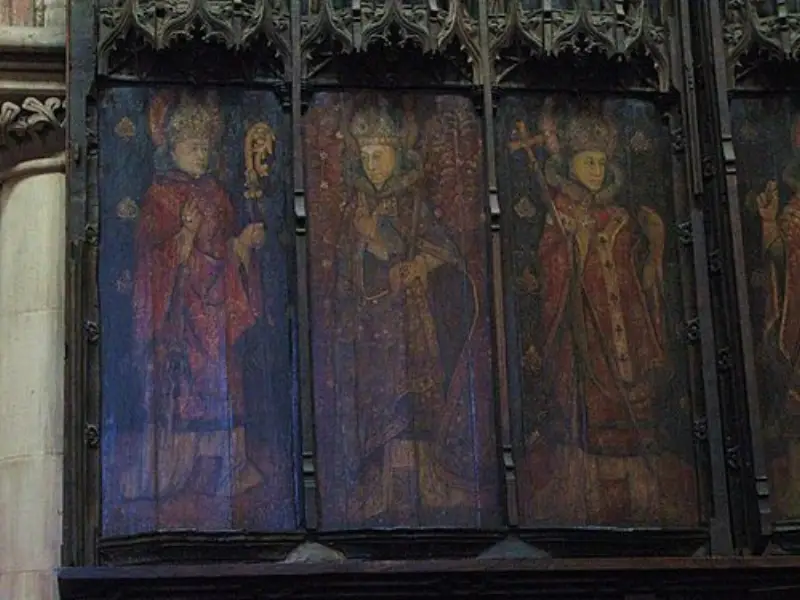
Alchmund of Hexham — the name is variously spelled Alcmund, Ealhmund, or Alhmund — became the seventh bishop of the see of Hexham in Northumberland, receiving consecration on 24 April 767, and governed that church until his death on 7 September 780 or 781. The see he inherited was centred on the church at Hexham founded by Wilfrid, the great seventh-century bishop whose shrine church, adorned by Acca his successor, made Hexham one of the honored places of Anglo-Saxon England; Alchmund's grave was dug beside Acca's, outside the church. Of his life virtually nothing is now known — an admission the older historians made plainly — yet he was plainly venerated among the saints of Hexham. His cult's most striking monument is the story of its own rescue: by the early eleventh century, after the Danes had ravaged the north, his tomb had been entirely forgotten, until Symeon of Durham recorded that the bishop came in a vision to Dregmo, a Hexham man, urging that the body be translated. Alfred, sacrist of Durham, did so — taking a bone for Durham until the shrine would not stir and the theft had to be undone. In 1154 the bones of the Hexham saints were gathered into a single shrine, which Scottish raiders destroyed in 1296.
The Complete Life
The See of Wilfrid and Acca
Alchmund took charge of a church already old and storied; his consecration fell on 24 April 767. The community at Hexham had been founded in the 670s by Wilfrid, the most assertive bishop of the early English church, who built there a church of dressed stone that contemporaries compared to Rome; Acca, his successor, enriched it with relics and altars and made it a place of pilgrimage. The see of Hexham, alternating with Lindisfarne in the Northumbrian arrangement, counted Alchmund as its seventh bishop. Of the man himself the record concedes that virtually nothing is now known — no birth, no kindred, no acts. What can be said is that he held the see through the years when Northumbrian kingship was decaying into the feuds that would open the country to the Danes, and that he was buried at his death on 7 September 780 or 781 beside Acca, outside the church, in the company of the house's founders.
Death and the Forgotten Tomb
Alchmund's death on 7 September 780 or 781 went unrecorded in any chronicle that survives; his burial beside Acca was the last public fact of his life. Within two and a half centuries his tomb had been entirely forgotten — the Danes ravaged that part of the country, Hexham's church fell, and the memory of the shrine went with it. The recovery came, so Symeon of Durham tells it, through an apparition: Alchmund showed himself in a vision to Dregmo, a Hexham man, and pressed him to have the body translated. Dregmo carried the message to Alfred son of Westou, sacrist of Durham, the great collector of northern relics, who came and raised the bones — and took one of them, for Durham. No strength of man could budge the shrine until the bone was given back, a detail the northern historians retold with approval, as the saint's own judgment on relic theft.
The Hexham Saints
Alchmund's sanctity is of the pre-congregation kind: no process, no decree, but the enduring judgment of a local church that counted him among its founders and honored his grave. The cult's institutional moment came in 1154, when the ruined church of Hexham was restored once more and the bones of the Hexham saints, Alcmund among them, were gathered into a single shrine — a collective reliquary that made the succession of bishops of the house into one company of patrons. The arrangement lasted a century and a half. In 1296 a Scottish border raid pillaged and at last destroyed both church and shrine, and the relics of the Hexham saints were lost. His feast remained on 7 September in the northern calendars, and the Catholic Encyclopedia carried his notice into the modern reference tradition. Symeon of Durham's narrative of the vision and the immovable shrine is among the most frequently cited twelfth-century translation accounts.
What Remains
Alchmund's legacy is largely the lesson of his transmission. He is one of the many Anglo-Saxon bishops whose entire surviving dossier is an episcopal list, a burial note, a translation miracle recorded two centuries after his death, and a feast day. The vision to Dregmo and the immovable shrine entered the historical writing of Symeon of Durham, one of the best twelfth-century narrators, and so Alchmund owes his modern memory to a historian as much as to a cult. The Prosopography of Anglo-Saxon England keeps his entry; the dictionaries of the saints keep his day. For the church of Hexham, refounded and rebuilt across the centuries, he remains the seventh in the line of Wilfrid, and a reminder of how much of early English Christianity rests on names whose stories the wars consumed. The Hexham succession — Wilfrid, Acca, Alchmund, and their successors — thus survives in the historical writing of the north even where its monuments do not.
Timeline
- 24 Apr 767
Consecrated seventh bishop of the see of Hexham in Northumberland
§ Introduction
- 7 Sep 780
Dies at Hexham, in either this year or 781, and is buried beside Acca outside the church
§ Introduction
- 1154
After the ruined Hexham church is restored, the bones of the Hexham saints, Alcmund among them, are gathered into a single shrine
§ Relics
- 1296
Scottish raiders pillage and destroy both the church and the shrine of the Hexham saints
§ Relics
The Record
- Patron of
- Hexham, England
- Symbols
- Bishop's vestments·The Hexham shrine
- Canonization
- Pre-congregation (ancient cult among the Hexham saints)
Prayer
Profile text adapted from the Wikipedia article, licensed CC BY-SA 4.0.
Pray with this saint every day
Save St. Alchmund of Hexham to your favorites, read the full profile, and get feast-day reminders in the Saints app.
Get the Saints AppFree on the App Store for iPhone and iPad