
c. 735-804·Feast May 19
St. Alcuin of York
Deacon, Abbot of Tours, Scholar
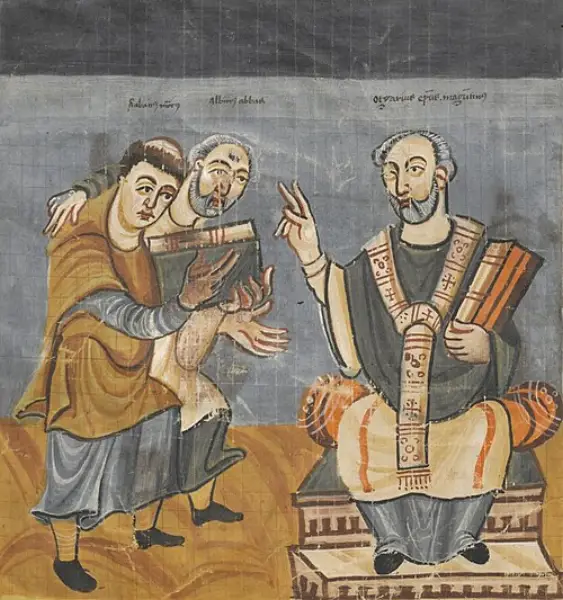
Overview
Alcuin of York, in Latin Flaccus Albinus Alcuinus, was born in Northumbria around 735: an Anglo-Saxon scholar, cleric, poet and teacher who went on to serve as the intellectual architect of the Carolingian Renaissance. Educated at the cathedral school of York under Archbishop Ecgbert, a disciple of Bede, he became a teacher in the 750s, head of the York school after 767 and a deacon, though never a priest. Returning from a mission to Rome in 781 he met Charlemagne at Parma and was persuaded to join his court, becoming master of the Palace School at Aachen in 782, where he taught the king himself, his sons Pepin and Louis, and the young clerics of the chapel. Einhard judged him the most learned man to be found anywhere. His writings took in theological and dogmatic treatises, grammatical works, poems, and his famous collection of mathematical puzzles, and among his pupils were the dominant intellectuals of the next Carolingian generation. In 796 Charlemagne made him abbot of Marmoutier at Tours, where he perfected the Carolingian minuscule script that shaped European handwriting for centuries. He died at Tours on 19 May 804.
The Complete Life
York
Alcuin was born in Northumbria, presumably in the 730s, and virtually nothing is known of his parents or origins. The Vita Alcuini asserts he was of noble English stock, but Donald A. Bullough, reading Alcuin's own references to his kinsmen Wilgils of Ripon, father of Saint Willibrord, and Beornrad, abbot of Echternach and bishop of Sens, judged the family of ceorl status, free but subordinate, risen through connection with the aristocracy. The boy came to the cathedral church of York in the golden age of Archbishop Ecgbert and King Eadberht, when the Northumbrian church was being reorganized on the tradition of learning Bede had begun. The York school was renowned for the liberal arts, literature, science and religious studies, and Alcuin thrived under Ecgbert's devotion, becoming a teacher in the 750s, head of the school after Æthelbert became archbishop in 767, and a deacon. He was never ordained priest, and although nothing truly proves that he ever took monastic vows, he lived as though he had.
§ Background
The Palace School
In 781 King Ælfwald of Northumbria dispatched Alcuin to Rome, charged with securing confirmation of York's elevation to an archbishopric and of Eanbald I's election. Travelling back, he fell in with Charlemagne once more at Parma and, reluctantly at first, was persuaded to join the court, writing afterward that the Lord had called him to serve King Charles. In 782 he became master of the Palace School at Aachen, joining the illustrious scholars of the Carolingian Renaissance, Peter of Pisa, Paulinus of Aquileia, Rado and Fulrad. The school, founded for the royal children's manners, was transformed under Alcuin into a home of the liberal arts and religious instruction: among his pupils were Charlemagne himself, the king's sons Pepin and Louis, youths dispatched to court and the clerics of the palace chapel, and he brought his York assistants Pyttel, Sigewulf and Joseph along with him. As court chancellor in Aachen he also served the practical government of the realm, and his circle produced the leading churchmen and scholars of the next generation.
§ Charlemagne
Tours
In 796 Alcuin was made abbot of Marmoutier Abbey at Tours, a retirement in name only, since the house became the busiest intellectual center of the Frankish empire. There he directed the scriptorium that worked on perfecting the Carolingian minuscule, the clear, rounded hand that replaced the regional scripts of the earlier middle ages and, through the humanists' revival of it, underlies the type in which most modern books are set. At Tours he also produced editions of the Bible, corrected against the best texts available, a labor of enormous consequence for the transmission of the Latin scriptures. His letters from these years, addressed to kings, popes and pupils, show an old man following the affairs of the empire with anxiety and wit, reproving the brutality of the court he served and mourning the Viking raids that had begun to fall on the coasts he came from. He remained at Tours until his death on 19 May 804, at about sixty-nine.
§ Tours and death
Veneration
Alcuin belongs to the pre-congregation era of sanctity, honored at Tours and York by immemorial tradition rather than by process; his feast has long been kept on 19 May, the day of his death. His cult was always that of the learned monk-bishop rather than the wonder-worker: what his medieval admirers venerated was the teacher whose school regenerated Europe, and the abbot of a great house of prayer and study. The Cathedral and school of York claimed him as their most illustrious product, St Peter's School counting him among the earliest of its heads, and the abbey of Tours kept his tomb among its founders of the second age. Modern scholarship has given him a second kind of commemoration, since the study of the Carolingian Renaissance necessarily passes through his letters, his textbooks and his scriptorium, making him one of the best-documented figures of the eighth century. His name entered the Roman Martyrology's tradition of the learned saints of the early middle ages.
§ Charlemagne
Legacy
Alcuin's legacy is the shape of European learning itself. The curriculum of the trivium and quadrivium that he carried from York to Aachen, and for which he wrote the grammatical codices while his student Hrabanus Maurus wrote on the quadrivium, fixed the framework of medieval education for centuries. The Carolingian minuscule perfected under his direction at Tours preserved Latin literature through the dark centuries by making manuscripts legible to every reader. His Bible corrections at Tours stand behind the medieval Vulgate. And the company he formed, pupils who became abbots, bishops and scholars across the Frankish world, made the court school of a warrior king into the seedbed of a civilization's scholarship. Few saints who never ruled a church or died a martyr's death have had a tithe of his effect on the daily life of the mind, which is why historians, as much as the Church, keep his memory green.
§ Introduction
Timeline
- 735
Born in Northumbria, presumably sometime in the 730s
§ Introduction
- 750
Graduated to become a teacher at the York school during the 750s
§ York
- 767
Took over headship of the York school and became a deacon after Æthelbert became archbishop
§ York
- 781
Sent to Rome to petition for York's archiepiscopal status; met Charlemagne at Parma on the journey home
§ York
- 782
Became master of Charlemagne's Palace School at Aachen, teaching the king, his sons and young clerics
§ Charlemagne
- 790
Returned from the Frankish court to England, dwelling there for some time
§ Return to Northumbria and back to Francia
- 792
Was back at Charlemagne's court by mid-792, writing letters about Northumbrian church affairs
§ Return to Northumbria and back to Francia
- Jul 793
Wrote letters and a poem giving the only significant contemporary account of the Viking attack on Lindisfarne
§ Return to Northumbria and back to Francia
- 794
Upheld orthodox doctrine against the Adoptionist views of Felix of Urgel at the Council of Frankfurt
§ Return to Northumbria and back to Francia
- 796
Received Marmoutier Abbey at Tours into his care after the death of Abbot Itherius
§ Tours and death
- 797
His plea against forced conversion prevailed as Charlemagne abolished the death penalty for paganism
§ Charlemagne
- 799
Claimed in a letter to have sent Charlemagne arithmetical figures, identified by some with the Propositiones
§ Mathematician
- 799
Prepared or directed four corrected Bibles at Tours, probably across the years 799 to 801
§ Theologian
- 19 May 804
Died at Tours and was laid to rest at St. Martin's beneath an epitaph of his own composing
§ Tours and death
In Their Own Words
The Lord was calling me to the service of King Charles.
The church of St Cuthbert is spattered with the blood of the priests of God, stripped of all its furnishing, exposed to the plundering of pagans.
I, your Flaccus, am busy carrying out your wishes and instructions at St. Martin's, giving some the honey of the holy scriptures, making others drunk on the old wine of ancient learning.
The people, by Divine ruling, is to be led, not to be followed, and for witness persons of high standing are to be preferred. The saying, 'The voice of the people is the voice of God,' is not to be listened to, since the seething of the crowd is always near to madness.
Therefore remember to care rather for the soul than the flesh, for this remains and that perishes.
The Record
- Major works
- Propositiones ad Acuendos Juvenes (mathematical puzzles)·Quaestiones in Genesim·Grammatical works on the trivium·Theological treatises and letters·Poems (Latin)
- Patron of
- Scholars and teachers (by tradition)·Librarians (by tradition)
- Symbols
- Scroll and book·Carolingian minuscule script·Abbot of Tours
- Canonization
- Pre-congregation; ancient cult, long venerated at Tours and York
Prayer
Bibliography
Show 3 sources
- ↑ Mayr-Harting 2016 , p. 207 asserts Charlemagne met Alcuin – for the second time – at Parma in 781. Story 2005 , p. 137 reports that Alcuin had previously been sent to Charlemagne by Ethelbert.
- ↑ A more skeptical attitude toward Alcuin's authorship of this text and others is taken by Gorman 2002 , pp. 101–130
- ↑ See also Jaeger 1991
Profile text adapted from the Wikipedia article, licensed CC BY-SA 4.0.
Pray with this saint every day
Save St. Alcuin of York to your favorites, read the full profile, and get feast-day reminders in the Saints app.
Get the Saints AppFree on the App Store for iPhone and iPad