
c. 639-684·Feast January 30
St. Aldegund
Frankish Abbess of Maubeuge
Overview
Aldegund — also Aldegundis or Aldegonde — was a Frankish Benedictine abbess, born about 639 at Guînes in the County of Hainaut and dying in 684 at the Maubeuge abbey she had founded. Her kinship with the Merovingian royal house was close: Walbert, Count of Guînes, and Bertilla de Mareuil, her parents, were in time honoured as saints themselves, and she is generally reckoned the sister of Saint Waltrude (Waudru) of Mons. She is the most famous member of what the historian Aline Hornaday calls the 'Maubeuge Cycle' of Merovingian saints, the aristocratic kindred that filled seventh-century Hainaut with convents. Urged to marry, she chose the cloister instead. The legend gives her a walking-on-the-waters crossing of the river Sambre; on its banks at Malbode she built a small hospital, which grew into the great Benedictine abbey of Maubeuge, later served by canonesses. Breast cancer took her life in 684, and the abbess's office then passed to her nieces — Waltrude's daughters Aldetrude, and afterwards Madelberte — each of them likewise a saint.
The Complete Life
Early Life
Aldegund was born about 639 into the highest aristocracy of northern Gaul, a family so saturated with sanctity that her parents, Walbert and Bertilla de Mareuil, were themselves honoured as saints. Her sister — or, as some scholars prefer, kinswoman — was Waltrude (Waudru), foundress of Mons; the two women anchor what Aline Hornaday named the Maubeuge Cycle, the concentration of Merovingian noblewomen who, across a couple of generations, turned Hainaut into one of the most intensively monastic regions of the West. To be a daughter in such a house was to be marriageable property; Aldegund's first act of freedom was to refuse.
§ Introduction
Vocation and the Sambre
Urged to marry, she chose the life of the cloister. The legend of her vocation is the river: she is said to have walked across the waters of the Sambre, a sign that sealed her break with the world her family had planned for her. On the northern bank at Malbode she established a small hospital — a xenodochium in the old tradition, combining care of the sick with the beginnings of community life. It was a founder's practical beginning, medicine before monument.
§ Introduction
Maubeuge Abbey
The hospital became the abbey of Maubeuge, one of the famous houses of Benedictine nuns, later replaced by canonesses. As first abbess Aldegund governed a community that was simultaneously a religious house, a landholding enterprise, and a refuge — the triple function of the great Merovingian nunneries. Her sister Waltrude did the same at Mons, some miles west, and the two houses with their kin-network set the religious geography of the region. Aldegund received the religious habit, the tradition holds, from St. Aubert of Cambrai and St. Amandus, who admitted her to vows before she became abbess.
§ Introduction
Final Years
Aldegund died in 684 of breast cancer — an unusually specific medieval diagnosis, and the origin of her later patronage. Her succession stayed in the family: her niece Aldetrude, Waltrude's daughter, followed her as abbess of Maubeuge, and was followed in turn by her sister Madelberte; both are venerated as saints. The Maubeuge Cycle rolled on through the granddaughters.
§ Introduction
Cult
Several early Lives of Aldegund exist, but none by contemporaries; the most substantial is the tenth-century biography by Hucbald of Saint-Amand, printed by the Bollandists. Her feast is kept on 30 January in the Roman Catholic Church and by the Orthodox Church. Her major shrine was the abbey of Maubeuge in what is now the French Nord.
§ Introduction
Legacy
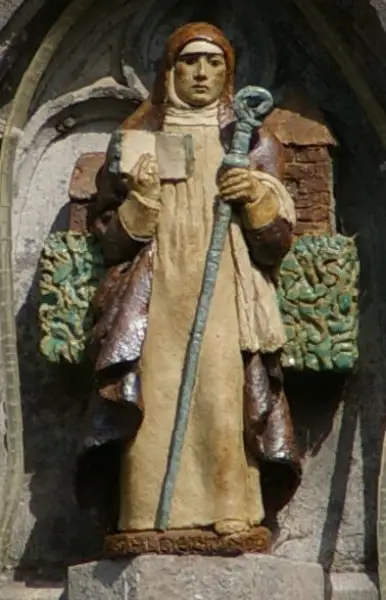
Aldegund's modern reach is mostly medical: she is invoked against breast cancer and wounds, one of the small group of saints whose patronage grew from their own recorded disease. In Belgium and northern France her image — statues like that at Noirchain in Hainaut — keeps her memory in the landscape, and historians read her life as a case study of how Merovingian aristocratic women exercised power through foundation when every other door was shut.
§ Introduction
Timeline
- 639
Born at Guînes in the County of Hainaut to Walbert and Bertilla de Mareuil
§ Introduction
- 684
Died of breast cancer at Maubeuge Abbey and was succeeded by her niece Aldetrude
§ Introduction
The Record
- Major works
- Founded Maubeuge Abbey
- Patron of
- Against breast cancer·Against wounds·Maubeuge
- Symbols
- Abbess's crozier·River Sambre·Lamp
- Canonization
- Pre-congregation; centre of the 'Maubeuge Cycle' of Merovingian saints
Prayer
Bibliography
Show 7 sources
- ↑ February 12 / January 30. https://www.holytrinityorthodox.com/htc/orthodox-calendar/
- ↑ Aline Hornaday, "Toward a Prosopography of the "Maubeuge Cycle" Saints", Prosopon Newsletter , 1996 on-line text Archived 2021-01-17 at the Wayback Machine .
- ↑ Thurston, Herbert. "St. Aldegundis." The Catholic Encyclopedia Vol. 1. New York: Robert Appleton Company, 1907. 30 May 2016
- ↑ Butler's Lives of the Saints , 1864.
- ↑ article in Archéologie (March 2003), n° 398, p. 7
- ↑ Saint of the Day, January 30: Aldegundis of Maubeuge Archived 2020-02-25 at the Wayback Machine SaintPatrickDC.org. Retrieved 2012-03-06.
- ↑ Butler, Alban (1866), The Lives of the Fathers, Martyrs, and Other Principal Saints , James Duffy, p. 66 , retrieved 2021-07-26
Profile text adapted from the Wikipedia article, licensed CC BY-SA 4.0.
Pray with this saint every day
Save St. Aldegund to your favorites, read the full profile, and get feast-day reminders in the Saints app.
Get the Saints AppFree on the App Store for iPhone and iPad