
c. 639-709·Feast May 25
St. Aldhelm
Abbot of Malmesbury, Bishop of Sherborne
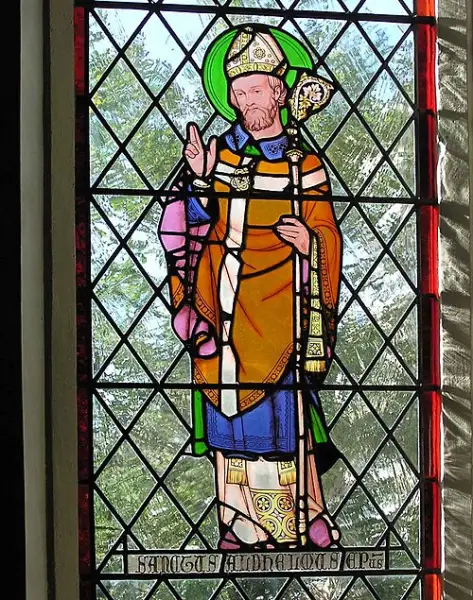
Overview
Aldhelm, in Old English Ealdhelm, born around 639 and said to be the son of Kenten of the royal house of Wessex, was Abbot of Malmesbury, first Bishop of Sherborne, and the first great scholar and Latin poet of the Anglo-Saxons. Educated at the school of the Irish monk Maeeldub at Malmesbury and later under Hadrian at Canterbury — where he learned Greek, Latin, and the whole encyclopedic program of the Roman mission — he led the West Saxon church through the dispute over Easter with the British Christians of Cornwall and Wales. His Latin treatises, riddles, and songs, and his practice of standing on a bridge singing folk verses to draw a crowd for the Gospel, made him famous in his lifetime. He died at Doulting in Somerset on 25 May 709, and his shrine at Malmesbury was one of the great pilgrimages of the south. He is the patron of Malmesbury, Sherborne, musicians, and songwriters.
The Complete Life
Early Life and Education
Aldhelm was born before the middle of the seventh century, around 639, in Wessex; Kenten, a member of the West Saxon royal house, is named as his father, though Faritius, his early biographer, is surely wrong to call him brother to King Ine. He received his earliest schooling at Malmesbury, in the school run by the Irish monk and scholar Maeeldub, a place steeped in the great Irish learning of that era. To this he added the discipline of Canterbury, studying under Hadrian, the African-born abbot who with Archbishop Theodore had made the Canterbury school the finest in northern Europe; there Aldhelm learned Greek and Latin letters, Roman law, arithmetic, and the computus. The combination of Irish and Roman schooling in one man made him, uniquely, a bridge between the two traditions of the English church. He must have been about thirty when he began under Hadrian, already no callow beginner, and the Greek words that stud his later Latin began there.
§ Early life and education
Abbot of Malmesbury
Aldhelm was professed a monk at Malmesbury and became its abbot in 675, ruling the house for thirty years and making it the intellectual center of the West Saxon kingdom. Under him Malmesbury grew from an Irish hermitage into a great Benedictine foundation with lands, schools, and scriptoria, and its abbot became the natural counselor of the West Saxon kings. In 705, when the vast diocese of Wessex was divided at the council at Alfred's place, Aldhelm was consecrated first bishop of Sherborne, keeping Malmesbury with him; he held the see for the last four years of his life. As bishop he founded churches across Dorset and Somerset, and the traditions of his pastoral journeys, on foot and singing, run through the whole southwest. At Frome and Bradford-on-Avon he planted two daughter houses as centres of learning — the first licensed by Pope Sergius I in a bull of 701 — and at Malmesbury he won the monks the right to elect their own abbot.
§ Introduction
Mission and the Easter Controversy
Aldhelm's most consequential public work was the letter to King Geraint of Dumnonia on the Easter question — the great dispute over the date of the feast between the Roman observance, which Wessex had now accepted, and the older British computation still kept in Cornwall and Wales. His Epistola ad Gerontium argued the Roman case with the full weight of his learning and his notorious love of wordplay, and it fixed the West Saxon church firmly in the Roman obedience. His mission was also popular: William of Malmesbury records that, unable to draw the common people to hear Scripture, he took up the English songs of the countryside, and standing like a minstrel on a bridge, sang until a crowd gathered — then traded the entertainment for the Gospel. It is the earliest story of English evangelistic music. His Carmen Rhythmicum preserves the journey through Devon and Cornwall that the same errand took him on.
§ External links
Scholar and Poet
Aldhelm is the first Englishman whose Latin writings survive in quantity, and they are astonishing: the De laude virginitatis, a treatise on virginity in both prose and 3,000-line verse versions, dedicated to the nuns of Barking; the hundred riddles of the Aenigmata, a teaching collection that circulated for centuries; letters stuffed with Greek vocabulary, coinages, and elaborate puns, the showmanship of a man who wanted his students to love language. His style was ornate to the point of mannerism, but beneath it lies a real spirituality: the conviction that all learning is for the praise of God and the nurture of purity, and that the monk's mind, like his body, should be wholly given. He was, Bede's generation agreed, the most learned man of the English. Artwil, an Irish king's son, submitted verses for his judgment, and Cellanus of Péronne was among his correspondents — a reach of fame that had crossed the Irish Sea in his own lifetime.
§ Introduction
Final Years
In 709 Aldhelm fell ill while on episcopal visitation and died at Doulting in Somerset on 25 May, at a chapel he had founded; his body was carried in relays to Malmesbury, and the villages along the route still point to resting places of the cortege. He was buried in the abbey church, and his shrine at Malmesbury, hung with the offerings of pilgrims, became one of the richest in the west of England — a destination so famous that after the Norman conquest the abbey was rebuilt around it. Successive translations of his relics were occasions of civic celebration at Malmesbury until the Reformation destroyed the shrine. Egwin of Worcester, his friend, raised crosses at the halting-places of the cortege; Doulting keeps the church and St Aldhelm's Well that bear his name; and he was buried in the abbey's church of St Michael at Malmesbury.
§ Introduction
Veneration
Aldhelm was venerated as a saint immediately after his death, his cult needing no process in the pre-congregation age. His feast on 25 May is kept in the Catholic, Eastern Orthodox, and Anglican churches — one of the few Anglo-Saxon saints claimed happily by all three, since his learning belongs to the whole English tradition. Malmesbury Abbey, now the parish church, preserves his tomb and memory; Sherborne kept his festival for centuries; and the dedications of St Aldhelm's churches across the southwest, from Headley to Poole to Toronto, carry his name wherever English Christianity planted itself. Dunstan translated his relics in 980; Dorset's headland is St Aldhelm's Head, however often it is mis-said for St Alban's; his white-cross-on-red flag may be flown in his honour; Salisbury's West Front holds his statue in niche 124; Sherborne Abbey keeps Marzia Colonna's 2004 figure; and a pastoral area of the Catholic diocese of Clifton took his name in 2023. The Church of England keeps its commemoration on 25 May.
§ Introduction
Legacy
Aldhelm's legacy is the English literary imagination. He was the first to write substantial Latin poetry and prose, the first English riddler, and — with his songs on the bridge — the first named figure in English vernacular music. Medieval England read his riddles in the schools for centuries; modern scholarship has made him the founding father of Anglo-Latin literature, the subject of renewed study for his Greek, his metrics, and his book-lists, which preserve the names of works otherwise lost. As patron of musicians and songwriters he gathers under one patronage the scholar and the singer, which in him were never separate. Bede called him a wonder of erudition within a generation of his death; his hermeneutic Latin stayed England's dominant style for centuries and his riddles were monastic school texts until the Norman Conquest, after which his very manner came in time to be thought barbarous.
§ Introduction
Timeline
- 639
Born in Wessex, said to be a son of Kenten of the royal house
§ Introduction
- 661
Entered Malmesbury as a monk under the Irish scholar Maeeldub, probably from this year
§ Early life and education
- 668
Began studies under Hadrian at Canterbury after Theodore arrived as archbishop
§ Early life and education
- 675
Appointed to direct Malmesbury monastery on Maeeldub's death, becoming its first abbot
§ Abbot of Malmesbury
- 685
Built a church at Frome in Somerset around this time
§ Abbot of Malmesbury
- 701
Received a papal bull from Sergius I, after a Roman pilgrimage, to establish the monastery at Frome
§ Abbot of Malmesbury
- 705
Became first bishop of the new see of Sherborne on the division of the West Saxon diocese
§ Bishop of Sherborne
- 25 May 709
Died at Doulting during his diocesan rounds; buried at St Michael's in Malmesbury Abbey
§ Death and veneration
- 980
Relics translated by Dunstan, Archbishop of Canterbury
§ Death and veneration
In Their Own Words
Aldhelmus cecinit millenis versibus odas
The Record
- Major works
- De laude virginitatis (On Virginity)·De virginitate (prose version)·Epistola ad Ehfridum·Aenigmata (one hundred riddles)·Carmen de virginitate·Old English songs and verses (lost)
- Patron of
- Malmesbury·Sherborne·Musicians·Songwriters
- Symbols
- Monk playing a harp·Bishop with staff sprouting ash leaves
- Canonization
- Pre-congregation; venerated in the Catholic, Orthodox, and Anglican churches
Prayer
Bibliography
Show 12 sources
- 1 2 3 4 Walsh A New Dictionary of Saints pp. 21–22
- 1 2 3 4 5 6 7 8 9 10 11 12 13 14 One or more of the preceding sentences incorporates text from a publication now in the public domain : Chisholm, Hugh , ed. (1911). " Aldhelm ". Encyclopædia Britannica . Vol. 1 (11th ed.). Cambridge Univers
- 1 2 3 "St. Aldhelm ( c. 639 – 709)", Athelstan Museum, Malmesbury
- ↑ Annette Burkitt, Flesh and Bones of Frome Selwood and Wessex, 2017, The Hobnob Press, p341 ISBN 978 1 906978 50 1
- ↑ "St Aldhelm" . Athelstan Museum . Retrieved 10 January 2021 .
- ↑ Chisholm 1911 .
- ↑ Probert, Duncan (2010). "New light on Aldhelm's letter to King Gerent of Dumnonia". Aldhelm and Sherborne : essays to celebrate the founding of the bishopric . Oxbow Books. pp. 110– 28. ISBN 978-1-84217-357-2 .
- ↑ "Sherborne Town" . Sherborne Town . Retrieved 17 August 2013 .
- 1 2 Fryde, et al. Handbook of British Chronology p. 222
- ↑ Rogers, W. H. Hamilton (1888). Memorials of the West, Historical and Descriptive, Collected on the Borderland of Somerset, Dorset and Devon . James G. Commin. p. 49.
- ↑ "Doulting Conservation Area Appraisal" (PDF) . Mendip Council. Archived from the original (PDF) on 11 June 2011 . Retrieved 20 November 2010 .
- ↑ Thurston, Herbert (1907). "St. Aldhelm". Catholic Encyclopedia . Vol. 1. New York: Robert Appleton Company . Retrieved 21 September 2012 .
Profile text adapted from the Wikipedia article, licensed CC BY-SA 4.0.
Pray with this saint every day
Save St. Aldhelm to your favorites, read the full profile, and get feast-day reminders in the Saints app.
Get the Saints AppFree on the App Store for iPhone and iPad