
died c. 640·Feast June 16
St. Alena
Virgin martyr of Forest and patron against toothache
Overview
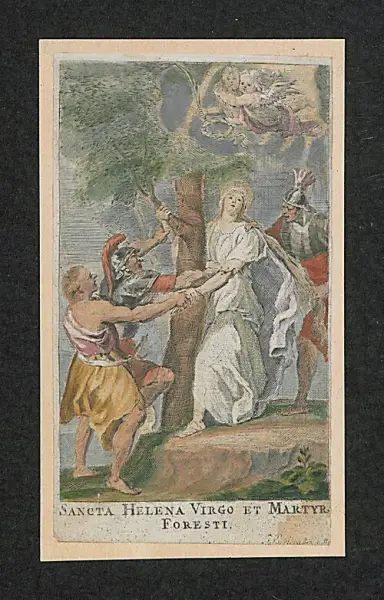
Alena, honoured in some sources as Alène or Alina and remembered as Alena of Forest, Alena of Brussels, or Alena of Belgium, was a virgin martyred around the year 640, the daughter of noble pagan parents in the village of Dilbeek just outside Brussels. The traditional account, written down in the twelfth century, tells how she chose to be baptized without her parents' knowledge and attended Mass in secret, until her father discovered her Christianity and concluded that she had been bewitched into conversion. The guards he sent to bring her home met resistance, and in the struggle the girl lost an arm; she died in prison from her injuries. An angel was said to have borne the severed limb to the chapel of her hidden worship, and the miracles reported at her burial, including the restoration of Duke Omundus's sight, persuaded her own parents to examine the faith and embrace it. On Pentecost Sunday, 19 May 1193, with the Bishop of Cambrai's permission, Abbot Godeschalk of Affligem enshrined her remains at the Priory of Forest as the relics of a saint, an act that amounted to her canonization. Her chapel became a celebrated place of pilgrimage; she is invoked for eye troubles and toothache, and her feast is kept in Brabant on 16 June, with other commemorations on 18, 19, and 24 June.
The Complete Life
A Daughter of Noble Pagans
The Alena of tradition was born at Dilbeek, a village just outside Brussels in what is now Belgium, in the first half of the seventh century. Her father was Levold, a man of noble rank and pagan religion, and her mother was Hildegaart; both were hardened in the faith of their ancestors, in a frontier country where Christianity was advancing among the aristocracy but by no means victorious. Into that household a daughter was born who would come to the Christian faith on her own, against the will and without the knowledge of the two people with the greatest power over her. The account that preserves her story was written down some five hundred years after the events it relates, in the twelfth century, and historians read it with all the caution such a distance requires. Yet the story's shape is remarkably domestic and unsentimental: no visions launch it, no miracles open it, only a girl quietly choosing baptism in a house where the font was forbidden. Her father would later conclude that Christians had bewitched her into conversion, an accusation that captures precisely the gulf between the generations, and the tragedy that followed flowed from that gulf rather than from any clash with distant imperial power.
§ Life
Baptism in Secret
Alena's conversion was an act of quiet defiance accomplished without spectacle. She chose to be baptized without her parents' knowledge, receiving the sacrament that her noble pagan household would have forbidden her, and from that day she lived a divided life: a daughter of Levold's hall and, in secret, a child of the Church. As one of the faithful she could join the Eucharist only by stealth, slipping away to the chapel where the forbidden worship was offered, guarding a secret that could not be kept forever in a house of servants and retainers. The twelfth-century legend does not tell us who instructed her or where she found the priest who dared baptize the daughter of a pagan lord; those details are lost, and their loss is instructive, for it shows how much of early Christian life in the Low Countries went on beneath the sight of the chroniclers. What the legend does record is her fidelity. Baptized against her father's will, she did not treat the grace as a private comfort to be set aside when it became dangerous; she kept attending, kept praying, kept the Christian life at the cost of constant risk of discovery. The vocation she embraced in secret would soon be confessed in public, at a price she could not have imagined at the font.
§ Life
Discovery, Struggle, and Prison
The reckoning came through her father. When Levold discovered that his daughter was living and worshipping as a Christian, he reached for the only explanation his unbelief allowed: Christians, he concluded, had bewitched her into conversion. The accusation was in its way a compliment, for it conceded that no argument of his could account for her firmness. He dispatched guards to bring the girl home, and they found that the slight figure they had been sent to retrieve had no intention of coming quietly. She resisted, and in the struggle that followed her captors dealt her a terrible wound: she lost one arm. The mutilated girl was carried off and held, and there in prison the injuries proved beyond her strength. She died in custody of the wounds she had received, a martyr in fact if not by any formal sentence, killed not for what she said but for what she was and would not renounce. The legend completes the horror with its most famous image: an angel appeared and carried the severed arm to the chapel where the girl had secretly worshipped, laying the price of her fidelity on the altar of the faith she had died for. The chapel kept the relic, and the story, for a thousand years.
§ Life
The Miracle That Converted Her Parents
Alena's death did not end her influence; according to the tradition, it multiplied it. Wonders of many kinds were reported where her body lay buried, and the most famous is recorded with a name attached: Duke Omundus, one of her father's own men, had his sight restored by invoking her prayers. The blind man who saw again was the first of the pilgrims, and the report of his healing carried the girl's reputation far beyond Dilbeek. Most remarkable of all was the conversion her witness worked at home. Her parents, the account says, were shocked by the angelic translation of the severed arm, but it was the combination of the miracles and the testimony of her determined faith that led them to examine Christianity seriously, and they too were converted. The daughter who had defied them won them precisely by dying rather than yielding, and the household that had produced a martyr ended by producing Christians. Here is the whole spirituality of the martyrdom in miniature: fidelity kept in secret, made visible in trial, and fruitful beyond death. Alena sought no audience and preached no sermon; her body argued the case her voice had never made, and the argument converted the two people hardest to convince.
§ Life
Burial and First Veneration
Alena died at Forest, then a settlement outside Brussels and now one of the nineteen municipalities of the city, which is why she is called Alena of Forest as often as Alena of Dilbeek. Her body was buried there, and the burial site quickly became a place where the faithful reported wonders. Pilgrimage to a martyr's grave was the oldest form of Christian veneration, older than calendars, processes, or papal decisions, and the cult of Alena began exactly there, at the tomb of a girl whose own family had first come to pray as penitents and converts. The local church received her remains, and in time the chapel that held them became part of Forest's parish church, a chapel containing her tomb-monument and her relics, so that parish worship and the memory of the martyr were joined in a single sacred space. The date of her death, around 640, placed her among the earliest saints of the Brabant country, and the fondness of the region for her never faded: the feasts kept on 16 June in Brabant, the Orthodox commemoration on 18 June, the Italian observance on 19 June, and the North American feast on 24 June all trace back to the devotion that gathered first at her grave.
§ Life
Pentecost at Forest, 1193
Alena's formal recognition came more than five centuries after her death, and it took the shape the age gave to such acts. The Bishop of Cambrai, in whose diocese Forest then lay, granted permission for Abbot Godeschalk of Affligem Abbey to install the martyr's remains in the Forest priory, a house under Affligem, honouring them as those of a saint. The enshrinement took place on Pentecost Sunday, 19 May 1193, and the sources call it what it was: effectively a canonization. In an era before papal canonization had become the ordinary route, the solemn elevation and enshrinement of relics with episcopal approval was how the Church declared a saint, and Forest celebrated the day as the martyr's entrance into public, universal honour. The choice of Pentecost was fitting for a saint whose story is one of hidden grace made manifest: the feast of the Spirit's descent marked the public descent of the Church's judgement upon a life it had long privately revered. From 1193 onward, Alena's cult rested not on popular rumour alone but on the settled act of her bishop, and the priory church at Forest became the shrine from which her veneration spread through Brabant and beyond.
§ Veneration
Reliquaries, Pilgrims, and a Modern Puzzle
Alena's relics had a long and eventful afterlife. Around the year 1600 her jawbone and upper arm rested in Forest's parish church, each within a gem-encrusted reliquary crafted in the 1400s, while her remaining bones, collarbones excepted, reposed in the abbey church within a Baroque reliquary made in 1644 at the orders of Abbess Françoise de Bette, who governed the community from 1637 to 1666. Suppression came to the abbey in 1796, and its final superior, Juana Francisca de Rueda de Conteras, bore the reliquary away to a monastery near Würzburg for safety, and it did not return to Forest until 1812; the collarbones are kept still in a reliquary in the church of St Ambrosius at Dilbeek. Modern science has raised a sober question about the Forest remains: carbon-14 analysis dates them to the ninth or tenth centuries, and their dimensions and form point to a man's frame, though DNA testing proved inconclusive. Faith and scholarship will have to hold that puzzle together. Meanwhile the cult lives on: Alena is venerated in Brussels, invoked for eye troubles and toothache, shown in paintings as a princess holding fast to a stump, or deprived of her arm, sometimes healing a blind man, and it was in the background of a church at Dilbeek that Pieter Breughel the Elder set his Blind Leading the Blind.
§ Veneration
Timeline
- 640
Alena dies in prison at Forest from the injuries suffered when her father's guards seized her, after losing an arm in the struggle
§ Life
- 19 May 1193
Abbot Godeschalk of Affligem enshrines Alena's remains at the Priory of Forest as the relics of a saint, with the Bishop of Cambrai's permission
§ Veneration
- 1600
By this date Alena's jawbone and upper arm are preserved in the parish church of Forest, each in its own jewel-studded fifteenth-century reliquary
§ Veneration
- 1644
A Baroque reliquary for the remaining bones is made for the abbey church at the commission of Abbess Françoise de Bette
§ Veneration
- 1796
On the suppression of the abbey, the last abbess carries the Baroque reliquary to a monastery near Würzburg for safety
§ Veneration
- 1812
The reliquary carried away in 1796 is returned to Forest
§ Veneration
The Record
- Patron of
- toothaches·eye trouble
- Symbols
- princess clinging to a tree stump·one arm torn off·healing a blind man·an angel assisting her
- Canonization
- Enshrined as a saint on Pentecost Sunday, 19 May 1193, by permission of the Bishop of Cambrai
Prayer
Bibliography
Show 7 sources
- "Saint Alena" at SQPN. Archived 2012-04-29 at the Wayback Machine. Accessed 2012-05-10.
- "Saint Alina" at Ebobas. Accessed 2012-05-10.
- "Saint of the Day for 24 June" at St Patrick's. Accessed 2012-05-10.
- "Saint Alena of Belgium (+ 640)". Retrieved 2024-08-09.
- Fransen, Bart, "Recherches historiques / Historisch onderzoek", Bulletin of the Royal Institute for Cultural Heritage, 32 (2006–2008), p. 95–101.
- Van Strydonck, Mark; Ervynck, Anton; Vandenbruaene, Marit; Boudin, Mathieu, Anthropology and 14C Analysis of Skeletal Remains from Relic Shrines: An Unexpected Source of Information for Medieval Archaeology, Radiocarbon, 51:2 (2009), p. 569–577.
- Martyrologium Romanum, 2004, Vatican Press (Typis Vaticanis), pp. 697-844.
Profile text adapted from the Wikipedia article, licensed CC BY-SA 4.0.
Pray with this saint every day
Save St. Alena to your favorites, read the full profile, and get feast-day reminders in the Saints app.
Get the Saints AppFree on the App Store for iPhone and iPad