
1070-1107·Feast April 4
St. Alèthe de Montbard
Mother of St. Bernard of Clairvaux
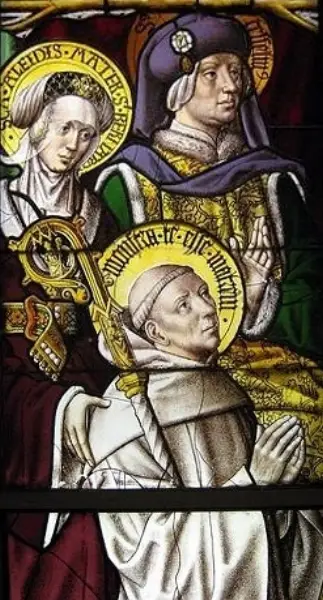
Overview
Alèthe de Montbard, also called Aleth, Alette, Alix or Alice, was a saint of the twelfth century, the mother of St. Bernard of Clairvaux. Born in 1070, the daughter of Bernard I, first count of Montbard in Burgundy, she spent her childhood at the Château de Montbard; her brother André de Montbard was one of the founders of the Knights Templar and later the order's fifth grand master. It seems that she was destined for the convent, but at fifteen, in 1085, she married Tescelin le Roux, a knight and lord of Fontaine-lès-Dijon, vassal of the duke of Burgundy. Of their seven children, six sons and a daughter, three became saints: Bernard of Clairvaux, Gerard, and Ombeline. Devoted to the poor, she built a chapel of Saint Ambrosinian opposite the castle in 1102, on the site of the later church of Saint-Bernard de Fontaine-lès-Dijon. Her guidance shaped Bernard decisively; after her death on 1 September 1107, aged thirty-seven, Bernard, then seventeen, resolved to become a monk at Cîteaux, and he, his brothers and finally his sister all entered religion. Her body, honored as a saint's from the first, was translated to Clairvaux beside Bernard's tomb in 1250.
The Complete Life
Early Life
Alèthe was born in 1070 into the very top of the Burgundian aristocracy, the daughter of Bernard I, the first count of Montbard, and she passed her childhood in the castle whose tower still stands over the town. The Montbards were of the first rank: her brother André de Montbard would become one of the nine founders of the Knights Templar and the fifth master of that order, and the family's connections ran through the highest houses of the duchy. The sources suggest that she, or her parents for her, had at one time intended the cloister, but at fifteen her hand was sought by Tescelin le Roux, a knight of honorable but more modest lineage, lord of Fontaine-lès-Dijon and vassal of Duke Eudes I, and the marriage took place in 1085. The alliance, a great lady wedding a modest but connected lord, brought her to the castle of Fontaine, where the room on the ground floor of a tower, in which her most famous son would be born, is a chapel today.
§ Introduction
Marriage and Motherhood
At Fontaine-lès-Dijon Alèthe bore seven children, six sons and a daughter, and the sources agree that the household she governed was unusually devout even for its age and class. She devoted herself, the life records, to helping the neediest, and in 1102 she erected a chapel in honor of Saint Ambrosinian across from the castle, the germ out of which the church of Saint-Bernard de Fontaine-lès-Dijon later grew. Her children were Bernard, the third son and the future abbot of Clairvaux; Gérard, who would follow Bernard into monastic life and be venerated as a saint; Ombeline, who in 1132 became abbess of the Cistercian nuns of Jully-les-Nonnains and is also honored as a saint; and the rest, all of whom eventually embraced the religious life Bernard proposed. The tradition of Bernard's biography, which credits his mother's guidance as the decisive shaping of his soul, is unanimous on the point; his fierce tenderness, his austerity and his capacity for love were, his first biographers imply, his inheritance from her.
§ Introduction
Death and the Vocation of Her Children
Alèthe died on 1 September 1107, on the feast of the saint to whom her chapel was dedicated, thirty-seven years old, leaving her children half-grown. Bernard was seventeen. He later marked her death as the beginning of his own conversion, the moment when the brilliant, worldly youth turned toward God, and within six years, in 1113, he had carried his brothers and some thirty companions to the struggling new monastery of Cîteaux, the act from which the Cistercian transformation of Europe would flow. The tradition adds a vision: Alèthe appearing to her son in white, assuring him that God had set him apart and that he was to guide his brothers in the monastic life, an episode in which the family's sense of her continued motherhood is expressed in the idiom of the age. Tescelin, her husband, ended his life as a monk of Cîteaux; every child of the marriage entered religion; the whole house followed where the mother's memory pointed.
§ Introduction
Veneration
Alèthe's sanctity was recognized by the generation after her death rather than by any process. Her body, as that of a saint, was translated to the crypt of St. Benignus at Dijon, where her tomb drew remarkable devotion for more than a hundred years; toward the close of the twelfth century it was sculpted with the figures of her six sons, each wearing the habit of Cistercian monks, a sculptural sermon on the family she had given to the church. In 1250 the abbot of Clairvaux translated her remains to his abbey, setting them beside the tomb of her son, where mother and doctor have lain together ever since in the tradition's memory. Her cult, confirmed by usage and never subjected to modern process, keeps her feast on 4 April at Fontaine-lès-Dijon and in the Cistercian family, and the chapel of her foundation grew into the basilica and convent that now compose the shrine of Saint Bernard at his birthplace.
§ Introduction
Legacy
Alèthe's legacy is inseparable from her son's: without her, in the judgment of every biographer, no Bernard of Clairvaux, and without Bernard no Cîteaux as history knows it, no crusade preaching of 1146, no mystic of the Song of Songs; she is one of the hidden causes of the twelfth century. She stands in the calendar for a particular kind of sanctity, the mother's, exercised entirely within marriage, household and motherhood, and completed by the offering of her children. The room of Bernard's birth, made a chapel in the fifteenth century and given to the Feuillants, and the basilica that grew from her own chapel of 1102, keep the site as a place of pilgrimage, and mothers have long invoked her. Her brother's path into the Templars and her children's into Cîteaux together sketch the two great spiritual adventures of the Burgundian nobility of her generation, the sword and the cloister, and her house sent members to both.
§ Introduction
Timeline
- 1070
Born at Montbard, daughter of Count Bernard I of Burgundy
§ Introduction
- 1085
Marries Tescelin le Roux, lord of Fontaine-lès-Dijon, at age fifteen
§ Introduction
- 1102
Erects a chapel honoring Saint Ambrosinian across from the castle at Fontaine-lès-Dijon
§ Introduction
- 1 Sep 1107
Dies aged thirty-seven on the feast of Saint Ambrosinian; her body is later placed in the crypt of St. Benignus
§ Introduction
- 1250
Her remains translated to Clairvaux beside the tomb of St. Bernard
§ Introduction
The Record
- Patron of
- Mothers·Widows and parents of religious·Fontaine-lès-Dijon
- Symbols
- Mother with her children·Chapel of the poor
- Canonization
- Ancient cult; venerated as Blessed Alèthe at Clairvaux and Fontaine-lès-Dijon
Prayer
Bibliography
Show 6 sources
- ↑ Nominoe (30 July 2023). "Le diocèse de Dijon met à l'honneur la bienheurese Aleth de Montbard" . Riposte-catholique (in French) . Retrieved 24 October 2024 .
- 1 2 McGuire, Brian Patrick (12 October 2020). Bernard of Clairvaux: An Inner Life . Ithaca, New York: Cornell University Press . doi : 10.1515/9781501751554 . ISBN 978-1-5017-5155-4 .
- ↑ "Bienheureuse Alèthe de Montbard | L'histoire de l'Eglise au fil des jours" . www.historia-ecclesiae.fr . Retrieved 24 October 2024 .
- ↑ "Josbert unknown of La-Ferté-sur-Aube | A Database of Crusaders to the Holy Land, 1095–1149" .
- 1 2 "Saint Bernard of Clairvaux | Biography, Cistercian, Legacy, & Facts" . Encyclopædia Britannica . 12 October 2024 . Retrieved 24 October 2024 .
- 1 2 3 Philbée, André (1990). Saint Bernard de Fontaine, abbé de Clairvaux: sa vie et sa spiritualité . Épiphanie. Paris: Editions du Cerf. ISBN 978-2-204-04209-3 .
Profile text adapted from the Wikipedia article, licensed CC BY-SA 4.0.
Pray with this saint every day
Save St. Alèthe de Montbard to your favorites, read the full profile, and get feast-day reminders in the Saints app.
Get the Saints AppFree on the App Store for iPhone and iPad