
1556-1581·Feast December 1
St. Alexander Briant
Priest, Religious and Martyr (Jesuit)
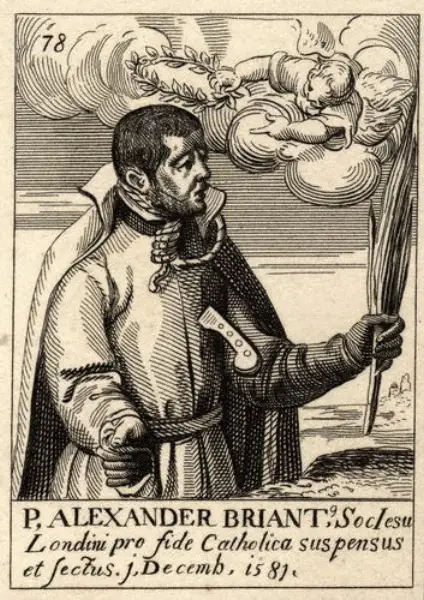
Overview
Born in Somerset in August 1556, Briant went up early to Hart Hall, Oxford, where he fell under the influence of Robert Parsons, completing his studies with him at Balliol; that friendship, together with Richard Holtby's, brought him into the Catholic Church. He crossed to the English College at Reims and then Douai, was ordained priest on 29 March 1578, and in August 1579 returned to labor secretly in his home county of Somerset. In April 1581 officers hunting for Parsons seized him instead. Carried to the Counter prison and then to the Tower, he was tortured in an effort to make him name fellow priests; from that confinement he wrote to the Jesuit Fathers in England asking admission to the Society, which was granted — making him a Jesuit in everything but formal profession by the time of his death. Tried with six other priests at Westminster in November 1581 on a charge of high treason, he was condemned and executed at Tyburn on 1 December 1581, hanged, drawn and quartered at twenty-five, alongside Edmund Campion and Ralph Sherwin. He wrote from prison that he had felt no pain under his tortures, adding that whether this was miraculous God alone knew.
The Complete Life
Early Life
Alexander Briant was born in Somerset on 17 August 1556, into an England remade by the Reformation a generation earlier. The parish church of his childhood was stripped of its altars; the Mass his grandparents had known was now high treason. He was a clever boy and went up to Oxford early, entering Hart Hall — the present Hertford College — where his tutor was Robert Parsons, the brilliant and future Jesuit, and where he completed his studies at Balliol. His association with Parsons and with Richard Holtby was the hinge of his youth: under their influence the young scholar, raised in the official religion, examined the claims of the old one and crossed over. Conversion cost him his university prospects, as it cost most who made it, and he left England for the colleges that had been built abroad to keep English Catholic learning alive.
§ Life
Conversion and Vocation
On the continent Briant studied first at the English College in Reims, then at its successor house at Douai in the Spanish Netherlands, and received ordination to the priesthood on 29 March 1578. Such colleges had a single purpose: to supply priests for the English mission, and every seminarian knew that assignment meant returning to a country where his ordination was, in effect, his death warrant. Briant volunteered anyway, and in August 1579 was sent to England, laboring in his own county of Somerset — the country of his birth, now mission territory. He was not yet a Jesuit; his entry into the Society came later, and in the most extraordinary way, from a prison cell. During his confinement in the Tower he wrote to the Jesuit Fathers in England asking to be received, and his request was granted, making him a Jesuit in everything but liberty.
§ Life
Mission and Ministry
Briant's ministry in Somerset was the classic work of the English mission priests: saying Mass in hidden rooms, reconciling converts, hearing confessions, and keeping the recusant community supplied with the sacraments under the constant threat of priest-hunters and informers. The work was concentrated on the Catholic gentry households that sheltered clergy, and its danger was personal and immediate — a priest in Elizabethan England moved by night, said Mass behind locked doors, and lived on the loyalty of people who risked ruin by housing him. He labored in this way for roughly two years. On 28 April 1581 a search party hunting his old tutor Parsons arrested him instead, along with Gilbert Bodey; the authorities had missed their primary quarry and settled for a young priest they could use.
§ Life
Spirituality and Teaching
Briant's surviving writing is one letter, and it has carried his memory for four centuries. Written from prison to the Jesuit Fathers in England, it asks for admission to the Society and reports that under the various tortures he felt no pain — and then adds, with careful honesty, that whether this was miraculous God alone knew. The letter is a spiritual document of the first order: a man under torture attributing nothing to his own courage, careful not to claim a miracle he cannot verify, and asking in the middle of it for the one thing still withheld from him, formal membership of the religious order he has come to love. His spirituality was thus Ignatian in substance before it was Ignatian in form — indifference to suffering, scrupulous honesty, and a desire to serve as a religious rather than merely to endure as a victim.
§ Trial and Execution
Trial and Final Years
After fruitless attempts in the Counter prison to extort information from him, Briant was taken to the Tower and tortured on the rack — the standard Elizabethan method for extracting the names of harboring households. He gave them nothing usable. On 16 November 1581 he was arraigned with six other priests at Westminster's Queen's Bench on a charge of high treason — the legal fiction under which the presence of a Catholic priest in England was construed as treason against the Queen — and was condemned to death. He was executed at Tyburn on 1 December 1581, hanged, drawn and quartered, at twenty-five years old; through malice or carelessness of the hangman he was put to needless suffering on the scaffold. He died beside Edmund Campion and Ralph Sherwin, the three of them closing one of the most famous judicial killings of the age.
§ Trial and Execution
Canonization
Briant was beatified by Pope Leo XIII on 29 December 1886, in the great late-Victorian beatifications of the English martyrs. On 25 October 1970 Pope Paul VI canonized him among the Forty Martyrs of England and Wales, the collective canon of the Reformation-era dead that honored clergy and laity, priests and housewives, in a single act. He is also counted among the Douai Martyrs. His individual feast is kept on 1 December, the day of his death, with the common feast of the Forty on 25 October. His liturgical memory is layered accordingly: individually on 1 December, the day of his death; with the Forty Martyrs on 25 October; and among the Douai Martyrs on 29 October.
§ Introduction
Legacy
Briant's legacy rests on the same scaffold as Campion's — the two names are inseparable in the history of Tyburn — but his own contribution is distinct: the letter from the Tower, the torture without sensation he would not claim as a miracle, and the vocation completed in chains. A corporal preserved at the English College in Rome, stitched with the names of five priests, carries his name among them. In 2023 a pastoral area of the Diocese of Clifton — his home country of the southwest — was named in his honor, returning his memory to the Somerset that had once hunted him.
§ Veneration and relic
Timeline
- 17 Aug 1556
Born in Somerset
§ Introduction
- 29 Mar 1578
Ordained a priest after studies at the English colleges of Reims and Douai
§ Life
- Aug 1579
Assigned to the English mission and labored in his native Somerset
§ Life
- 28 Apr 1581
Arrested by a party searching for Robert Parsons
§ Life
- 16 Nov 1581
After torture in the Tower, where he wrote seeking admission to the Jesuits, he was arraigned at Westminster and condemned
§ Trial and Execution
- 1 Dec 1581
Executed by hanging, drawing and quartering at Tyburn alongside Edmund Campion and Ralph Sherwin
§ Trial and Execution
- 29 Dec 1886
Beatified by Pope Leo XIII
§ Veneration and relic
- 25 Oct 1970
Canonized by Pope Paul VI among the group honored as the Forty Martyrs of England and Wales
§ Veneration and relic
- 2023
A pastoral area of the Diocese of Clifton was named in his honor
§ Veneration and relic
In Their Own Words
Whether this that I say be miraculous or no, God knoweth.
The Record
- Symbols
- Noose·Knife in chest·Martyr's palm·Crown of martyrdom·Crucifix
- Canonization
- Beatified by Pope Leo XIII on 29 December 1886; canonized by Pope Paul VI among the Forty Martyrs of England and Wales on 25 October 1970
Prayer
Bibliography
Show 9 sources
- ↑ "Book of Martyrs," New York: Catholic Book Publishing Co., 1948
- ↑ “Blessed Alexander Briant”. New Catholic Dictionary . CatholicSaints.Info. 27 July 2012. Web. 2 February 2019
- 1 2 Saxton, Eugene. "Blessed Alexander Briant." The Catholic Encyclopedia Vol. 1. New York: Robert Appleton Company, 1907. 1 February 2019
- ↑ Pollen, John Hungerford. "Venerable John Slade and Venerable John Bodey", Acts of English Martyrs Hitherto Unpublished , Burns and Oates, 1891, p. 54 This article incorporates text from this source, which is in the public domain .
- ↑ Monks of Ramsgate. “Alexander Briant”. Book of Saints , 1921. CatholicSaints.Info. 24 May 2012
- ↑ Mullett, Michael . "Briant, Alexander". Oxford Dictionary of National Biography (online ed.). Oxford University Press. doi : 10.1093/ref:odnb/3378 . (Subscription, Wikipedia Library access or UK public library membership required.)
- ↑ Patron Saints Index: "Saint Alexander Briant"
- ↑ "Five Martyrs | Jesuit Collections" . www.jesuitcollections.org.uk . Archived from the original on 21 July 2022 . Retrieved 21 July 2022 .
- ↑ "Parishes" . Clifton Diocese . Retrieved 9 February 2024 .
Profile text adapted from the Wikipedia article, licensed CC BY-SA 4.0.
Pray with this saint every day
Save St. Alexander Briant to your favorites, read the full profile, and get feast-day reminders in the Saints app.
Get the Saints AppFree on the App Store for iPhone and iPad