
1872 – 1937·Feast November 21 (church calendar); December 4 (civil calendar)
St. Alexander Hotovitzky
Russian Orthodox Hieromartyr, Missionary to America
Overview
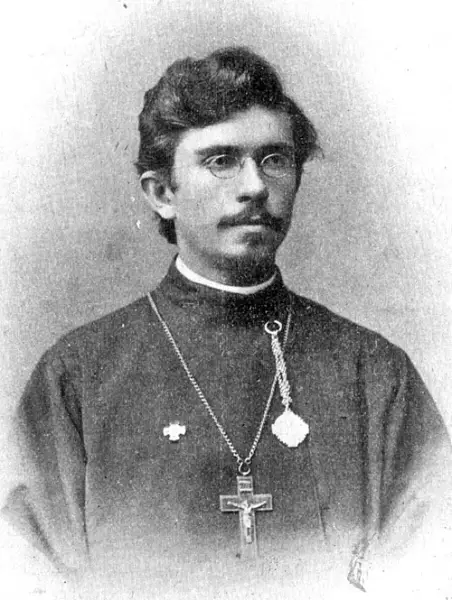
Alexander Hotovitzky, born on 11 February 1872 at Kremenets in Volhynia, the son of a priest who rectoried the Volhynia Theological Seminary, became one of the founding pastors of Orthodoxy in North America and one of the last of its Russian martyrs. Educated at the Volhynia Seminary and the St. Petersburg Theological Academy, he was sent in 1895 to North America, attached as a lay missionary-reader to St. Nicholas Church in New York within the Diocese of the Aleutians. Ordained priest at San Francisco in 1896 by Bishop Nicholas Ziorov after his marriage to Maria Scherbuhina, he served the New York parish for nearly two decades: founding Orthodox parishes at Yonkers, Passaic, Philadelphia, and Watervliet, editing the American Orthodox Messenger, building the new St. Nicholas Cathedral with a five-thousand-ruble gift from Tsar Nicholas, and serving under the future Patriarch Tikhon. Recalled to Russia in 1914, he served in Helsinki and from 1917 at Christ the Savior Cathedral in Moscow, working with Tikhon through the council of 1917-18. Arrested repeatedly, tried with the church's defenders of sacred vessels in 1922, exiled to Turukhan in Siberia in 1924, he was shot on 19 August 1937. He was glorified as a hieromartyr in 1994.
The Complete Life
Early Life and Education
Alexander Alexandrovich Hotovitzky was born on 11 February 1872 at Kremenets in Volhynia, a western province of the Russian Empire in what is now Ukraine, into the hereditary priesthood of the Russian church: his father, also Alexander, was a priest and served as rector of the Volhynia Theological Seminary, the school that trained the clergy of the province. The son's path was thus set from childhood through the seminary at Volhynia to the St. Petersburg Theological Academy, the senior theological school of the empire, from which he graduated in 1895 with a master's degree. The appointment that followed was unusual and decisive: instead of a parish in the old country, he was assigned to the Aleutian and North American diocese, the church's immense and experimental American jurisdiction, as a lay missionary, attached as reader to the St. Nicholas Church in New York City. Before ordination he married Maria Scherbuhina, a graduate of the Pavlovsk Institute in St. Petersburg; Bishop Nicholas Ziorov ordained him deacon, and then, on 25 February 1896 at the diocesan cathedral in San Francisco, to the priesthood.
§ Work in the United States
Eighteen Years in America
Hotovitzky's American pastorate, eighteen years under Bishop Nicholas, the future Patriarch Tikhon, and Archbishop Platon, built much of the institutional skeleton of Russian Orthodoxy in the United States. Returning to New York a week after his ordination, he pastored St. Nicholas and multiplied it: parishes were established through his instrumentality at Yonkers, Passaic, Philadelphia, and Watervliet, ministering to immigrants who had come from Galicia and Carpatho-Russia; he additionally acted as his church's envoy to American religious bodies and assemblies, a pioneer of Orthodox ecumenical presence. He edited the American Orthodox Messenger, the journal of Orthodox activity in the country, and helped found and run the Orthodox mutual aid society. His great project was the new St. Nicholas Cathedral in New York, for which he traveled across the United States and to Russia raising funds, the Tsar himself contributing five thousand rubles; the edifice became the diocesan cathedral in 1903. When the treaty ending the Russo-Japanese War was signed at Portsmouth in 1905, Hotovitzky was among the Orthodox clergy who went there, singing a solemn Te Deum in Christ Church with choristers from the cathedral.
§ Work in the United States
Moscow, Trial, and Exile
Recalled to Russia on 26 February 1914, Hotovitzky was given charge of the Orthodox congregation in Helsinki, in the Grand Duchy of Finland, working as assistant to the archbishop of Finland, the future Patriarch Sergius, against the proselytizing of the Lutheran majority. That August of 1917 he moved to the cathedral of Christ the Savior in Moscow as an assistant priest, arriving just before the All-Russian Church Council and the October Revolution; he took an active part in the council and assisted Tikhon, now patriarch, in administering the Moscow diocese. The Bolsheviks arrested him briefly in May 1920 and November 1921; when church property was confiscated in 1922, allegedly for famine relief, and Tikhon forbade the surrender of sacred vessels, Hotovitzky drafted the parish resolution demanding guarantees that donations would relieve hunger. For this he was tried at Moscow in November 1922 with 104 other clergy and laity, refused to implicate the others, and on 13 December received a ten-year sentence. Amnestied in October 1923, he was exiled in 1924 to Turukhan in northern Siberia; after his return he was made protopresbyter, assisted the Deputy Locum-Tenens Metropolitan Sergius, and in the 1930s served as rector of the church honoring the Deposition of the Robe.
§ Russia and martyrdom
Martyrdom and Glorification
In the summer of 1937, at the height of the Great Purge, Hotovitzky was arrested once more, sentenced to death, and shot on 19 August 1937, at sixty-five. He was buried at Donskoye Cemetery in Moscow, among the unnumbered dead of that year. His glorification as a hieromartyr came in 1994, when the Russian Orthodox Church, freed to remember its twentieth-century dead, added him to the choir of the new martyrs and confessors; his feast is kept on 21 November by the church calendar and 4 December by the civil calendar, and both the Russian and the Greek Orthodox calendars carry his commemoration. The veneration has crossed his old mission field: the crypt chapel of the Uspenski Cathedral in Helsinki bears his name, and the city of Jersey City, New Jersey, where his parishes once stood, has designated a block of Grand Street before the Orthodox cathedral as Saint Alexander Hotovitzky Way.
§ Introduction
Legacy
Hotovitzky is one of the few saints who belong fully to two churches' histories. American Orthodoxy, especially the Orthodox Church in America, counts him among its founders: the parishes he planted, the cathedral he raised, the journal he edited, and the aid society he served are the documented beginnings of organized Orthodoxy in the United States, and the OCA's own account of his glorification treats it as the recognition of an American as much as a Russian saint. The Russian church counts him among its martyrs, a confessor of the church's independence against a state that demanded its property and its silence, and a link in the chain that runs from Tikhon, whom he served in New York and Moscow alike, to the church's survival. His life joins the two in one arc: the missionary who became the martyr, the builder of churches who watched the greatest of them be dynamited, and whose own witness outlasted the regime that killed him.
§ Russia and martyrdom
Timeline
- 11 Feb 1872
Born at Kremenets in Volhynia, son of a priest who led the Volhynia Theological Seminary
§ Introduction
- 1895
Graduated from the St. Petersburg Theological Academy and was sent as a lay missionary to New York
§ Work in the United States
- 25 Feb 1896
Ordained priest by Bishop Nicholas Ziorov at San Francisco, then became pastor of St. Nicholas Church, New York
§ Work in the United States
- 1903
Saw the new St. Nicholas edifice in New York, which he had raised funds for, become the diocesan cathedral
§ Work in the United States
- 26 Feb 1914
Recalled to Russia after eighteen years in America; named to lead the Orthodox congregation in Helsinki
§ Russia and martyrdom
- Aug 1917
Transferred to Christ the Savior Church in Moscow as assistant priest under Patriarch Tikhon
§ Russia and martyrdom
- May 1920
Arrested by the Bolsheviks for the first time for violating government decrees on religion
§ Russia and martyrdom
- Nov 1921
Arrested again for a brief period as church persecution intensified
§ Russia and martyrdom
- 27 Nov 1922
Put on trial in Moscow with 105 clergy and laity accused over the retention of church valuables
§ Russia and martyrdom
- 13 Dec 1922
Sentenced to ten years in prison, loss of property and five years of civil rights
§ Russia and martyrdom
- Oct 1923
Granted amnesty with fellow defendants; thereafter served in Moscow churches without a parish
§ Russia and martyrdom
- 4 Sep 1924
Recommended for administrative exile and sent to the Turukhan region of Siberia for three years
§ Russia and martyrdom
- 19 Aug 1937
Arrested in the Great Purge, sentenced to death and shot; buried at Donskoye Cemetery, Moscow
§ Russia and martyrdom
- 1994
Glorified as a hieromartyr by the Russian Orthodox Church
§ Introduction
The Record
- Major works
- Editor of the American Orthodox Messenger·Sermons and reports of the North American mission
- Patron of
- Orthodox clergy·Missionaries to America·Prisoners of conscience
- Symbols
- Priestly cross·Christ the Savior Cathedral, Moscow
- Canonization
- Glorified as a hieromartyr by the Orthodox Church in 1994
Prayer
Bibliography
Show 7 sources
- 1 2 3 "New-Hieromartyr Alexander Alexandrovich (Hotovitsky)", Holy Trinity Cathedral
- 1 2 "Glorification of the Priestmartyr Alexander Hotovitzky" . Orthodox Church in America . Retrieved 2023-01-19 .
- ↑ "Parish Background", St.Basil's Russian Orthodox Church, Watervliet, New York
- ↑ " "History of Saint Nicholas Cathedral", Russian Orthodox Church in the United States of America" . Archived from the original on 2014-03-16 . Retrieved 2014-01-15 .
- ↑ " "Christ Church Service", Portsmouth Peace Treaty" . Archived from the original on 2016-03-03 . Retrieved 2014-01-15 .
- 1 2 3 "New Martyr Alexander Hotovitsky was in Portsmouth for 1905 treaty signing" . OrthoChristian.Com . Retrieved 2023-01-19 .
- ↑ Greek Orthodox Archdiocese of America
Profile text adapted from the Wikipedia article, licensed CC BY-SA 4.0.
Pray with this saint every day
Save St. Alexander Hotovitzky to your favorites, read the full profile, and get feast-day reminders in the Saints app.
Get the Saints AppFree on the App Store for iPhone and iPad