
1221-1263·Feast November 23 (repose); August 30 (translation of relics)
St. Alexander Nevsky
Grand Prince of Vladimir, Prince of Novgorod
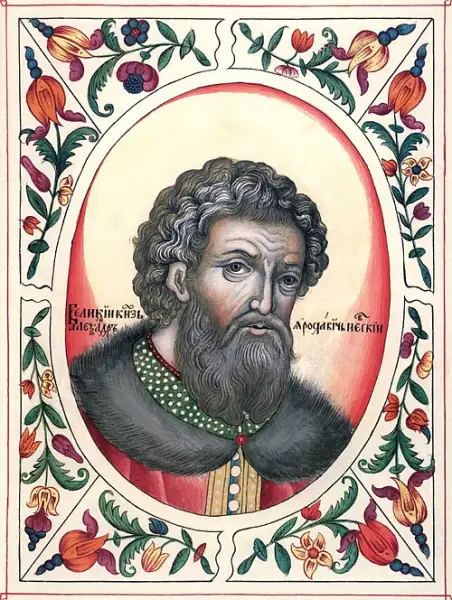
Overview
Alexander Yaroslavich Nevsky, monastic name Aleksiy, born on 13 May 1221 and dead on 14 November 1263, was Prince of Novgorod in several terms and Grand Prince of Vladimir from 1252 to his death, a grandson of Vsevolod the Big Nest. He rose to legendary status for his victories over the Swedish invaders at the Battle of the Neva in 1240, which earned him the honorific 'Nevsky' though the title was only applied from the fifteenth century, and over the German crusaders at the Battle on the Ice of Lake Peipus in 1242. Toward the east he consented to pay the Golden Horde tribute, the policy under which the Orthodox Church and the Russian lands were preserved from Mongol destruction while Alexander fought foreign powers to the west and south. Taking monastic vows on his deathbed, he was canonized by Metropolitan Macarius in 1547. Later generations reckoned him among the great heroes of their history, the saviour of his people from the German yoke and from the loss of their church, and he was invoked by Peter the Great in the building of St. Petersburg and promoted as a patriotic icon in the Soviet Union, especially during the Second World War, when Eisenstein's 1938 film Alexander Nevsky fixed his image. Critics have argued that the importance of his battles was inflated for political ends, and that his deference to the Horde entrenched its long mastery of Russia.
The Complete Life
Early Life
Alexander was born at Pereslavl-Zalessky on 13 May 1221, though an older tradition of historiography gives 30 May 1220, the second son of Grand Prince Yaroslav II of Vladimir; his mother was Feodosia Mstislavna, daughter of Mstislav Mstislavich. His grandfather was Vsevolod the Big Nest, in whose vast principality the political centre of the Rus had shifted from Kiev to the northeast. He spent his youth in Pereslavl, and little is known of Yaroslav's children before 1238: the chronicles preserve a portrait of Alexander as taller than others, his voice like a trumpet, his face like Joseph's, his strength a part of Samson's and his wisdom Solomon's, as portrayed in the Tale of the Life and Courage — the story of the pious and Great Prince Alexander — a work compiled within a generation of his death. His eldest brother Fyodor died in 1233 at fourteen. The world of his boyhood was breaking: in 1237-38 the Mongols destroyed the Grand Principality of Vladimir, killing his great-uncle Yuri II at the Battle of the Sit River, and his father received the throne from the khan as a tributary. Alexander inherited, with his offices, the double problem that defined his life: the Horde in the east and the crusading powers on the Baltic.
Vocation
Alexander's vocation, in the terms his church later honoured, was the defence of the Russian land and the protection of its church by whatever means the times allowed. Elected prince of Novgorod in 1236, confirmed by his father and by the veche that needed his armies, he began to rule on his own when Yaroslav was called away during the Mongol invasion. In 1240, three years after the Swedes had obtained papal authorization for their crusade, he destroyed the Swedish expedition on the Neva, a victory of sufficient resonance that the river's name was eventually attached to him. Expelled and recalled by the fickle assembly, he met the Livonian knights of the Teutonic Order on the ice of Lake Peipus in April 1242 and broke them. But the same man who fought the West submitted to the East: he journeyed to the Horde, and later to Karakorum, accepted the khan's licence for the grand principlaity, and enforced the payment of tribute, judging, as his church came to judge, that resistance to the Mongols would mean annihilation, and that coexistence with them, who taxed but did not convert, was the only way to preserve Orthodoxy.
Mission
Alexander's mission, as the Russian tradition understands it, was to save the church. The two halves of his policy belong together: arms against the Latin West, whose conquest would have brought the Russian church under Rome, and tribute to the Golden Horde, whose yoke was fiscal and political rather than religious. In 1240 he refused the papal overtures that followed his victory; in 1252, having supported the wrong candidate in a succession struggle within the Horde's politics, he made his peace, received the patent as Grand Prince of Vladimir, and spent the last decade of his life holding the northeast together under Mongol overlordship. In 1257-59 he compelled a reluctant Novgorod to submit to the Mongol census, the most unpopular act of his career and, in the long view, the one that spared the city the fate of those that refused. He suppressed anti-Mongol uprisings where they would have brought reprisal, and travelled repeatedly to the Horde as advocate for his land, a diplomacy of the cross carried out at the price of his popularity. His mission was thus not the battlefield alone but the harder service of securing the survival of an entire church in the space between two empires.
Final Years
Alexander's last years were spent in constant journeying between Vladimir, Novgorod, and the Horde. His fourth journey to the Horde, in 1262-63, was undertaken, the chronicles say, to avert a new punitive expedition, and he returned successful but broken in health. At Gorodets on the Volga, on 14 November 1263, he died, having taken before his death the great monastic schema with the name Aleksiy, the final act of a life whose worldly offices were now laid down. The news reached Vladimir as Metropolitan Cyril was celebrating the liturgy, and his cry to the people, that the sun of the Russian land had set, fixed the tone of the national mourning. His body was brought to Vladimir and buried in the Nativity Monastery, and the memory of his death was kept immediately. The Tale of his life, composed soon after, canonized the image before the church canonized the man. The translation of his relics in 1724 by Peter the Great to the Alexander Nevsky Lavra in St. Petersburg, the monastery founded around them, gave the cult its final and most splendid setting, and the second feast of August 30 commemorates that translation.
Canonization and Cult
In 1547 Metropolitan Macarius of Moscow added Alexander to the saints of the Russian Orthodox Church, in the great series of canonizations by which Macarius organized the Russian church's calendar after the consolidation of the autocephalous metropolitanate. The cult had, in practice, long preceded the decree: Vladimir had venerated its prince from the time of his burial, and his Life had circulated as a saint's life for two centuries, presenting him as the God-guarded ruler, warrior against the enemies of the faith, and obedient son of the church. His canonization established the type of the warrior-saint-prince that the Russian church would apply to others after him. Peter the Great, who took the Poltava anniversary for the translation of the relics, deliberately attached the cult to the new imperial capital; the Alexander Nevsky Lavra became one of Russia's great monasteries, and the Order of Alexander Nevsky, founded in 1725, extended his name into the state's iconography. The Soviet regime, atheist in doctrine, promoted the same figure as a patriotic hero, and in 1938 Eisenstein's film Alexander Nevsky with Prokofiev's score completed the transformation of the saint into a national myth.
Legacy
The legacy of Alexander Nevsky is unique among the saints in being simultaneously religious, political, and cinematic. In the church he is the defender of Orthodoxy against the Latin West and the preserver of the church under the Mongol yoke, a prince who ruled by the sword and died a monk. In Russian national memory he is 'one of the great heroes of Russian history', the man who beat the Swedes and the Germans on the eve of the worst years of the Mongol period, and his name has been given to battleships, orders, squares, and cities. The use and abuse of his image, by Peter the Great, by the Soviet propaganda of the Second World War, and by later Russian politics, has attracted a critical literature of its own: critics contend that the scale and significance of his victories were inflated for political ends, and that his accommodation with the Horde cemented its domination and the isolation of Russia from Europe. The historical Alexander, neither the icon of the films nor the villain of the critics, was a ruler who made hard choices between two imperial systems and chose the survival of his church. That the church honoured him for it, and that his people have never stopped arguing about him, is his truest monument.
Timeline
- 13 May 1221
Born at Pereslavl-Zalessky, second son of Grand Prince Yaroslav II of Vladimir
§ Early life
- 1236
Appointed prince of Novgorod by his father, with the approval of the veche
§ Prince of Novgorod (1236–1240; 1241–1256; 1258–1259)
- 1239
Married Aleksandra, daughter of Bryacheslav Vasilkovich, prince of Polotsk, to consolidate power
§ Family
- 15 Jul 1240
Suddenly attacked and defeated the Swedish army at the confluence of the Izhora and Neva rivers
§ Second Swedish Crusade and the Battle of the Neva (1240)
- 5 Apr 1242
Defeated the Livonian heavy cavalry of Hermann of Dorpat on Lake Peipus in the Battle on the Ice
§ Battle on the Ice (1242)
- 1248
Received Kiev, Chernigov and the entire Russian land from the khan while his brother Andrey took Vladimir
§ Grand Prince of Vladimir (1252–1263)
- 1249
Returned from the Horde in the autumn and took up the title of Grand Prince of Kiev
§ Grand Prince of Vladimir (1252–1263)
- 1251
Sent envoys to Norway, producing the first peace treaty between Novgorod and Norway
§ Battle on the Ice (1242)
- 1252
Assumed the title of Grand Prince of Vladimir after Andrey was driven out for defying the Mongols
§ Grand Prince of Vladimir (1252–1263)
- 1259
Led an army to Novgorod and forced the city to pay the tribute it had refused to the Golden Horde
§ Grand Prince of Vladimir (1252–1263)
- 1261
Made a treaty with the Lithuanian king Mindaugas against the Livonian Order
§ Battle on the Ice (1242)
- 14 Nov 1263
Fell ill returning from Sarai and died at Gorodets-on-the-Volga, reportedly taking the schema as Alexey
§ Death and burial
- 23 Nov 1263
Buried at the Nativity monastery in Vladimir nine days after his death
§ Death and burial
- 1380
Remains uncovered before the Battle of Kulikovo after a vision and found incorrupt
§ Veneration and sainthood
- 1547
Canonized by Metropolitan Macarius of Moscow as a saint of the Russian church
§ Veneration and sainthood
- 1695
A wooden reliquary was made in Moscow for his relics, which were placed in it in 1697
§ Veneration and sainthood
- 11 Aug 1723
Relics removed from Vladimir by order of Peter the Great and transported to Shlisselburg
§ Veneration and sainthood
- 30 Aug 1724
Relics moved to Saint Petersburg and placed in the lavra's Annunciation Church on 30 August
§ Veneration and sainthood
- 1753
Empress Elizabeth provided a silver shrine and sarcophagus, cast from 90 pounds of silver
§ Veneration and sainthood
- 30 Aug 1790
Shrine and relics translated to the new Holy Trinity Cathedral of the Lavra at its consecration
§ Veneration and sainthood
- 1922
Sarcophagus opened and relics removed during the seizure of church valuables; silver shrine sent to the Hermitage
§ Veneration and sainthood
- 1989
Relics returned from museum storage to Holy Trinity Cathedral
§ Veneration and sainthood
The Record
- Major works
- Diplomatic settlement of Novgorod's relations with the Golden Horde·Founding and protection of the church in the Vladimir lands (as prince)
- Patron of
- Russia (national symbol)·Russian soldiers (modern invocation)
- Symbols
- Sword and shield of Novgorod·Monastic schema·Horseman with cross
- Canonization
- Canonized as a saint of the Russian Orthodox Church by Metropolitan Macarius of Moscow in 1547
Prayer
Profile text adapted from the Wikipedia article, licensed CC BY-SA 4.0.
Pray with this saint every day
Save St. Alexander Nevsky to your favorites, read the full profile, and get feast-day reminders in the Saints app.
Get the Saints AppFree on the App Store for iPhone and iPad