
died 26 August 303·Feast August 26 (Roman Catholic); September 22 (Eastern Orthodox)
St. Alexander of Bergamo
Martyr, Standard-Bearer of the Theban Legion
Overview
Alexander of Bergamo is the patron saint of Bergamo and of a constellation of Lombard towns, a martyr put to death in that city on 26 August 303, in the opening persecution of Diocletian. The details of his life are uncertain: he was most likely a Roman soldier or a resident of Bergamo tortured and killed for refusing to renounce his Christian faith, and the later Christian story made him a standard-bearer of the Theban Legion, the legendary legion of Saint Maurice, and a survivor of the decimation ordered against the legion at Agaunum before he fled into Italy. In that narrative he was spotted, taken, and locked up in Milan's Zebedeo prison, escaped with the help of the faithful Fidelis, was recaptured at Como, knocked down a sacrificial altar before the enraged Maximian, survived an execution whose first attempt failed when the executioner's arms went rigid, escaped again, and preached at Bergamo in the house of the lord Crotacius, converting Firmus and Rusticus, who were themselves later martyred. He was finally beheaded on 26 August 303, on the ground where San Alessandro in Colonna now stands. The oldest Passio dates from about the eighth century, but his cult is older, and Bergamo's cathedral is dedicated to him.
The Complete Life
History and Legend
Two accounts of Alexander exist, and honesty requires both. The historical minimum, stated by the modern students of the cult, is that he was most likely a Roman soldier, or else a Bergamo native or resident, who underwent torture and death rather than give up his Christian faith when the persecution broke out in 303; the city remembered his death on 26 August at a site it never forgot, and the cult is older than any surviving text, the oldest Passio dating only from about the eighth century. The legendary account, which the later Bergamasque tradition elaborated, makes him the standard-bearer of the Theban Legion, the legion of Saint Maurice said to have been recruited from Christian Egypt and decimated for its faith at Agaunum; in that story Alexander survived the decimation, fled across the Alps, and began in Italy a second career of confession that ended at Bergamo. The Theban Legion narrative itself belongs to a tradition historians treat with reserve, but its adoption of Alexander shows what the medieval city wanted its patron to be: a soldier of the empire who obeyed a higher command.
§ Introduction
The Flight through Lombardy
The Passio gives Alexander's Italian career as a sequence of escapes as structured as a romance. Recognized at Milan, he is imprisoned in the Zebedeo prison, on the site later occupied by the church of Sant'Alessandro in Zebedia; he is visited there by the faithful Fidelis and by Bishop Maternus, and with Fidelis's help he gets out, fleeing toward Como, where he is taken again. Returned to Milan, he is pushed toward the sacrifice and answers by knocking down the altar, enraging Maximian; condemned to beheading, he survives the attempt because the executioner's arms go rigid at the stroke. Imprisoned again, he escapes once more, passing through Fara Gera d'Adda and Capriate San Gervasio, towns that still count him as patron, to Bergamo. There the lord Crotacius takes him in and urges him to hide; Alexander chooses instead to preach, and his converts include Firmus and Rusticus, who would themselves be martyred. The geography is the point of the tale: each station of the flight became a station of the cult, the saint's path written into the map of the plain.
§ Legend
Martyrdom
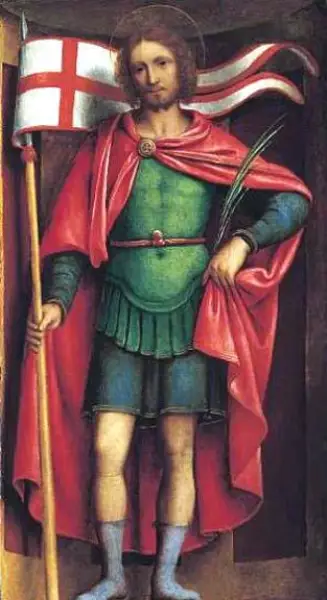
The end came at Bergamo on 26 August 303. Taken at last after his preaching had made concealment impossible, Alexander was beheaded on the spot the city has kept ever since, the ground where the church of San Alessandro in Colonna now stands, its column marking the traditional spot of the execution. The manner of the record, death by the sword after public confession, belongs to the historical layer of the tradition; the elaborate sequences that precede it belong to the devotional elaboration of the early Middle Ages, and the two layers cannot now be separated. What is beyond question is the cult: Bergamo's cathedral is dedicated to him, his feast fills the city's calendar, and his relics, after their long medieval history, rest in the chapel of the ducal castle of Pescolanciano. The Roman Catholic Church keeps his feast on 26 August and the Eastern Orthodox Church on 22 September, and Bernardino Luini, Lorenzo Lotto's workshop, and Ponziano Loverini, whose Martyrdom of 1887 hangs in the Vatican Pinacoteca, are among the painters who have given him his face.
§ Introduction
Patronage
No canonization file exists for Alexander, because no canonization was ever needed: the city that buried him acclaimed him, and the cult spread from the martyr's own ground outward across the plain of the Po. He is the patron of the diocese and city of Bergamo and of a long list of comuni, among them Albano Sant'Alessandro, Barzio, Besozzo, Capriate San Gervasio, Caronno Pertusella, Castel Gabbiano, Cervignano d'Adda, Cesate, and many others, a distribution that traces both the flight legend and the real medieval network of Bergamasque influence. The church of Rome maintains a national church for natives of Bergamo, and his name is among its dedications, so that the Bergamasque in the capital prayed under the patron of his city. His standard with the white lily, the attribute of his iconography, joins the soldier's ensign to the sign of purity, the whole legend in a single emblem: the military man whose obedience was finally to Christ.
§ Patronage
Legacy
Alexander of Bergamo is a study in how a martyr becomes a civic father. From a death remembered on a column outside Roman Bergomum, the city built first a shrine, then a church, then an identity; by the Middle Ages the saint's name was in the city's foundations, and the modern city still counts its churches of San Alessandro, the cathedral, the Colonna, the Zebedia of the Milanese prison-episode, as fixed stars. The historical Alexander, a soldier or townsman who would not deny Christ, is almost inaccessible behind the legendary one; but the two agree in the essential, and the essential is what the patronage has always been about. For the historian, the case illustrates the relationship of the Theban Legion cycle to the local martyrs of northern Italy, the great legend gathering the small ones into its ranks; for the church, the man behind both layers remains a witness that the confession of faith, in a soldier's or a citizen's mouth, can cost exactly what it cost him.
§ Legend
Timeline
- 303
A purge of Christians from the imperial armies precedes the Diocletianic persecution; Alexander, standard-bearer of the Theban Legion, is among its victims
§ Legend
- 26 Aug 303
Beheaded at Bergamo on ground now occupied by the church of San Alessandro in Colonna
§ Legend
The Record
- Patron of
- Bergamo and many Lombard and Italian comuni·Soldiers
- Symbols
- Depicted as a soldier·Military standard bearing a white lily
- Canonization
- Pre-congregation (ancient cult; patron of Bergamo)
Prayer
Bibliography
Show 6 sources
- ↑ Misinato, Maurizio. "Sant' Alessandro di Bergamo", Santie Beati
- ↑ "Saint Alexander", Daily Compass , August 26, 2021
- ↑ Monks of Ramsgate. "Alexander". Book of Saints , 1921. CatholicSaints.Info. 24 May 2012 This article incorporates text from this source, which is in the public domain .
- ↑ "Bergamo's Festival for Saint Alexander", Best of Bergamo", August 9, 2010
- ↑ "St. Alexander", Veneranda Fabbrica del Duomo di Milano
- ↑ "The Martyrdom of Saint Alexander of Bergamo", St. Mary's Press
Profile text adapted from the Wikipedia article, licensed CC BY-SA 4.0.
Pray with this saint every day
Save St. Alexander of Bergamo to your favorites, read the full profile, and get feast-day reminders in the Saints app.
Get the Saints AppFree on the App Store for iPhone and iPad