
d. c. 251·Feast August 11 (Roman Catholic); August 12 (Orthodox); February 12 (Maronite)
St. Alexander of Comana
Bishop and Martyr, 'The Charcoal Burner'
Overview
Alexander of Comana, Greek Alexandros Komanoon, called Alexander Carbonarius — the charcoal burner — and honored as the 'Charcoal Burner' saint, was bishop of Comana in Pontus, in Asia Minor, and died a martyr under Decius around 251. Whether he was the first to occupy the see is unknown. His curious surname records his humility: wishing to avoid worldly honors, he had set himself to burning charcoal, and people remarked how exceptionally dirty he became as a result. He was called a philosopher, though whether the word was meant literally is uncertain; what he preferred were heavenly things over earthly ones, and in that preference his philosophy lay. His virtues came to light by accident, a product of the contempt in which he was held: when Gregory Thaumaturgus arrived at Comana to assist in choosing a bishop and had turned away every candidate put forward, someone sneeringly proposed that he might make do with Alexander the charcoal-burner. Gregory took the jest at its word, summoned the man, and discovered a saint of great capabilities. Alexander was made bishop and administered the see with wisdom until he was burned to death in the Decian persecution.
The Complete Life
The Charcoal Burner
Of Alexander's origins nothing is recorded. His name in history is his trade: Carbonarius, the charcoal burner. Comana in Pontus — modern Gumenek near Tokat in Turkey — was a real city with a real church, and Alexander, a Christian of sufficient standing to be proposed for its episcopate, had chosen to live by burning charcoal, the lowest and dirtiest work there was, precisely so that worldly honors could not reach him. His exceptional dirtiness was remarked on by everyone: the tradition preserves the embarrassment as faithfully as the virtue. He was called a philosopher, the Catholic Encyclopedia entry notes, but whether the term is meant literally no one can say — his philosophy, such as it was, lay in preferring heavenly things to earthly ones.
§ Introduction
The Election
The story of his discovery is one of the great anecdotes of patristic hagiography. Gregory Thaumaturgus, the wonder-working bishop of Neocaesarea, had been invited to Comana to assist in the choosing of a bishop, and had turned down all the candidates. Someone proposed — the sources agree the tone was derisive — that Alexander, the charcoal-burner, might be worth his attention. Gregory treated the jest in earnest, called for the man, and discovered a man of saintly character and great capabilities. Alexander was consecrated bishop of the see, which he then governed with wisdom. The mockery of the court became the judgment of the church; the dirty man proved clean where it counted.
§ Introduction
Martyrdom
Alexander met his death in the fires of the persecution Decius carried out — around the year 250 or 251, in the same wave that killed so many of the Anatolian confessors. The manner of his death matched the trade he had chosen: the man who had lived over the coals died by fire.
§ Introduction
Cult
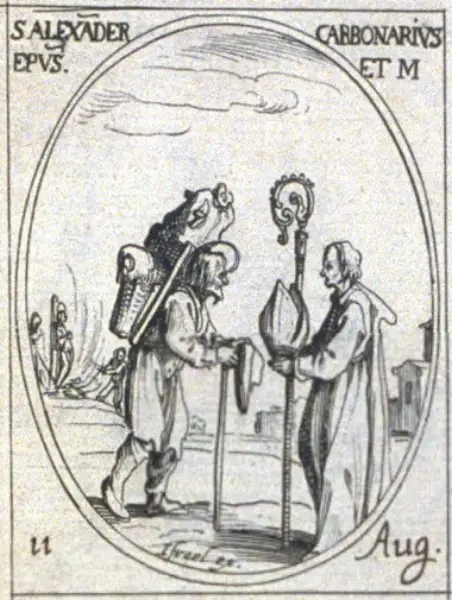
Alexander would have been entirely unknown were it not for a discourse of St. Gregory of Nyssa on the life of Gregory Thaumaturgus, in which the election at Comana is incidentally described — a paragraph in a sermon preserving a saint whole. His feast is kept on 11 August by Roman Catholics, 12 August by Orthodox Christians, and 12 February in the Maronite calendar. An engraving by Jacques Callot fixed his image for the early modern West.
§ Introduction
Legacy
Alexander is the patron of charcoal burners, and through them of all who work in trades the respectable despise. His story has kept its point for eighteen centuries: that sanctity hides where no one looks for it, and that the church's greatest failures of imagination are about persons. Gregory's willingness to take a joke seriously remains half of the lesson; Alexander's willingness to be the joke is the other half.
§ Introduction
The Record
- Patron of
- Charcoal burners
- Symbols
- Charcoal and soot·Bishop's vestments over a laborer's clothes·Fire (his martyrdom)
- Canonization
- Pre-congregation
Prayer
Bibliography
Show 2 sources
- 1 2 Christie, Albany James (1867). "Carbonarius Alexander". In William Smith (ed.). Dictionary of Greek and Roman Biography and Mythology . Vol. 1. Boston: Little, Brown and Company . p. 115.
- ↑ "Saints (archived copy)" . Archived from the original on 2007-02-17 . Retrieved 2018-01-15 .
Profile text adapted from the Wikipedia article, licensed CC BY-SA 4.0.
Pray with this saint every day
Save St. Alexander of Comana to your favorites, read the full profile, and get feast-day reminders in the Saints app.
Get the Saints AppFree on the App Store for iPhone and iPad