
2nd century-251·Feast March 18
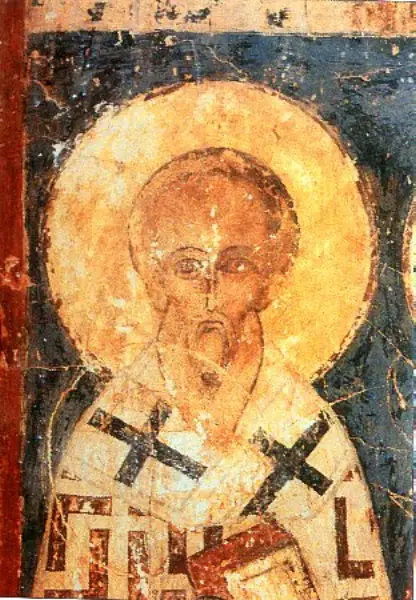
St. Alexander of Jerusalem
Bishop and Martyr
Overview
Alexander of Jerusalem, born in Cappadocia in the second century, was a bishop of the third century honored as a martyr and saint across the Eastern Orthodox, Oriental Orthodox, Roman Catholic, and Anglican churches. A prominent pupil of Clement of Alexandria at the Catechetical School toward the end of the second century — he called Clement his 'master' and 'blessed father' — he was also a contemporary and close friend of Origen. He became the first verifiable bishop of Cappadocia, serving around 200-212, and in those years gave refuge to Clement, who had escaped the Severan persecution then under way in Egypt. A pilgrimage to Jerusalem, during which he was imprisoned at Caesarea, ended with his being chosen coadjutor bishop of Jerusalem, where he built a new library and, with Origen, founded a school. An aged confessor of earlier persecutions, he was imprisoned again under Decius and died in chains at Caesarea Maritima in 251, one of the first martyrs of the Decian persecution whose death Eusebius recorded.
The Complete Life
Education in Alexandria
Alexander was born in Cappadocia in the second century, into a world where the faith was still young enough that its teachers had learned it from the apostles' hearers. His formation was Alexandrian: he studied under Clement at the Catechetical School toward the end of the second century, and their relationship is well documented by Eusebius in the Ecclesiastical History, for Alexander's letters called Clement his master and blessed father. He also refers to his teacher Pantaenus, the Stoic-turned-Christian who had preceded Clement as head of the school. Both his teachers brought Hellenistic philosophy to the service of the Gospel, and the early Church — above all at Alexandria — consciously shaped the office of bishop and the Christian teacher on the model of the Hellenistic scholarch, the head of a philosophy school — a pattern Alexander's whole career embodies. From Pantaenus and Clement he inherited the scholar-bishop ideal his whole career would carry, first to Cappadocia and then to Jerusalem.
§ Alexandria
Bishop of Cappadocia and Jerusalem
Alexander became Cappadocia's first bishop — most historians, Eusebius among them, recognize him as the first bishop of the region whose episcopate can be verified — and held the see there around 200-212 before his move to Jerusalem. In those years he welcomed his former teacher Clement of Alexandria, then in flight from the Severan persecution in Egypt, and the two of them are remembered for consolidating the theological underpinnings of the Cappadocian church. Traveling to Jerusalem, whether on pilgrimage or on church business, he was imprisoned at Caesarea, and while in captivity the church of Jerusalem, whose bishop Narcissus was extremely old, chose him as coadjutor bishop. He accepted the unusual arrangement, and the see of Jerusalem, holy city of the faith, gained an Alexandrian scholar as its shepherd. The move also made him the first bishop on record translated from one see to another.
§ Bishop of Cappadocia
Building the Church of Jerusalem
In Jerusalem Alexander's mission was educational and institutional: with Origen, who came to the city in 215, he founded a school for catechesis and theology, deliberately transplanting the Alexandrian model to the church of the holy places; and he built a library that became famous in the following century, the very library in which Eusebius, bishop of Caesarea, would later work with its catalog of commentaries and letters. His correspondence, partly preserved by Eusebius, shows him as a man of wide friendships — with Origen, with the churches of Antioch and Alexandria — and as a bishop who thought in terms of institutions that would outlast lives. It was an old tradition that he governed Jerusalem jointly with the ancient Narcissus for years, the young scholar and the ancient confessor in tandem. Eusebius preserves fragments of his letters: one to the Antinoites, another to the Antiochenes, a third to Origen, and a fourth, written jointly with Theoctistus of Caesarea, to Demetrius of Alexandria.
§ External links
Martyrdom under Decius
Alexander's end came in the persecution of Decius, the first empire-wide assault on the Church's leadership. Already an old man, and already a confessor of the earlier Severan troubles, he was seized at Caesarea Maritima, probably while defending the faith before the tribunal, and imprisoned in chains. Eusebius preserves the tradition that he died in prison in 251, in the seventh year of his second captivity by some reckonings, and the church counted him among the martyrs, a bishop who died not by the sword but by the slower violence of chains and age. His death opened the decade of confessor-bishops — Fabian of Rome, Babylas of Antioch, and Alexander among them — whose sufferings shaped the Church's understanding of its own leadership. The church remembered his white hairs and sanctity as a double crown in captivity, and told how the beasts set loose on him licked his feet or left their impress on the arena sand.
§ External links
Veneration
Alexander belongs to the pre-congregation martyrs. He is venerated by the Eastern Orthodox Church, which keeps him on 16 May and 12 December with the differing calendars, by the Oriental Orthodox churches, by the Anglican Communion, and by the Roman Catholic Church, whose martyrology records him on 18 March. The variety of dates reflects the several local traditions that received his memory, from Caesarea's prison calendars to Jerusalem's episcopal lists. His cult never developed the shrines of the great martyrs, but his name entered the diptychs of the ancient churches, and his letters, quoted by Eusebius, kept him present in the memory of scholars. He is entered in the great Greek Synaxarion on both of his Orthodox dates, the Roman martyrology holds his 18 March, and the pre-congregation manner of his honoring means no decree founded his cult — only the unbroken usage of Jerusalem, Caesarea, and the calendars that copied them.
§ Introduction
Legacy
Alexander's legacy is quieter than the great confessors' and in some ways more lasting. The library he built at Jerusalem became one of the seedbeds of Christian scholarship, used by the historians and exegetes of the following century, and the school he founded with Origen carried the Alexandrian love of learning to the church of the holy places. As a pastor he modeled the scholar-bishop at a time when the office was still defining itself, and as an old confessor he gave the Decian generation a witness that learning and martyrdom are not rivals. He remains a patron figure for the Christian intellectual life lived to the end in chains. Eusebius's habit of quoting his letters kept Alexander in the conversation of church historians, and his episcopal library is cited whenever the intellectual life of third-century Jerusalem is now measured.
§ Alexandria
Timeline
- 200
Chosen first bishop of Cappadocia, the earliest verifiable holder of that see
§ Bishop of Cappadocia
- 212
Ministry in Cappadocia closes near this year, ahead of his translation toward Jerusalem
§ Bishop of Cappadocia
- 231
Becomes coadjutor to the aged Narcissus at Jerusalem; first recorded transfer of a bishop between sees
§ Jerusalem
- 251
Dies a prisoner at Caesarea in the Decian persecution after refusing to deny Christ
§ Persecution and death
The Record
- Major works
- Letters (preserved in part by Eusebius)
- Patron of
- Jerusalem's ancient church·Librarians and theological libraries (by tradition of his foundation)
- Symbols
- Bishop's vestments·Chains of imprisonment
- Canonization
- Pre-congregation martyr, died in the persecution of Decius
Prayer
Bibliography
Show 9 sources
- ↑ Christie, Albany James (1867). "Alexander" . In William Smith (ed.). Dictionary of Greek and Roman Biography and Mythology . Vol. 1. Boston: Little, Brown and Company . p. 115. Archived from the original on 2007-05-18.
- ↑ Cappadocia History
- 1 2 3 Campbell, Thomas. "St. Alexander." The Catholic Encyclopedia Vol. 1. New York: Robert Appleton Company, 1907. 22 Sept. 2012
- ↑ " "St. Alexander of Jerusalem", FaithND, University of Notre Dame" . Archived from the original on 2016-07-01 . Retrieved 2018-12-27 .
- ↑ (in Greek) Ὁ Ἅγιος Ἀλέξανδρος ὁ Ἱερομάρτυρας Ἀρχιεπίσκοπος Ἱεροσολύμων . ΜΕΓΑΣ ΣΥΝΑΞΑΡΙΣΤΗΣ.
- ↑ (in Greek) Ὁ Ἅγιος Ἀλέξανδρος ὁ Μάρτυρας . ΜΕΓΑΣ ΣΥΝΑΞΑΡΙΣΤΗΣ.
- ↑ Eusebius , Ecclesiastical History , vi. 11.
- ↑ Eusebius , "Ecclesiastical History, vi. 14"
- ↑ Eusebius , "Ecclesiastical History, vi. 19"
Profile text adapted from the Wikipedia article, licensed CC BY-SA 4.0.
Pray with this saint every day
Save St. Alexander of Jerusalem to your favorites, read the full profile, and get feast-day reminders in the Saints app.
Get the Saints AppFree on the App Store for iPhone and iPad